
A new telescope built with a field of view large enough to unravel some of the universe's most mysterious puzzles will soon aim to brighten our understanding of dark energy and distant worlds.
Once NASA's Nancy Grace Roman Space Telescope launches this week, the mission is expected to explore the cosmos by surveying hundreds of millions of galaxies, capturing the sky in detail hundreds of times faster than even the Hubble Space Telescope.
"This enormous field of view will allow us to map astronomical objects in a way that we previously couldn't," said David Weinberg, a Distinguished University Professor of astronomy at The Ohio State University. "These better measurements may end up teaching us something extremely revolutionary about all kinds of matter in the cosmos."
More than two dozen Ohio State faculty, students and postdoctoral scholars have played a role in designing Roman's surveys, including the High-Latitude Wide-Area Survey, a portion of the mission aimed at probing the structure and expansion of the universe as it evolved through cosmic time. Anthony Harbo Torres, a senior graduate student in physics at Ohio State who helped calibrate Roman's image detectors, said that mission success can be attributed to decades of human ingenuity and perseverance.
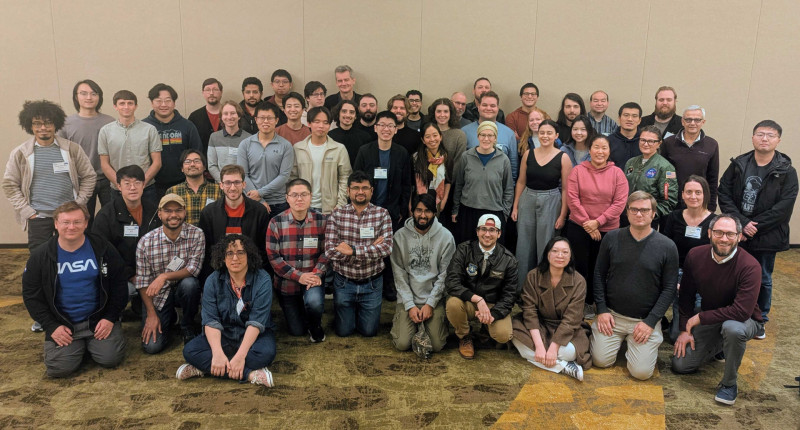 "With Roman, we'll be seeing some things for the first time, as well as revisiting places we've seen before but with an increased level of resolution," said Harbo Torres. "It takes so many people to tackle a monumental undertaking like this and make it possible, so I hope that our images inspire a sense of wonder when people see the scale and detail of the things we find."
The High-Latitude Wide-Area Survey aspect of the program plans to utilize the telescope to peer past the plane of the Milky Way to map about 12% of the sky in just under two years. In all, Roman's surveys will detect about a billion galaxies and 20 billion stars, more astronomical objects than have ever been detected by all of humanity's telescopes put together, said Weinberg.
"For just one single point, displaying an image from this telescope would be like looking at a wall full of 4K televisions," he said. "These will have an extraordinary image quality as it scans the sky for objects more than 100 million times too faint to see with the human eye."
This preciseness is one that typically eludes scientists when trying to look through our planet's blurring atmosphere, Weinberg said. Over the course of several months, Roman will settle into orbit at Lagrange point two (L2), a gravitationally stable point about a million miles away from Earth.
The Roman mission revolves around three core science themes - measuring dark energy, investigating exoplanets, and expanding the study of astrophysics and planetary science. Astronomers will use the data Roman sends back to study dark matter, an invisible substance that can only be perceived by its gravitational effect on other objects, as well as dark energy, a force that seems to have a hand in speeding up the universe's expansion. Understanding these aspects can also offer insights into local galactic history and evolution.
"Mapping clusters of dark matter will help us figure out why gravity on the scale of the universe is so radically different from gravity on the scale of a solar system or galaxy," said Weinberg. "Ohio State is part of the teams that are building the tools to actually do that advanced analysis."
But just getting a better lay of the land isn't Roman's end goal. Creating a more detailed sketch of the cosmos will help scientists answer critical questions about the inner workings of the universe, such as whether stellar systems like ours are rare and how many black holes there may be in the Milky Way, and extend the search for potentially habitable exoplanets.
"Roman is going to allow us to find extremely rare things and things that don't happen very often," said Scott Gaudi, the principal investigator of the Roman Galactic Exoplanet Survey Project Infrastructure Team and a professor of astronomy at Ohio State. "It's going to be those things that are likely going to surprise us and lead to new avenues of research."
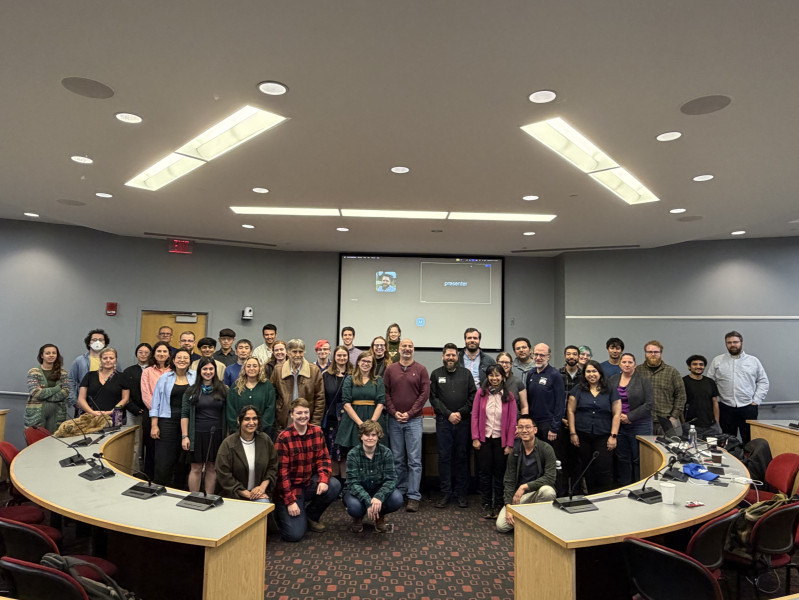 Compared to legacy instruments like the Hubble Space Telescope, Roman will map the sky about 1,000 times faster than its predecessor, a process made more efficient by its wide field-of-view, said Gaudi. Using a planet-hunting method called microlensing in tandem with the traditional transiting technique, researchers expect Roman will detect around 100,000 worlds, ideally expanding NASA's exoplanet catalog to new heights.
Although Roman is currently slated as a five-year mission, researchers hope the data it uncovers, along with the lifespan of its sturdy science instruments, allows the mission to continue operating for decades to come. "Even though Ohio State has a large footprint on the mission, we don't even begin to cover a fraction of the kind of science that can and will be done with Roman," said Gaudi. "Our job so far has been to make sure it's successful."
The telescope's first science findings are expected in mid-2027, but in the meantime, groups like the Roman Science Collaboration, of which Weinberg is a leading member, are looking forward to seeing how returns from this mission inform the next generation of astronomical priorities.
"The value of producing really big, vital datasets is that you then enable anyone in the world to go and make discoveries with it," said Weinberg. "That's a really powerful way of doing science, and I think bringing that to space-based astronomy is very inspiring."
To celebrate their role in the achievement, as many as 20 members of the Ohio State cohort plan to be present on the beach when Roman lifts off aboard a SpaceX Falcon Heavy rocket at Cape Canaveral, Florida.
This includes Christopher Hirata, another key member of Ohio State's Roman science team and a professor of physics at Ohio State, who notes that as large data sets and machine learning algorithms become indispensable for studying the universe's most fundamental parts, this mission is primed to reshape how future researchers interact with exciting new science tools.
"Roman's technology will have a huge influence on the future of space science," said Hirata. "From launch onward, it's going to be spectacular."


