
You've just finished a workout, lungs burning, heart pumping, and you feel energised and ready to take on the day. That's your brain rewarding you with a hit of dopamine - the feel-good hormone that exercise is known to trigger.
Now, a team of researchers at the University of Portsmouth has discovered that the post-workout warm glow isn't just good for you - it turns out it could be good for everyone around you as well.
A new study, published in the journal Psychology of Sport & Exercise , suggests that the mood boost triggered by exercise makes some people significantly more generous. There's a catch though - you have to enjoy breaking a sweat to feel the 'warm glow' of generosity.
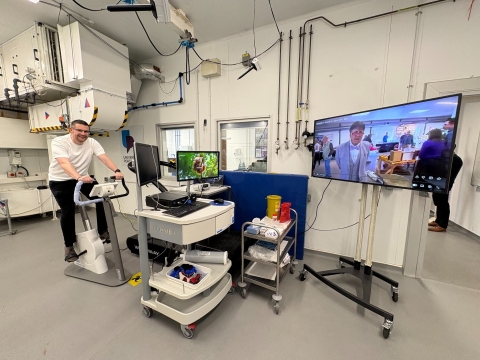
Dr Joe Costello in the Extreme Environments Laboratory
Associate Professor Dr Joe Costello , Research Group Lead for the Extreme Environments and Occupational Performance Group at the University of Portsmouth, explained: "Exercise did not directly make people more generous. Instead, it worked through mood. Participants who felt more energised and alert after cycling were significantly more likely to donate to charity and to take positive financial risks on their own behalf. Those who did not see an improvement in mood after exercise showed the opposite pattern, giving less."
The team believes the brain's dopamine system is central to this effect. Previous research by Dr Costello and his international colleagues has shown that exercise triggers a release of dopamine - the brain's "feel-good" hormone - which plays a key role in mood, motivation and reward processing.
"We know exercise is good for physical health, and we know it improves cognitive performance," added Dr Costello. "What we wanted to know was whether exercise can also make people more generous, more willing to give."
Exercise did not directly make people more generous. Instead, it worked through mood. Participants who felt more energised and alert after cycling were significantly more likely to donate to charity and to take positive financial risks on their own behalf.
Dr Joe Costello, Research Group Lead for the Extreme Environments and Occupational Performance Group
To test the idea, 138 adults were brought into the University's Extreme Environments Laboratories (EEL) and seated on stationary exercise bikes arranged around a television screen.
Those in the exercise group cycled at a moderate intensity - enough to raise their heart rates to between 120 and 130 beats per minute - watching an episode of the BBC daytime programme Bargain Hunt. Those in the control group simply sat on the bikes and watched the same episode without pedalling.
"We needed something completely neutral," said co-author Cheryl Williams, a PhD student in the School of Psychology, Sport and Health Sciences who works part-time as a fitness instructor at the University's Ravelin Sports Centre . "We didn't want to artificially excite people or raise their heart rates through the screen. Bargain Hunt doesn't evoke any powerful emotional reactions - at least for most people - which was exactly the point."
Before and after the session, participants completed mood questionnaires. They then played a series of real-money decision-making games, including the opportunity to donate to Macmillan Cancer Support and to give money to a stranger.
The authors say the implications for charities, public health, and even the economy could be considerable.
Lead author Professor Joe Cox , from the University's School of Accounting, Economics and Finance , said: "If exercise reliably produces a mood-driven 'warm glow' that makes people more generous, community sports events, gym classes and parkruns could become powerful fundraising mechanisms - helping people get into the right headspace to give.
"Charities could strategically place donation opportunities at the end of fitness events, when participants are most likely to be experiencing that afterglow. The mood boost is real, the generosity effect is real - it just needs to be channelled."
The study says designing programmes that foster positive emotional engagement with exercise, rather than simply mandating participation, may be key to unlocking these wider benefits.
Dr Cox added: "Exercise prescriptions are most likely to generate social and prosocial benefits among people who genuinely enjoy, or anticipate enjoying, physical activity."
The researchers hope to build on these findings with longer-term, real-world studies outside of the lab - tracking whether the mood and generosity effects of exercise build over time and exploring whether different forms of physical activity produce the same results.
The unique study brought together expertise from economics, behavioural psychology, extreme environments, and exercise physiology across two faculties within the University of Portsmouth. The interdisciplinary team was also supported by an undergraduate placement student.


