
Key points
- Astronomers analysed the radio and gamma-ray emission of nearly 200 extremely fast rotating pulsars.
- Many of these pulsars show radio signals coming from two or more separate regions along a huge sheet of charged particles.
- It is now thought these pulsars produce radio waves not just close to their surfaces, but also in a region far out where magnetic fields sweep around at nearly the speed of light.
Pulsars are ultra-dense, rapidly spinning and highly magnetised remnants of dead stars. They act like cosmic lighthouses, sending out regular pulses of radio waves and sometimes gamma rays in beams that sweep across the sky. A special class called millisecond pulsars spins hundreds of times per second and is among the most precise clocks in the Universe. For decades, astronomers believed that a pulsar's radio signals are produced close to the star's surface, near its magnetic poles. This new study challenges that long-held idea.
An unexpected discovery
Professor Michael Kramer from the Max Planck Institute for Radio Astronomy (MPIfR) in Germany and Dr Simon Johnston from Australia's national science agency, CSIRO, analysed radio observations of nearly 200 millisecond pulsars and compared them with gamma-ray data.
The duo discovered something striking in this large data set: about a third of millisecond pulsars show radio signals coming from two or more completely separate regions. In comparison, this behaviour occurs in only about 3% of slower rotating pulsars.
Even more striking, many of these isolated radio pulses line up perfectly with gamma-ray flashes detected by NASA's Fermi Space Telescope, suggesting that both signals are produced in the same extreme region of space.
A surprising conclusion
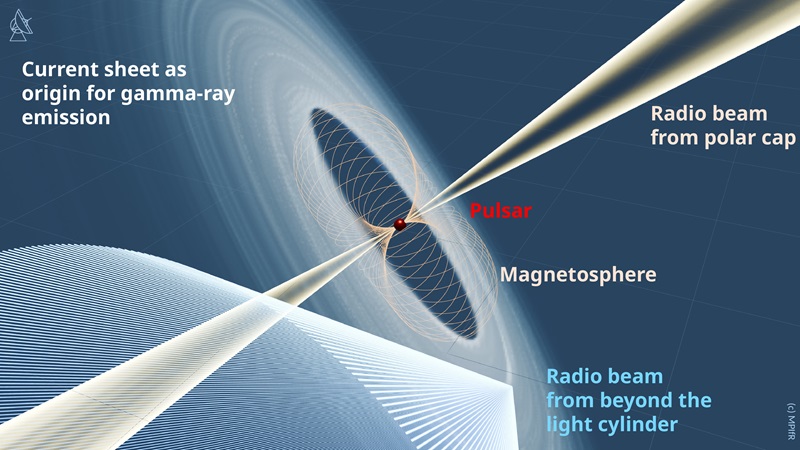
To explain these patterns, it is possible that millisecond pulsars produce radio waves in two very different places: one close to the star's magnetic poles, as traditionally assumed, and another in a swirling "current sheet" of charged particles just beyond the so-called light cylinder. Located farther out than the magnetic poles, the magnetic fields sweep around at nearly the speed of light to keep up with the star's rotation.
Depending on the observer's perspective on the pulsar, one sees radio emission from either near the surface, from far out, or from both regions. This gives rise to the unusual, broken-up radio profiles that have puzzled astronomers for years.
The current sheet is already thought to be responsible for gamma-ray emission, a high-energy burst only visible through specialised gamma-ray telescopes like Fermi. The alignment of radio waves and gamma-rays can be explained through this shared place of origin.
Exciting prospects and open questions
This discovery has several important consequences: more pulsars may be detectable than previously thought, because radio emission may not be limited to a narrow cone from close to the magnetic poles. Instead, it spreads over a wider range of directions. The finding also helps explain why astronomers often struggle to interpret the orientation of radio waves from millisecond pulsars, and suggests that nearly all gamma-ray millisecond pulsars also emit radio waves, even if those signals may be faint or difficult to detect.
This raises new challenges for stellar theories: Scientists now need to explain how stable radio pulses can be generated so far away from the star, in an extreme and turbulent environment.
Professor Michael Kramer said that millisecond pulsars are key tools for studying gravity, dense matter, and even gravitational waves.
"Understanding where their signals come from – and why they look the way they do – is essential for using them as precision instruments," explains Professor Kramer.
Dr Simon Johnston adds that, "as we are detecting signals both from the stars' surfaces and from the very edge of their magnetic reach, this study shows that these tiny, fast-spinning stars are even more complex and surprising than we thought."
This article was first published on the Max Planck Institute for Radio Astronomy's website.


