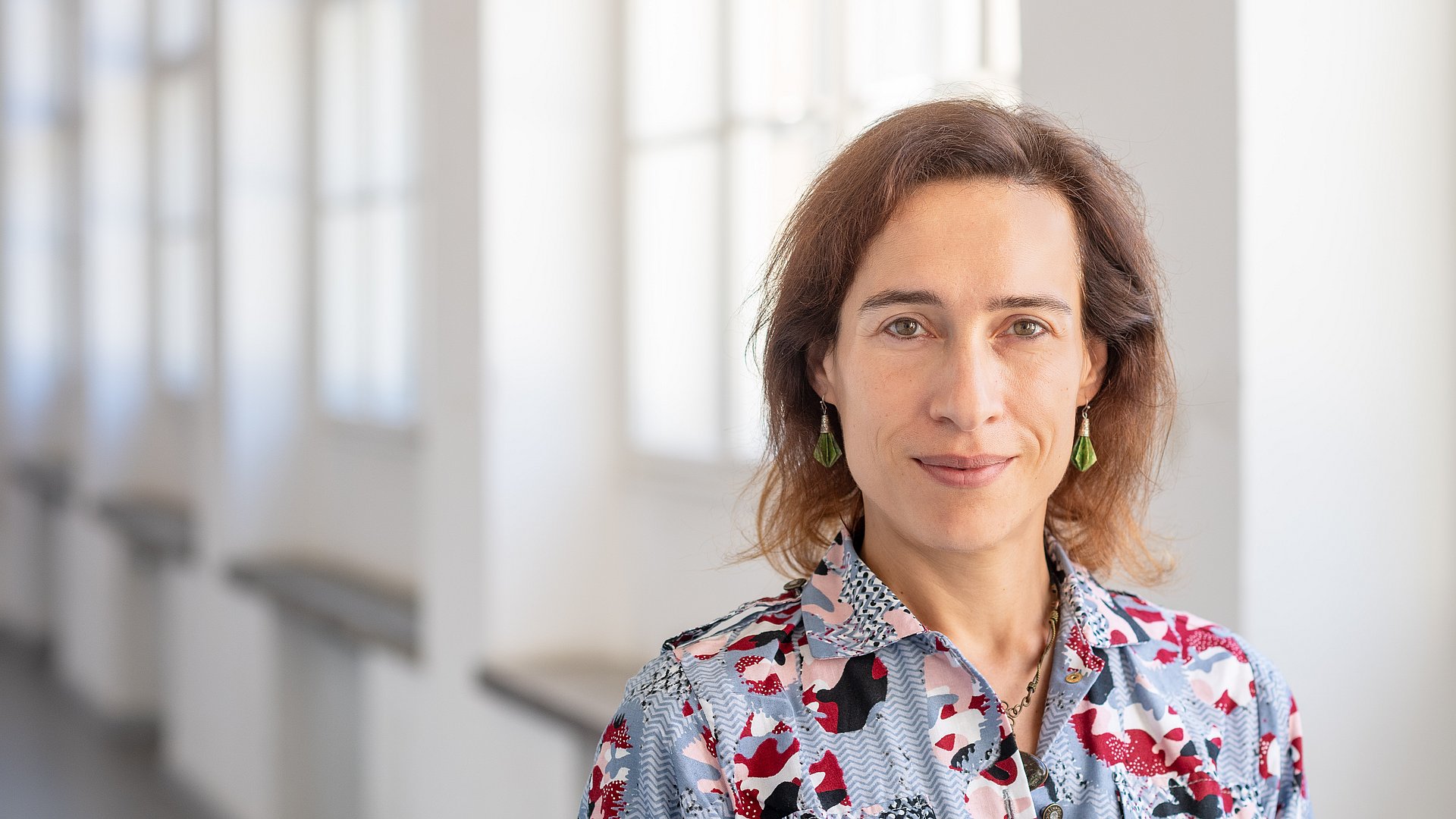
Sabina Leonelli is Professor of Philosophy and History of Science and Technology and heads the Public Science Lab. In the new episode of "NewIn," she explains why looking back at history can be helpful for science and technology development, how she wants to conduct research together with non-academics, and how the perception of philosophers in Germany differs from that in other countries.
Display external content
At this point content of an external provider (source: www.xyz.de) is integrated. When displaying, data may be transferred to third parties or cookies may be stored, therefore your consent is required.
You can find more information and the possibility to revoke your consent at www.tum.de/datenschutz .
I agree
Philosophy is not one of TUM's traditional subjects. What philosophical questions would you like to explore at the university?
Every researcher is faced with philosophical questions at almost every moment of the day. What method do you choose? How do you formulate your hypothesis? Do you believe that qualitative data or quantitative data is more trustworthy? These beliefs are all grounded in philosophical traditions and ways of thinking about what constitutes research, which criteria we use to determine reliable findings and what are the implications of our knowledge and the way we understand nature and humanity. In this sense all scientists are constantly making decisions with philosophical origins and implications. But many researchers are not used to or trained to consider these questions.
How can you train and motivate these scientists?
I don't think I need to motivate anyone. Scientists often just don't know whom to collaborate with when addressing these philosophical questions. Therefore, I want to make our discipline more visible, so that everyone at the university knows they can get proper research help. Most of my research takes place through interdisciplinary collaborations with different scientific groups and science policy organizations covering data-intensive biology, open science, the use of AI in biomedicine and environmental science, among other topics. I'm also doing research on scientific infrastructures such as databases and cloud services as well as on science policy systems.
What role does looking back at history play in your work?
One key question history can help us to answer is why we have certain priorities in science and technology and where they come from. For example, automation is a very important idea today. Many wish our life to be as automated as possible with machines that think, that are intelligent, that do the work for us. However, people have not always thought of machines as replacements for humans. There is a very long historical tradition of scientists thinking of machines as being complements to humans working alongside them. Understanding history can teach us a lot both about why we have certain ideas right now and what the alternatives could be.
 A. Heddergott / TUM
 How can students benefit from your research?
In addition to the Science and Technology Studies degree program , students from across the university can attend plug-in modules that address philosophical questions. These modules start with real scientific and technological problems and pose questions that are important for every discipline. How reliable is our knowledge of the world? What is evidence, and when should we mistrust it? Are there scientific revolutions? How do methods, assumptions and values affect the development of technologies?
You have worked in various countries. Are there any differences regarding the perception of philosophy?
In Germany, philosophers tend to be recognized as an important part of society. That is not always the case in the UK, where philosophers working at universities are often viewed with great suspicion. The downside of this social status in Germany is that people may also be a bit too cautious to approach a university professor. They might think "Maybe philosophy is not really for me", and that is exactly the perception I'm trying to change. Researchers working at a university are public servants in the literal sense. Therefore, my priority is to talk with different people from all areas of society about what they need in their daily life, what they expect from science, and how they think that technology can serve democracy. And then we should try to solve problems together.
To this end, you founded the Public Science Lab together with Anne Rademacher and Jörg Niewöhner.
We really want to learn from people beyond academia so that we are able to distinguish highly relevant societal problems from less important issues, for example, when we talk about urban mobility. We want to explore who decides how a problem is described and what knowledge is used to solve it. Involving people also allows us to address the sense of hopelessness many people have when it comes to technology. Too often, they feel overwhelmed, and they feel that AI is produced by big companies while they don't have the power to determine how these technologies are developed. The message of the Public Science Lab is a message of hope, showing that there actually is space for social agency, but we need to work together to achieve it.
Sabina Leonelli:
Since October 2024, Sabina Leonelli is Professor of Philosophy and History of Science and Technology at the TUM School of Social Sciences and Technology . After studying History, Philosophy and Social Studies of Science at the University College London and the London School of Economics and Political Science (LSE), she achieved a PhD in Philosophy from the Vrije Universiteit Amsterdam. She worked at the LSE and then as Professor of Philosophy and History of Science at the University of Exeter, where she was Director of the Centre for the Study of the Life Sciences and lead of research on Data Governance, Openness and Ethics for the Institute for Data Science and Artificial Intelligence. She currently serves as President of the International Society for History, Philosophy and Social Studies of Biology.