
The most advanced engines are not found in airplanes, cars or other machines - they are found in nature. Inside our cells, tiny protein motors power everything from cell division to muscle movement with an efficiency and precision that has fascinated researchers for decades and inspired long-standing efforts to replicate them. Now, scientists have taken an important first step.
An international research team led by Lund University and the University of New South Wales has created an artificial protein motor that can be controlled to take directed steps along a DNA track - a long-standing goal in synthetic biology.
Nature's protein motors carry out some of the most sophisticated mechanical tasks in the body with great precision and efficiency. Understanding and recreating how these biological motors achieve their remarkable performance has therefore been a major scientific challenge.
The new findings, published in Nature Nanotechnology, show that it is possible to build artificial protein motors using the same building blocks as biological ones.
"Just as the steam engine laid the foundation for today's mechanical engines, this breakthrough could mark the starting point for a deeper understanding of biology's own motors," says Heiner Linke, professor of nanophysics at Lund University and lead author of the study.
A molecular walk along DNA
The protein motor, named Tumbleweed, moves by alternating between three "feet" that bind to specific DNA sequences. By changing the surrounding chemical environment, the researchers can control both when the motor takes a step and the direction in which it moves.
"With Tumbleweed, we are gaining insight into the fundamental principles governing biological protein motors and how we may eventually come closer to matching nature's performance," says Heiner Linke.
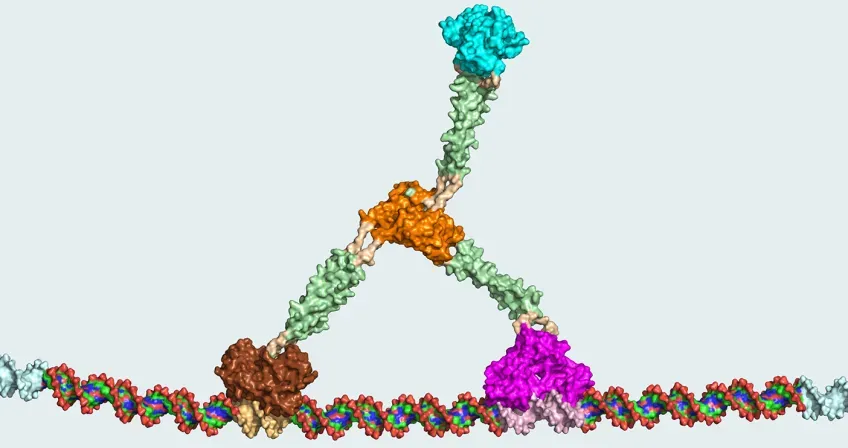
Nature's protein motors perform some of life's most advanced mechanical tasks. Linke explains that the motor protein myosin converts chemical energy into muscle force and plays an essential role in cell division, while kinesin transports signalling molecules within cells.
"Proteins are far more complex than other molecular building blocks and therefore offer much greater possibilities. But that same complexity also makes them more challenging to work with," he says.
From learning to walk to running a marathon
The ability to design entirely new proteins has advanced rapidly in recent years, but most efforts have focused on creating individual, static structures. With Tumbleweed, the researchers demonstrate that it is possible to create dynamic, moving structures that can be externally controlled.
For the researchers, Tumbleweed is only the beginning. Their next goal is to develop artificial proteins that no longer require external control but can "walk" independently using chemical fuel.
Linke compares the progress to a child learning to walk:
"Right now, we have a one-year-old who can take a few steps while holding someone's hand. The next stage is learning to walk independently. After that, we can start thinking about athletics, marathons and the Olympics," he concludes.
Publication:
Link to the article in Nature Nanotechnology:
Clocked stepping of an artificial protein walker along a DNA track
Research institutions involved:
- Lund University, Faculty of Engineering (LTH), Sweden
- University of New South Wales (UNSW), Australia
- Universität Bayreuth, Germany
- Simon Fraser University, Canada
- University of Bristol, United Kingdom


