
Researchers at Cornell have developed a laser-cooling technique that could potentially remove a significant bottleneck in the development of larger, faster quantum computers.
The findings, published Nov. 9 in the journal PRX Quantum, demonstrate how specially designed laser beams delivered through a microfabricated chip can cool multiple types of atomic motion simultaneously.
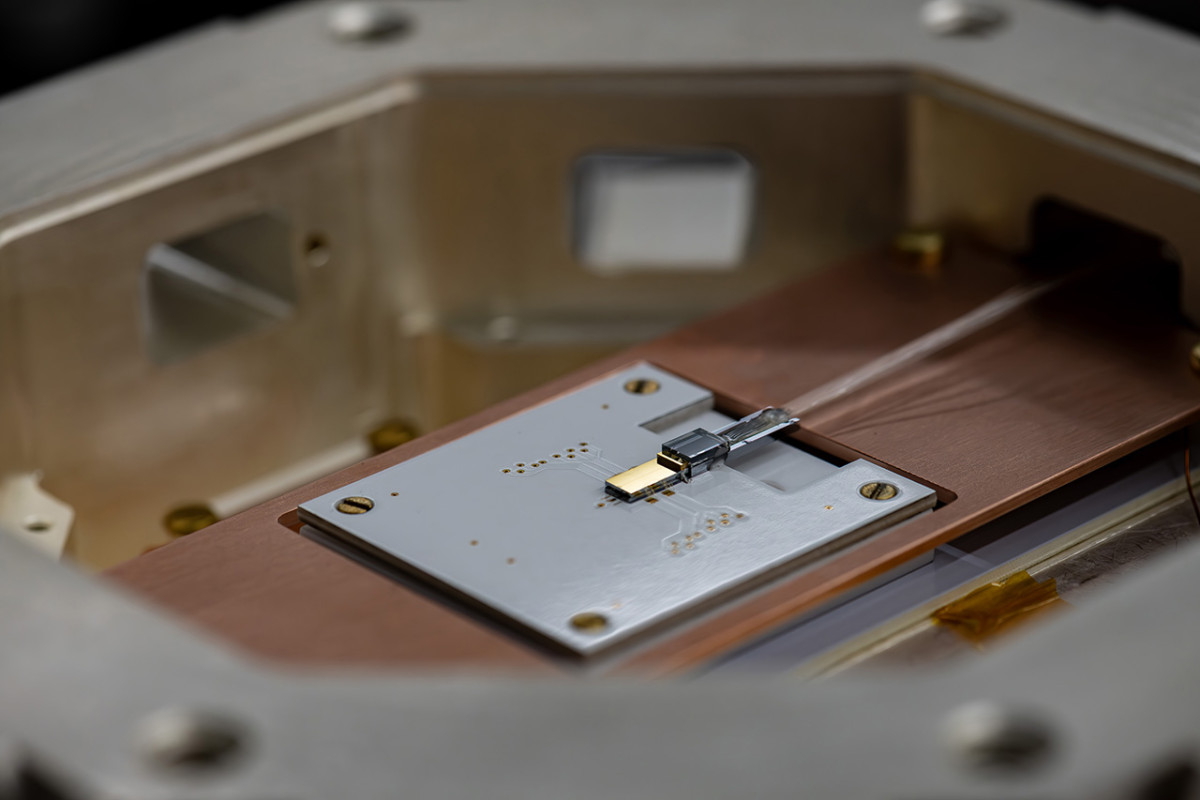
Optical fibers are routed to an ion trap device (gold) mounted on a carrier board. Integrated photonic components in the device deliver laser light in engineered spatial profiles used to cool the trapped ions.
The research was led by Karan Mehta, assistant professor of electrical and computer engineering in the Cornell Duffield College of Engineering.
Trapped-ion quantum computers use individual electrically charged atoms suspended in electromagnetic fields to process information in ways conventional computer bits cannot. These ions offer exceptionally precise quantum control, but even tiny amounts of unwanted movement can interfere with calculations. Lasers must repeatedly cool the ions to near their lowest possible energy states.
That cooling can consume a surprisingly large share of a quantum computer's operating time.
"You might think that the logic operations associated with running a computer would be the dominant timescale," Mehta said. "But cooling operations, particularly to near the quantum ground state, end up being a major bottleneck in leading systems."
Mehta's team is working on integrated photonic approaches to atom control, which guide light through microscopic pathways on the same chip that hosts the individual atoms. Their work uses the stability of this kind of optics to deliver a carefully controlled pattern of laser light, known as a standing wave, to trapped atoms.
The researchers used two laser beams traveling in opposite directions to create alternating regions of high- and low-light intensity. By positioning a trapped calcium ion at a point of minimum intensity, they could remove energy from its motion while suppressing unwanted interactions that otherwise cause heating.
The technique builds on theoretical predictions developed by doctoral student Zhenzhong Xing. Together with doctoral student Hamim Mahmud Rivy, the co-first authors implemented the techniques and experiments to translate the earlier modeling into an experimental demonstration. This included packaging that allowed chips to handle wavelengths from ultraviolet to near-infrared light, while operating at cryogenic temperatures.
Using a method called electromagnetically induced transparency cooling, the researchers brought the ion's targeted motion close to its quantum ground state in approximately 150 microseconds, compared with about 500 microseconds using a conventional laser arrangement.
In addition, the technique simultaneously cooled all three measured modes of the ion's motion, spanning a frequency range of approximately 5 megahertz. That capability matters because ions can oscillate in three dimensions, and each direction may have a different frequency. Conventional techniques often require separate cooling operations to address different types of motion.
"Usually it's challenging to cool all of them with just one single cooling mechanism," Xing said. "But what we demonstrate here is that if those motional frequencies are not too far apart, we can effectively cool them to the ground state."
The researchers also demonstrated cooling below the conventional Doppler limit, experimentally confirming a longstanding theoretical prediction.
An important aspect of the work is that the optical components are integrated into a chip, rather than relying entirely on elaborate arrangements of external lasers. The chip delivers multiple wavelengths of light needed to control the ion, an approach that multiple groups in the field are developing to extend systems to many more qubits.
The chips were fabricated commercially in the Netherlands through a collaboration with ETH Zurich. Cornell facilities, including the Cornell NanoScale Science and Technology Facility, were used in packaging and preparing the devices for experiments.
Although the experiments involved a single ion, the approach is applicable to larger trapped-ion quantum computers. The broader significance, Mehta said, is that the work points to ways in which technologies under investigation to make quantum computers larger can at the same time improve the fundamental operations on which those computers depend.
Co-authors of the study include doctoral students Vighnesh Natarajan and Aditya Milind Kolhatkar of Cornell, and Gillenhaal Beck of ETH Zurich.
The research was supported by the National Science Foundation, the Army Research Office and the Alfred P. Sloan Foundation.
Chris Dawson is a communications coordinator for Duffield Engineering.


