
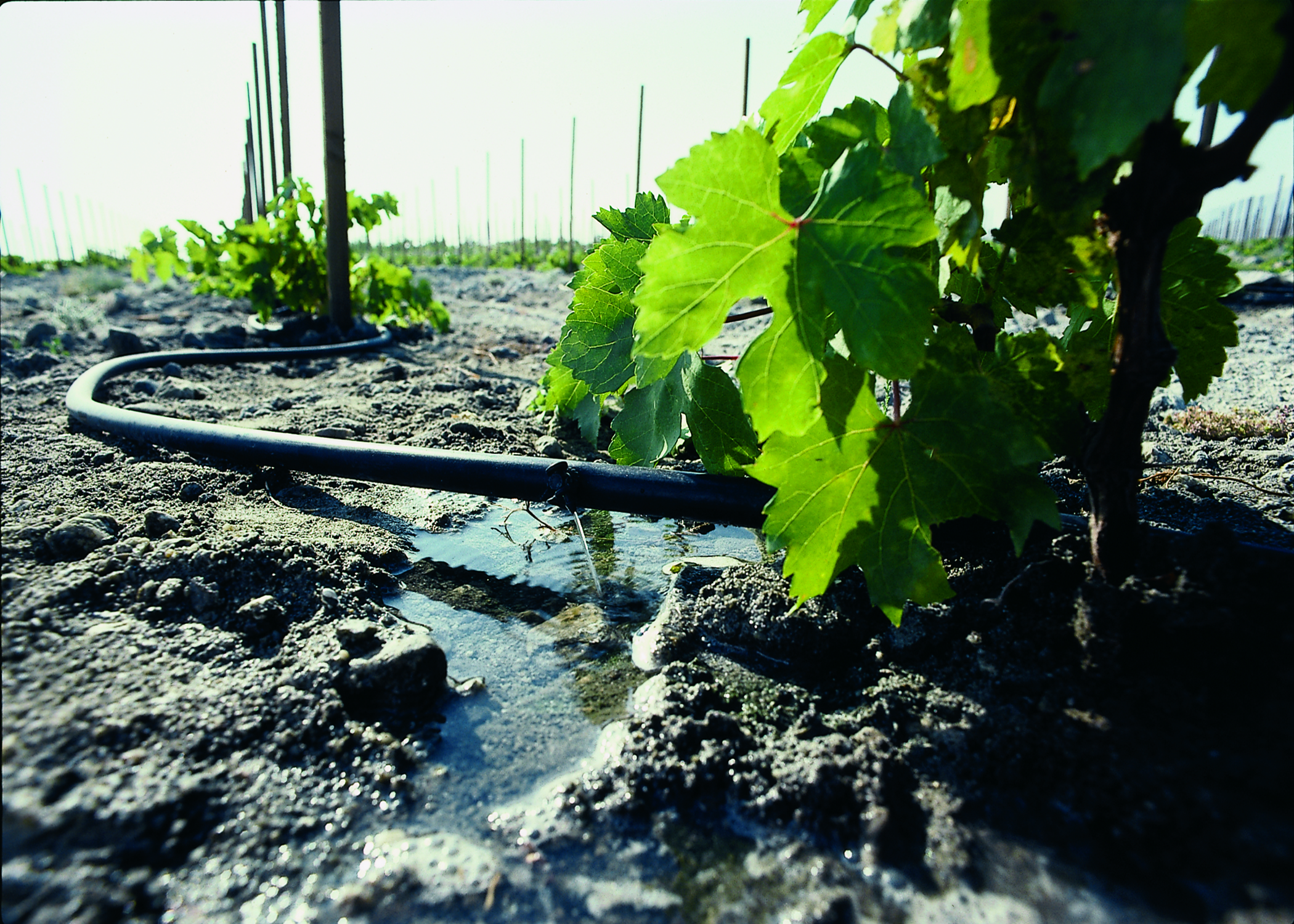
Drip irrigation watering grapes in a California vineyard. Grapes account for around 19% of the groundwater used for irrigating produce and specialty crops like fruits, nuts and veggies in Tulare, Fresno, Kings and Kern counties in California's Central Valley. Credit: Lynn Betts, USDA Natural Resources Conservation Service via Wikimedia Commons.
70% of the groundwater used to grow America's favorite fruits, nuts, veggies, seeds and greens comes from tapping aquifers beyond what they can refill, according to a new study. Irrigating with groundwater helped spare farms from the immediate impacts of droughts between 2008 and 2020, but dependence on draining aquifers for 49 out of the 65 produce and specialty crops studied could set up producers for future water supply strife.
The study provides the first county-level data on irrigation sources for 65 different specialty crops, including everything from cantaloupes to cabbage. "Up until this point, we've kind of been flying blind," said Jackie Hanley, a civil engineering graduate student at the University of Illinois at Urbana-Champaign and the study's lead author.
Knowing where irrigation water goes and where it comes from - rivers, reservoirs or underground aquifers - is vital for farmers and policymakers deciding how to manage finite water supplies for farms in the face of mounting water scarcity.
The study appears in Water Resources Research, AGU's journal for research on hydrology, water resources and the social sciences of water.
Inventorying Irrigation
Although specialty crops represent a smaller piece of U.S. agriculture than staples and grains like corn, wheat and alfalfa, foods like almonds, lettuce and peaches add important variety and vitamins to Americans' diets. As climate change brings more frequent, more intense droughts to major agricultural areas like the U.S.'s "Sunbelt," which stretches from Florida to California, farmers growing nuts, vegetables and fruits increasingly rely on irrigation.
Water for irrigating fields and orchards can come from two places: surface sources (like lakes, rivers and reservoirs) and groundwater, the second of which often comes from water pumped beyond how much aquifers refill each year, making it unsustainable. Depleted aquifers can only recover if the rate of pumping drops below the rate of natural water resupply.
Usually, irrigation data lumps together water usage into broad categories like "produce," but this 40,000-foot view makes it hard to see water supply risks and sustainability concerns that farmers and policymakers can act on.
To stitch together the first nationwide picture of crop-by-crop irrigation sources for specialty crops, Hanley and senior author, Megan Konar, professor in Civil and Environmental Engineering at the University of Illinois at Urbana-Champaign, combined satellite-based maps of irrigated fields, annual U.S. Department of Agriculture (USDA) maps of 65 different crops and measures of how much irrigation uses surface water, sustainable groundwater and unsustainable groundwater based on U.S. Geological Survey (USGS) annual irrigation data.
Keeping California Growing
California stands out as the U.S.'s irrigation hotspots for the 65 crops studied between 2008 and 2020. Few regions rival the state in specialty crop production, and those that do tend not to irrigate so widely. Even in other regions with major groundwater sources like the Midwest's Ogallala aquifer and the Mississippi Embayment aquifer, very little groundwater goes towards fruits, nuts and vegetables.
In Florida, most irrigation uses surface water and mainly goes towards two crops: 60% to sugarcane and 32% to oranges. In California, particularly within the Central Valley, specialty crops rely much more on groundwater, more than 90% of which comes from unsustainable pumping in Tulare, Fresno, Kings and Kern counties.
"This [data] is very useful for assessing risk to different crops, because the risks differ substantially depending on whether crops are surface-water-fed or groundwater dominant," said Nathan Mueller, an environmental scientist at Colorado State University. Crops that depend on surface water are more vulnerable to drought and changing rainfall patterns, whereas groundwater-dependent crops face the risk of over-taxed aquifers someday running dry.
Over a quarter of all aquifer-depleting irrigation went to almonds, which - like pistachios, tomatoes, grapes, peppers and garlic - get between 90% and 100% of their groundwater from nonrenewable pumping. "I've always heard that almonds use a lot of water, but this seemed almost too shocking to be true," said Hanley.
The crops using the lowest proportion of nonrenewable groundwater in the U.S. include raspberries, blackberries, blueberries and cranberries.
"I think it's very good for consumers to be aware of the way that the products they're buying trace back to some of these sustainability issues," said Mueller.
Seeking Sustainability
"The hope is that these estimates can inform policymakers, farmers and the general public of where their water is going," Hanley said. "It's not unreasonable to say, in the short term, we are using this resource unsustainably to meet current demand."
During the 2012-2017 California drought, for instance, farms guzzled even more unsustainable groundwater than usual to maintain specialty crop production. As surface water supplies became less dependable, irrigation shifted from a little over 50% groundwater to nearly 70%. Data in the new study suggests farmers have continued with this new, groundwater-based irrigation since the drought ended. Combined with groundwater pumping for non-specialty crops, this raises questions about how long the Central Valley's aquifers will hold out.
Hanley hopes the study's crop-by-crop irrigation inventory can help farmers and policymakers identify the crops and locations where improving water use efficiency or changing growing patterns could save the most water in their area. "I've come to really value place-specific data and place-specific solutions," Hanley said. "The most effective solutions are tailor-made for the environment that they exist in."
Notes for journalists:
This study is published in Water Resources Research, an AGU journal, and is freely available to view and download at this link: https://agupubs.onlinelibrary.wiley.com/doi/10.1029/2025WR041962
Paper title:
"Irrigation Water Withdrawals for Fruits, Vegetables, and Tree Nuts in the Continental United States from 2008 to 2020"
Authors:
- Jackie Hanley, Department of Civil & Environmental Engineering, The Grainger College of Engineering, University of Illinois at Urbana-Champaign.
- Megan Konar, Department of Civil & Environmental Engineering, The Grainger College of Engineering, University of Illinois at Urbana-Champaign.
AGU (www.agu.org) is a global community supporting more than half a million professionals and advocates in Earth and space sciences. Through broad and inclusive partnerships, AGU aims to advance discovery and solution science that accelerate knowledge and create solutions that are ethical, unbiased and respectful of communities and their values. Our programs include serving as a scholarly publisher, convening virtual and in-person events and providing career support. We live our values in everything we do, such as our net zero energy renovated building in Washington, D.C. and our Ethics and Equity Center, which fosters a diverse and inclusive geoscience community to ensure responsible conduct.
Subscribe or change your emailing preferences for the AGU Newsroom


