
A new generation of lion collars in Tanzania's Serengeti shows that human-wildlife encounters are becoming increasingly common. Researchers from Leiden University are working with local wildlife organisations and technology partner Smart Parks for wildlife monitoring, to better map these interactions.
Every five minutes, a new data point appears for lioness Sasa. She lives in the Serengeti, a vast savanna region in Tanzania. But however large the landscape may be, humans and lions are increasingly sharing the same areas. Ecologists Matana Ng'Weli, Emily Strange and Michiel Veldhuis aim to better understand where and when these encounters occur, and when they lead to conflict.
Video: lioness Sasa gets a new tracking collar
Due to the selected cookie settings, we cannot show this video here.
Watch the video on the original website or Accept cookies
Smart technology for long-term tracking
The innovative GPS collar records a lion's location every five minutes, a major improvement on the usual hourly measurements. The collar does not communicate via satellites. Instead, it stores data locally and transmits it through an energy-efficient network when a connection is available. This makes the system cheaper and significantly more energy efficient than traditional satellite collars. As a result, it provides an exceptionally detailed picture of movement through time and landscape, including both seasonal patterns and daily movement routes of lions.
Emily Strange explains: 'These collars make it possible to track movement at a much finer time scale, without us constantly having to replace batteries.' Michiel Veldhuis adds: ''Because the system uses less energy, we can not only collect data for longer, but also track more animals within the same budget.'

Humans and lions in shared landscapes
The project addresses a growing challenge: increasing contact between humans and lions in areas where both species use the same landscapes. This often leads to conflict, particularly around livestock, and in some cases results in retaliatory killings of predators.
'If we understand lions better, we can design landscapes in ways that make conflicts less likely.'
Matana Ng'Weli highlights the broader significance: 'If we understand which areas lions avoid or prefer, we can design landscapes in ways that make conflicts less likely.' This could include making high-risk areas less attractive to lions, while protecting safe migration routes.
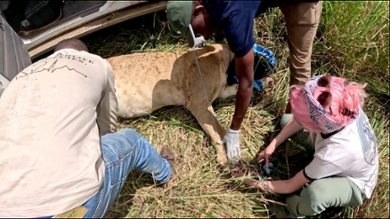
Pilot in the Serengeti
Lioness Sasa is the first to test the new collar. The pilot is conducted in collaboration with the Tanzania Wildlife Research Institute (TAWIRI) and Smart Parks, a company that develops technology to protect endangered species and conserve the environment. Veldhuis explains: 'This pilot is designed to help us improve the collars before scaling it up further - maximising data quality while minimising battery use.'
Strange adds: 'Ultimately, we want to expand this approach to more lions in regions where human and wildlife activity overlap. This will help us make better-informed decisions for both safety and conservation.'


