
A Sheffield start-up used UKDI funding to develop a robot that builds resilience into defence supply chains.
Rivelin Robotics developed a robot with human-like intelligence and dexterity to automatically clean and finish manufactured parts - removing the need for slow, costly, and hazardous manual hand-finishing
- Rivelin Robotics grew from a single founder to a team of 21, with 11 microfactories sold to customers across four countries
- UKDI funding gave Rivelin access to real end users including the RAF and the British Army during early-stage development
- Rivelin now has customers across Spain, France, Germany and the United States
Picture a naval vessel deployed far from home. A critical component fails which stops the ship from completing its mission. The crew have two options: wait weeks for a part to be shipped or pay a huge price to a local machine shop to fabricate a component on the spot. Either way, the taxpayer foots the bill and operational readiness takes a hit.
This is a reality that plays out across defence supply chains, and it's exactly the kind of problem UK Defence Innovation (UKDI) exists to help fix.
Built in Sheffield. Deployed worldwide.
Robert Bush founded Rivelin Robotics in Sheffield in January 2018 with a clear mission: eliminate the bottlenecks created when manufactured parts still need finishing by hand - work that is slow, costly, and often dangerous.
When metal, polymer or ceramic components come off a production line, whether printed, cast or machined, they are not actually ready for use. Components will have rough edges, excess structures and surface imperfections. Every single imperfection needs cleaning up, which is almost always done by hand.
Workers carrying out these tasks face well-documented occupational risks, from potential dust inhalation to vibration exposure, even when safety measures are in place. The work is also slow, inconsistent, and physically demanding
Rivelin's answer was to build a robot with the intelligence and dexterity of a human, that could finish manufactured parts quickly, consistently, and safely. The machine is also compact enough to sit on a workspace floor without disrupting existing workflows. Rivelin calls it a microfactory.
With UKDI funding and technical support from the Defence Science and Technology Laboratory (Dstl), Rivelin turned a promising idea into a deployed capability on the frontline.
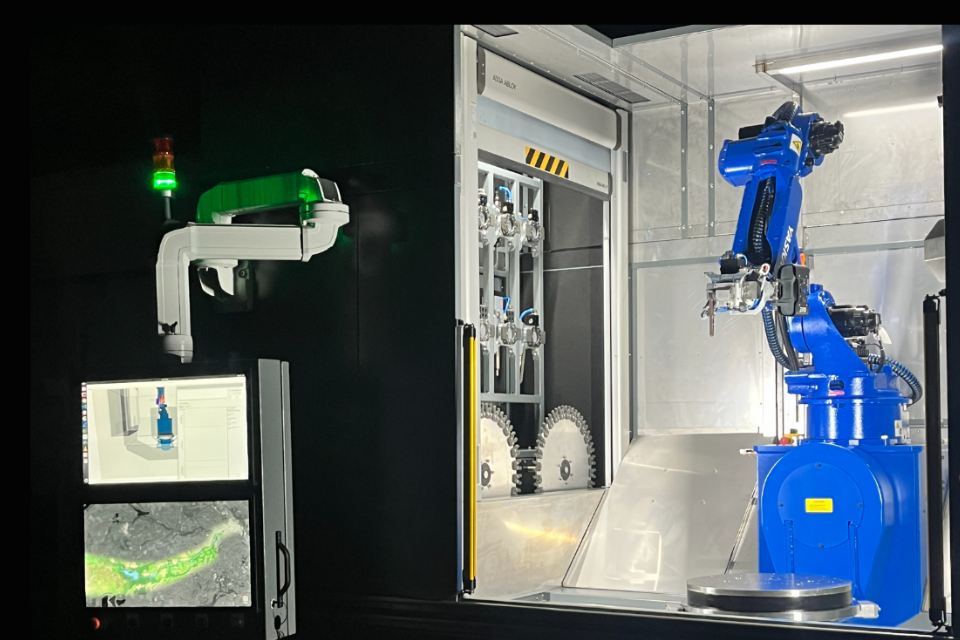
Rivelin's microfactory technology in action
Working with UKDI
Rivelin first engaged with UKDI (previously the Defence and Security Accelerator) through a competition called Right On Time: Automating Military Logistics in 2021. This competition, run on behalf of Dstl, focused on additive manufacturing in field environments.
Robert Bush, Rivelin Robotics founder, is direct about how their success in the competition had a huge positive impact on the company and the development of the technology,
"The Right on Time competition was not only beneficial monetarily, but it gave us access to potential users. That is worth its weight in gold," he explains.
As part of trials and assessment, Rivelin Robotics was able to showcase the microfactory to RAF and British Army end users early, while the technology was still in its initial stages and flexible to change. This helped shape the direction of Rivelin's development in ways that internal testing may not be able to replicate.
The funding also accelerated Rivelin's growth. They were able to hire more talent and invest in equipment which helped the company scale from a one-person start-up to a team of 21 - all based in Sheffield.
Robert also points to an additional benefit that often goes unspoken:
"When you're a brand-new company, it's huge when you get the backing of an organisation like UKDI. It adds credibility, almost like a stamp of approval that you've been vetted and the technology has been assessed as being something that end users really need. When other potential customers and investors are looking into your company, that stamp of approval carries real weight."
For companies that haven't worked with defence before, that credibility signal travels far beyond UK defence. It opens doors in other markets as well.
The results speak for themselves
Rivelin's microfactory technology doesn't just make parts faster. It boosts the economics of fast-paced manufacturing from the ground up. Working with one advanced manufacturer in the United States, Rivelin achieved a 90% reduction in cost-per-kilogram for completed components when compared to traditional hand-finishing methods. This is because the robot works at consistent peak efficiency and can finish multiple parts at the same time.
More importantly, it addresses the supply chain vulnerabilities that can make defence procurement fragile. By removing the final stage of manufacturing from the availability of skilled manual labour or local markets, Rivelin places operational resilience back in the hands of the people who need it at the moment they need it.
From Sheffield to the world
In the last two years, Rivelin has grown their team, and sold 11 microfactories worldwide, with more on order. The company now has defence customers across Spain, France, Germany and the United States, and has secured multi-year contracts as a result of relationships kickstarted through a UKDI and Dstl competition.
Robert Bush, founder of Rivelin Robotics:
"Rivelin is named after the Rivelin Valley in Sheffield - a place shaped by water power, gritstone, steel and generations of toolmakers. For centuries, this city built tools that helped power industry. It helped define the age of cutlery, the age of steel, and later the age of stainless steel. We believe Sheffield can do that again.
"At Rivelin, we are building an industrial robotic Swiss-Army knife platform for manufacturing: a flexible microfactory powered by our NetShape software that can handle multiple post-processing and metalworking tasks in one compact system. Today, manufacturers still rely on too much manual finishing, support removal, handling and bench work, which is slow, inconsistent, hard to scale, and difficult to staff. We automate that bottleneck. Our systems are already being deployed in aerospace and defence, helping customers reduce manual effort, improve traceability and unlock a faster, more scalable path to production. We are taking the craft, ingenuity and industrial spirit Sheffield is known for, and turning it into the next generation of manufacturing infrastructure."
Your idea could be next.
If you have a technology that could solve a real problem for defence and security, we want to hear from you. UKDI is the front door for companies who haven't worked with defence before, and we move at the pace the mission demands.


