
For Cornell University alumni Beckie Robertson '82 and Neil Robertson '82, the most meaningful engineering lessons rarely happened in a lecture hall.

Beckie Robertson '82 with her undergraduate mentor, Professor Emeritus Michael Shuler (middle), and husband Neil Robertson '82 during an April 23 ceremony celebrating Beckie Robertson as the recipient of the Cornell Duffield Engineering Distinguished Alumni Award.
That belief led the Robertsons to endow the Michael Shuler Biomedical Engineering Clinical Immersion Program. Named for the pioneering faculty member who founded what is now the Meinig School of Biomedical Engineering and mentored Beckie Robertson as an undergraduate researcher, the program places students in clinical settings to observe patient care, identify unmet needs and develop solutions grounded in real-world practice.
Their gift reflects lessons they first learned as Cornell students.
"Part of what made Cornell impactful was the ability to have experiences outside the classroom," said Neil Robertson. Those opportunities, he noted, reshaped his academic and career trajectory by revealing how engineering functions in practice.
For Beckie Robertson, that transformation came through undergraduate research in Shuler's lab.
"I got far more from my undergraduate research than I did from my experience in the classroom," she said, describing the experience as "transformational" and noting it provided mentorship, practical skills and a clear sense of direction in biomedical engineering.
The Robertson's endowment of the immersion program reflects a shared conviction that firsthand clinical experience helps students discover unmet needs and their own passions.
"You can be book smart and you can be street smart," Beckie Robertson said. "But until you've actually gotten your hands on and experienced it, how do you know?"
The couple's industry backgrounds - spanning venture capital and technology development - also inform their perspective. In their view, successful innovation depends not only on technical excellence but on understanding real user needs.
"As important as the technology is, understanding what the customer needs is critical," Neil Robertson said.
The clinical immersion model directly addresses what they see as a common pitfall among young engineers: designing solutions in search of problems. By embedding students in hospitals and clinics, the program encourages observation first, innovation second.
"The magic happens when you put an engineer and a clinician together," Beckie Robertson said. "You look, listen and understand the problems deeply - and then develop solutions."
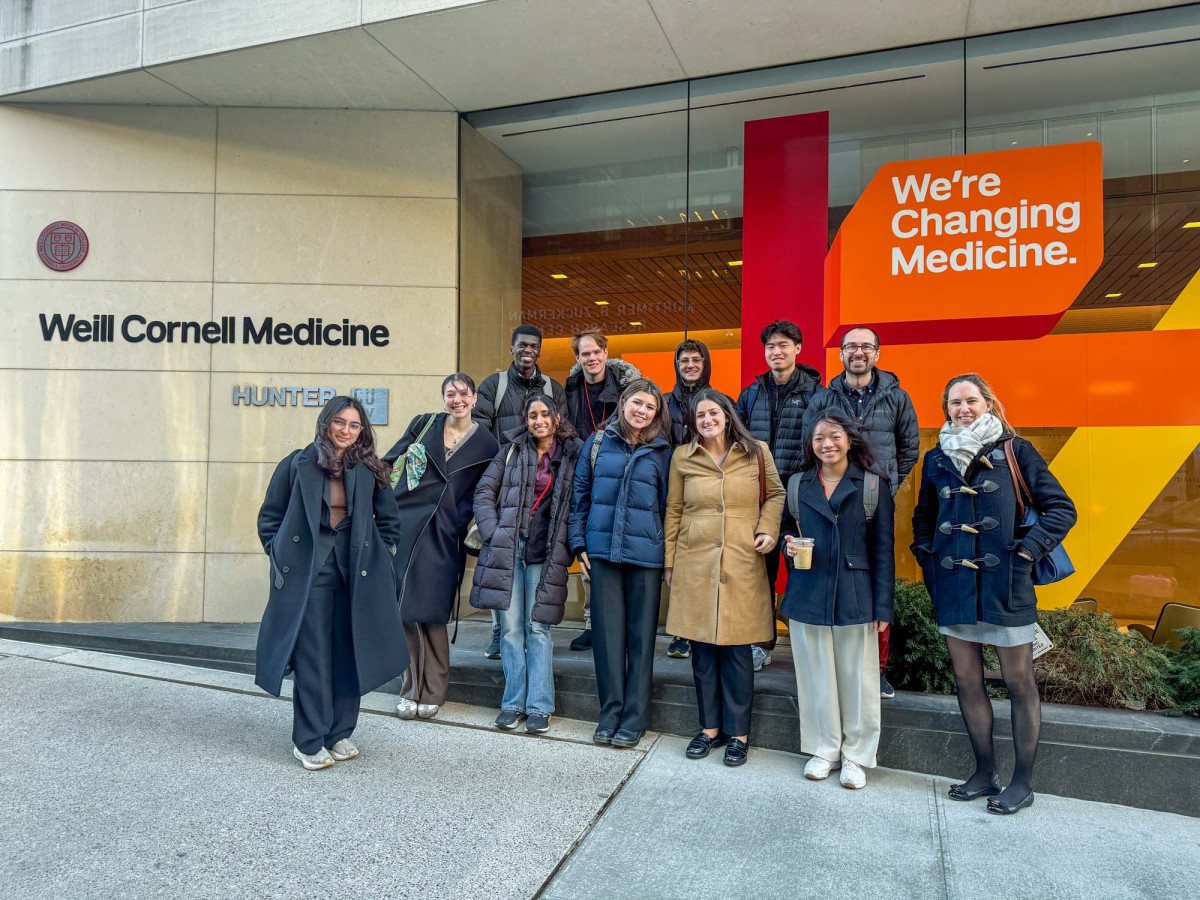
Students from the Michael Shuler Biomedical Engineering Clinical Immersion Program at Weill Cornell Medicine in New York City.
Ultimately, the Robertsons see the program as a launching point for future engineers. It helps students determine whether biomedical engineering is the right fit while equipping them with a mindset grounded in real-world impact.
Their philanthropy is rooted in a sense of continuity.
"Somebody gave back to us," Neil Robertson said. "Repeating that chain of events is really critical."
Earlier this year, Beckie Robertson received the Cornell Duffield College of Engineering's Distinguished Alumni Award, recognizing a career built on innovation, leadership and service. Through the endowed Michael Shuler Clinical Immersion Program, the Robertsons hope today's students will benefit from the same opportunities that shaped their own.
Or, as Beckie Robertson puts it: "We're paying it forward."


