
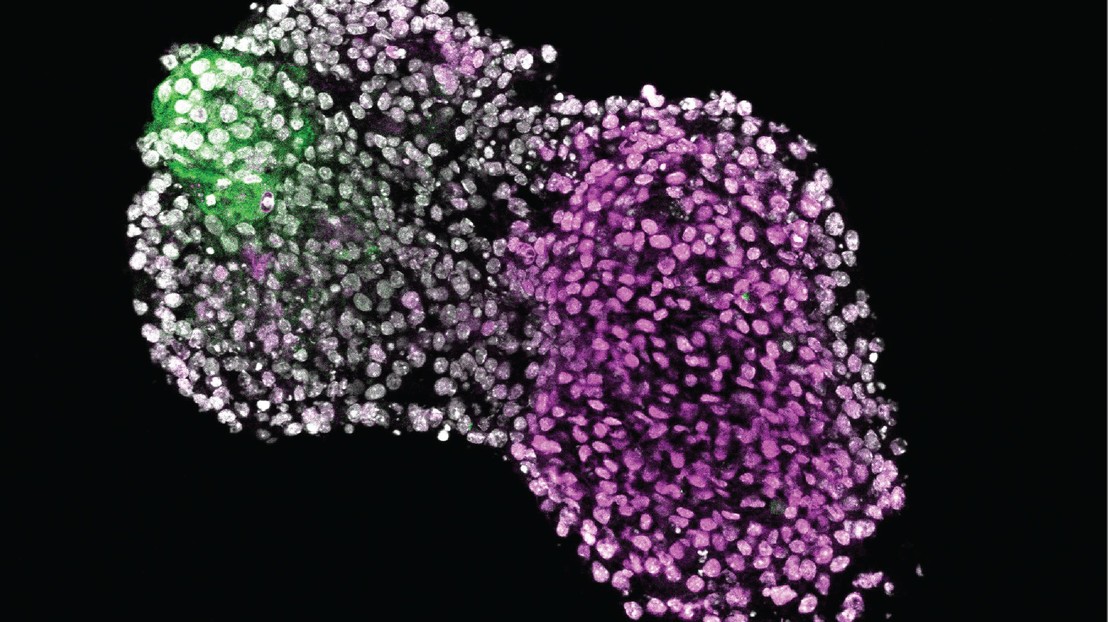
Fluorescence imaging of a budoid. Magenta: forming cartilage. Green: AER cells. Credit: 2025 EPFL/Evangelia Skoufa/Can Aztekin - CC-BY-SA 4.0
Scientists at EPFL have created a scalable 3D organoid model that captures key features of early limb development, revealing how a specialized signaling center shapes both cell identity and tissue organization.
During early development, the embryo builds the body's organs by exchanging chemical signals between different cell types. When developing limbs, a thin band of skin cells at the limb's surface, called the "apical ectodermal ridge" (AER), sends signals that guide the underlying population as it grows and forms bone, cartilage, and connective tissue.
The AER is hard to study because it forms only briefly in the embryo and secretes several types of signaling molecules at once. Studying these interactions in embryos is difficult, so scientists often turn to organoids, tiny lab-grown organs that offer researchers a controlled way to study how cells behave and interact as tissues form.
But most limb‑related organoid models have focused only on the mesoderm, missing the AER and other skin cells (surface ectoderm) that steer limb formation. "Without examining the AER's signaling center features, researchers cannot fully characterize how limb cell fates are coordinated or how tissues position themselves in the body and take shape," says Professor Can Aztekin.
At EPFL, Aztekin (now at the Friedrich Miescher Laboratory of the Max Planck Society) led a team of scientists to produce three‑dimensional organoids called "budoids" that display several features of the developing limbs, including symmetry breaking (the first step to shaping limbs), and early cartilage formation. The study is published in Science Advances.
To make the budoids, the scientists grew mixed cultures from mouse embryonic stem cells that produced AER‑like, surface ectoderm, and mesoderm populations, essentially all cell types found in a developing limb. When the team aggregated these cells, they self‑organized into three‑dimensional structures, creating budoids. The researchers then used this system to study how AER‑like cells guide the tissue's emerging organization.
The scientists made budoids by growing mixed stem‑cell cultures that naturally formed the main cell types involved in early limb development, then letting these cells assemble into simple 3D structures. This setup let them watch the tissue begin to take on early limb‑like shapes, see where cartilage formed, and test how AER‑like cells influenced these events by breaking the system apart and rebuilding it in controlled ways, giving them a clearer view of how early growth signals steer the very first stages of limb shaping.
Budoids offer a practical system to study how signaling centers like the AER influence early tissue formation, allowing researchers to study previously hard to examine parts of embryonic development, such as how cells coordinate their behavior, how early structures start to take shape, and how cartilage begins to form. The implications go beyond fundamental research to perhaps medical applications in the context of modelling congenital disorders, testing chemicals that can impair limb development, and even promoting regeneration.
"Budoids offer a more ethical alternative for studying limb development, a field that has traditionally relied heavily on animals," says Aztekin. "Because these stem-cell-based methods reproduce key features of embryonic tissues, many experiments that once required large numbers of embryos can now be performed in controlled organoid systems without using animals. This enables high-throughput, mechanistic studies while contributing to the replacement and reduction of animal use in developmental research."
Other contributors
- Friedrich Miescher Laboratory of the Max Planck Society
- EPFL Bioinformatics Competence Center
- University of Cantabria
- Technical University Dresden
- Roche Innovation Center


