
A study involving genetically identical fish reveals the principles of group behavior
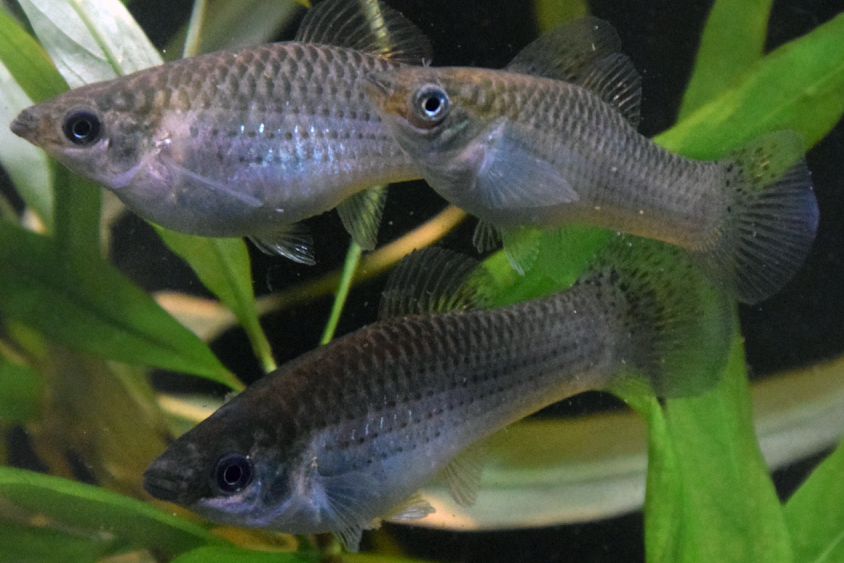
There's no such thing as a one-size-fits-all shoal, and this doesn't apply to clonal fish either. | Photo: David Bierbach
Schooling fish have long fascinated us with their mesmerizing collective movements and seemingly perfect coordination. But a new study on clonal mollies suggests that this behavior is not innate. During their first days of life, the fish still display distinct individual behaviors, and it is only around one month of age that they begin to form cohesive shoals, developing the coordinated movements characteristic of the group. However, several shoals of genetically identical clones begin to behave differently after a few weeks. The study was conducted by the Cluster of Excellence 'Science of Intelligence (SCIoI)', the Leibniz Institute of Freshwater Ecology and Inland Fisheries (IGB), Humboldt Universität zu Berlin, and UC Davis and published in "Current Biology".
In the study, the research team analyzed the behavior of the Amazon molly (Poecilia formosa), a naturally clonal fish. Because these fish share an identical genetic heritage, they provide a unique opportunity to study how behavior develops. Using video recordings the scientists observed ten groups of four siblings over 55 days. All the fish were reared together from birth under identical environmental conditions. Despite this standardization, significant differences in behavior developed between the groups.
"A swarm is more than the sum of its parts. This study of clonal fish shows that social experiences during development play a key role in the emergence of group behavior," said Dr. David Bierbach, author of the study from the Cluster of Excellence "Science of Intelligence".
The fish become more social as the grow
The young mollies did not immediately behave like they typically do in the cohesive groups consisting of older fish. During the first two weeks of life, the distance between group members was largely what would be expected if the fish were moving independently. From around three weeks onwards, however, the fish increasingly began to stay together, with particularly pronounced changes beginning around day 30. Their movements also became more correlated, indicating that individuals were increasingly responding to one another. This gradual convergence suggests that social interactions become more important with age.
Differences between the groups emerge very early
The researchers observed clear differences between the groups from the very first day of life. This was the case even though the fish were genetically identical within each group and were raised under standardized environmental conditions. For some behaviors, these differences were relatively stable. Mean swimming speed (i.e. how fast a fish swims on average over a certain distance or period of time) and distance from the center of the tank, for example, showed fairly consistent differences between groups over development.
Group behavior is not simply the average of individual behaviors
The researchers wanted to find out whether the shoal's behavior remained consistent over time. And indeed, it did not: The collective phenotype (i.e. the observable characteristics of the group's behavior) during its first five days was very different from that during the final five days of the experiment: in other words, the group's behavior had changed significantly over the first weeks of the mollies' lives. What makes this sound like a paradox is that individual Amazon mollies are known to maintain consistent behavioral differences over time. If group behavior were simply the average of the behavioral tendencies of its members, one would expect those differences to remain relatively stable as well. Instead, researchers observed that social behavior changed in ways that could not be explained by the individuals alone. This suggests that interactions between the fish play an active role in shaping the behavior of the group, allowing a collective phenotype to emerge and change over time.
Social interactions may change the trajectory of a group
One possible explanation is that social interactions become increasingly important as the fish mature. Early in life, when the fish show little social attraction, differences between groups may largely reflect differences that already exist between their individual members. As the fish become more socially responsive, interactions among group members can feed back on individual behavior. One fish changes its movement, another responds, and that response in turn influences the others. Such interactions can reinforce existing differences, reduce them or move groups onto different behavioral trajectories. The study cannot directly identify which specific social interactions generate which trajectories. It does, however, show that group-level differences become less predictable during the period in which social responsiveness change rapidly, i.e. in the first stages of life. The authors therefore suggest that increasing social feedback may contribute to the divergence of group phenotypes during development.
"The findings add another layer to our understanding of individual differences and collective behavior. Animal groups are often treated as relatively stable entities, with characteristic patterns of movement or social organization. But the results from the Amazon mollies suggest that these group-level characteristics can change substantially during development," said David Bierbach.
Understanding how group-level differences arise is a longstanding problem in the study of collective behavior. Groups are normally composed of different individuals and experience different environments, making it difficult to determine whether a group behaves differently because of the individuals it contains or because of interactions among its members. Being naturally clonal (i.e. consisting of genetically identical individuals throughout the entire species), the Amazon molly provides a particularly useful system for addressing this question. Previous work has shown that individual Amazon mollies can nevertheless develop consistent differences in behavior, even when raised under similar conditions.
The researchers therefore turned the logic around: instead of asking how genetically different individuals contribute to collective behavior, they asked what happens when genetically identical individuals are placed together in different groups. Automated video tracking recorded the position of the fish throughout daylight hours, providing a detailed picture of how each group's behavior changed during development. This "Big Brother Setup" allowed the researchers to follow groups from the moment they formed rather than studying groups that had already developed over weeks.


