
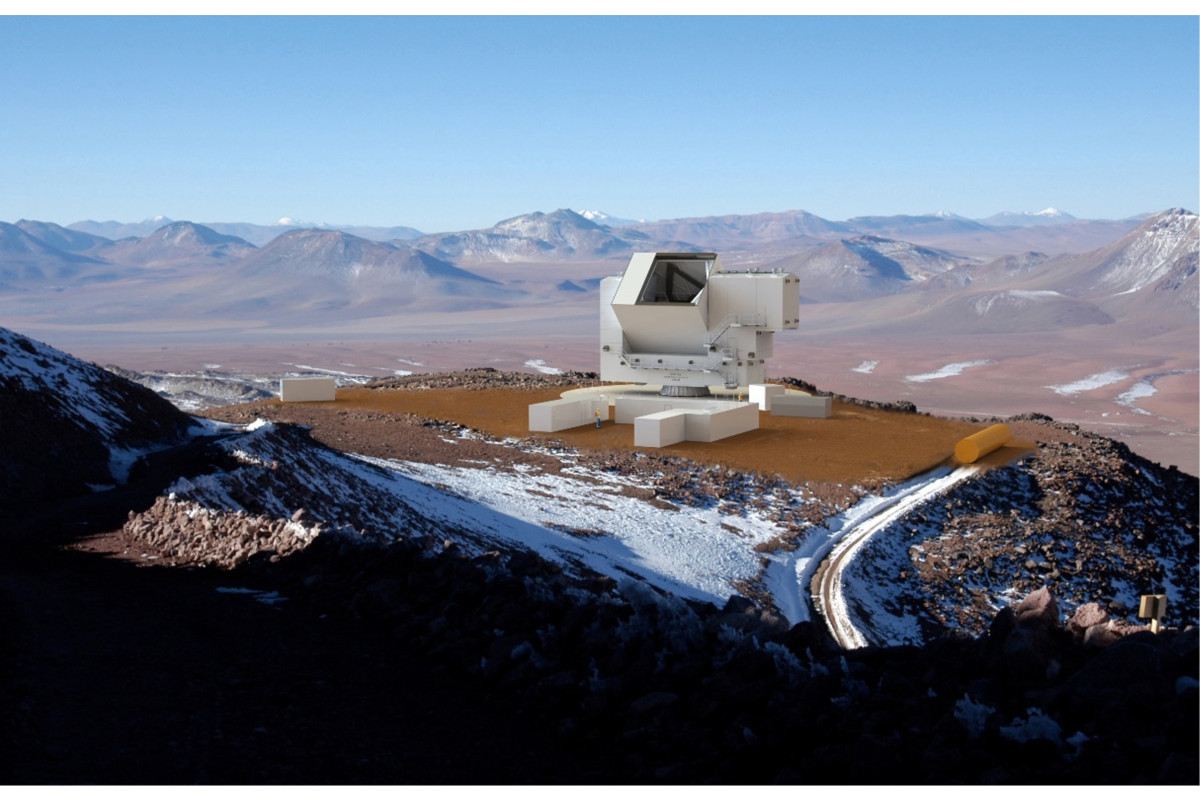
As the Fred Young Submillimeter Telescope (FYST) prepares for first light in 2026, its journey to the high Atacama Desert of Chile's Parque Astronómico Atacama, has been shaped not only by scientists and astronomers, but by a network of engineers, machinists, electronics specialists, riggers and support staff at the Cornell Laboratory for Accelerator-based Sciences and Education, CLASSE.
The telescope will operate at 18,400 feet above sea level, above much of Earth's atmosphere, enabling a wide range of ambitious science goals. These include mapping the universe's evolution from the birth of the first stars and galaxies, measuring the growth of galaxy clusters shaped by dark matter, probing magnetic fields in the Milky Way, and searching for subtle polarization signals in the cosmic microwave background that may point to primordial gravitational waves.
"It is the highest optical-throughput submillimeter telescope ever built, by about a factor of ten," said Mike Niemack, professor of physics and astronomy in the College of Arts and Sciences and lead scientist for FYST's Prime-Cam instrument. "That opens up a wide range of exciting science, from the cosmic microwave background to new ways of mapping how galaxies formed and evolved."
Achieving those goals, however, requires meeting some of the most demanding engineering, fabrication and coordination challenges in modern astronomy.
Extreme Requirements, Specialized Skills
Prime-Cam is one of two instruments planned for FYST. The instrument is being outfitted in the Space Sciences building of Cornell, with multiple low-temperature stages, silicon lenses, optical filters, detector arrays, and readout components. It must operate at cryogenic temperatures, with key detector stages cooled to near absolute zero. It must also maintain precise optical alignment while surviving transport across continents and final assembly at high altitude, where oxygen is scarce and working time is tightly regulated.
Those realities mean the design process does not end when fabrication begins. CLASSE's ability to adapt designs, respond to testing results and coordinate across technical disciplines plays a central role in supporting a project of this scale.
"There are many areas where CLASSE expertise is critical, including machining, engineering, riggers, procurement, electronics, scheduling, and human resources for helping manage all the people involved in these efforts." Niemack said. "In other words, many CLASSE team members are playing essential roles in enabling this research."
Meet the people and see the full article on the CLASSE website.


