
As wildflowers go, the mountain jewelflower is demure, clever and quietly unbreakable. It has spread across many of California's iconic landscapes, from Sonoma wine country to the oak-dotted foothills, even over the Sierra Crest, where snow covers the ground during winter.
"It seems at first glance like it could grow just about anywhere," said Jennifer Gremer, an associate professor in the Department of Evolution and Ecology at the University of California, Davis. "But if you look more closely, it's surprisingly vulnerable." The mountain jewelflower (Streptanthus tortuosus) faces an uncertain future - as do the 30 or so other jewelflower species spread across California.

As climate change alters atmospheric circulation, California's rain and snowfall are growing more erratic, and its seasons are shifting. Since 1960, California's wet season has moved later into the fall, with rains and snow that used to start in October now often arriving in November or December.
Jewelflowers can serve as bellwethers for many other California species. They have spent millennia adapting to climate and weather patterns and now tell a jarring story of how climate change will reverberate through the state's ecosystems.
"They're getting the rug pulled out from under them," Gremer said.
She and her colleagues Julin Maloof, a professor of plant biology, Sharon Strauss and Johanna Schmitt, both distinguished professors emerita of evolution and ecology, have spent a decade studying how California's jewelflowers adapted to such a wide range of climates - and how they may respond to future changes. They hope to generalize the lessons they learn from jewelflowers to identify other species that are at risk and help them adapt.
California harbors thousands of native plants whose lives are interwoven with countless birds and insects - making the task of shepherding all of them through climate change potentially overwhelming. "We aim to learn lessons that are much larger than just the jewelflower," said Maloof. "Our goal is for our insights to be applicable to many different species."

A natural wildflower experiment in climate adaptation
Gremer's jewelflower research is rooted in her work studying how plants in the Western United States cope with unpredictable variations in rainfall. During a postdoctoral fellowship at the University of Arizona, she studied how wildflowers that live for only a year ensure their long-term persistence in the Sonoran Desert, where a lack of rain can eradicate an entire species from the region.
"For annual plants, seeds are the only link to the future," said Gremer. "And germination - going from a seed to a tiny seedling - is a plant's most vulnerable life stage."
She found that common desert flowers like the Mojave Desert star (Monoptilon bellioides) and Texas filaree (Erodium texanum) cope with this uncertainty by producing a mix of seeds that "wait" different lengths of time - anywhere from one to 12 years - before germinating. "By doing this, the plant is actually hedging its bets," she said, ensuring that even if a drought kills every seedling for the next several years, some seeds still will survive. This allows the species to persist until rains return.
In 2015, Gremer connected with Strauss, who had studied jewelflowers for many years. California's 30-plus species of jewelflower are thought to have evolved from a single ancestral desert species. While S. tortuosus itself occupies an impressive range of local climates, jewelflowers collectively inhabit an even wider range, from northern Mexico into California, Oregon, Arizona and Nevada.
"That sets up an amazing natural experiment," said Gremer. By studying how their seeds germinate and how that influences their later success producing seeds, she, Schmitt, Strauss and Maloof hoped to understand another way that plants deal with uncertainty - by attempting to predict the future.

How later rainfall affects seed germination
Jewelflowers range from ankle- to hip-height. The plant's central stem often sprouts a dozen or more blossoms, which are white, yellow, brown, pink or purple, depending on the species. Each blossom resembles an ornate vase, topped with four curling petals and six velvety stamens.
Jewelflowers in Northern California often grow on rocky south-facing slopes, bathed in sunlight. And while S. tortuosus inhabits much of California, other species occupy tiny niches, growing in metal-rich serpentine soils that are toxic to many plants. Among these, the Mount Diablo and Mount Hamilton jewelflowers (S. hispidus and S. callistus, respectively) are each found on the slopes of only a single mountain. Rarest of all, the endangered Tiburon jewelflower (S. glandulosus niger) is confined to one valley spanning half a square mile on the edge of San Francisco Bay.
Most jewelflowers face uncertainty over the arrival of annual rains, which trigger their seeds to germinate. As California's fall rains move later into the year, seeds must now germinate later, too.
"So, we get this counter-intuitive result, that with global warming, they are actually germinating in colder weather than before," Gremer said.
In two experiments published in 2024 and 2025, she, Schmitt, Strauss, Maloof and postdoctoral fellow Samantha Worthy tested how this delayed start might affect jewelflowers. They simulated the onset of rains at different times by starting to water groups of seeds on different dates.
Delayed watering caused eight out of 11 jewelflower species to germinate at significantly lower rates. And germinating later in the season caused eight species to produce fewer seeds by the end of the growing season. Together, these results suggested that fewer offspring would successfully germinate and reproduce in future seasons.
"As rains arrive later and later, most of these species will suffer," Gremer predicted. "Some of them are probably already seeing negative effects."
The same could also be true of many other plant species that are currently widespread across California. Plants that seem adapted to a wide range of local environments may have surprisingly stringent climate requirements.
What old plants reveal about climate adaptation
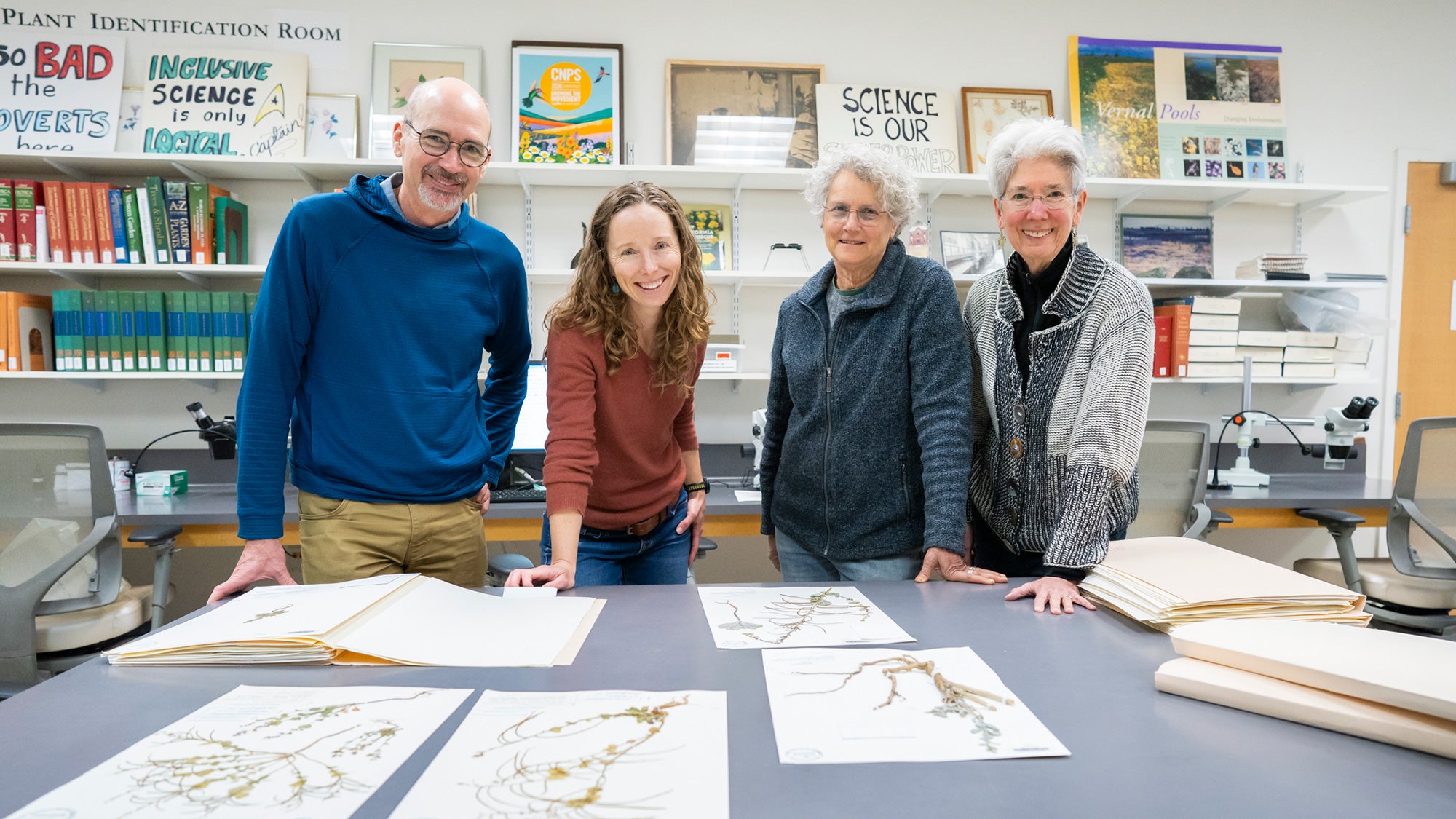
The group used historical specimens to investigate how various jewelflower species may have adapted to such a wide range of California climates. Strauss and former postdoc Megan Bontrager led an effort to examine 2,000 pressed plant specimens, representing 14 different jewelflower species, including many archived at the J.M. Tucker Herbarium at UC Davis.
These carefully preserved specimens, gathered by botanists between 1898 and 2016, noted the exact date and location of collection. Bontrager, Strauss and Worthy examined the maturity of each plant - whether it had buds, flowers or seeds - and estimated the approximate date when each plant germinated. Then, using climate records, they estimated the temperature and moisture levels that each plant experienced through the growing season.
They came to a surprising conclusion.
These 14 species grow in deserts, rolling foothills and high mountains, at elevations of up to 10,500 feet. But rather than adapting to a wide range of temperatures, each species' temperature preferences for growing conditions were almost identical. By responding to subtle cues - such as minimum or maximum daily temperature, soil moisture, hours of daily sunlight or chilling - each species timed its germination and reproduction to allow growth to occur within a narrow window of average daily temperatures, roughly 48°F to 54°F.
"Each species evolved a set of tricks for timing its germination and reproduction," said Gremer. "It's a remarkable discovery."
But as California's rainy seasons continue to shift, those fine-tuned cues are starting to yield bad results. New plants sprouting into colder, darker weather are reproducing less successfully, making fewer seeds during their lifetimes. These negative effects could eventually cause some species to shrink into smaller geographic areas - or struggle to survive at all.

Helping annual plants adapt to shifting weather patterns
Gremer and Maloof are now building on these lessons, collaborating with Troy Magney, an associate professor at the University of Montana, and Denneal Jamison-McClung, director of the UC Davis Biotechnology Program, on an ambitious project called IntBio, short for integrative biology.
Rather than comparing different species of jewelflowers, IntBio focuses on S. tortuosus. By studying how different populations of S. tortuosus have adapted to locales at different elevations and local climates, they aim to devise strategies to adapt vulnerable species to the changing climate.
Recent field experiments in the Sierra Nevada suggest that S. tortuosus that naturally live at high elevations are already surviving and reproducing less successfully than expected. Analyses by UC Davis postdoc Brandie Quarles Chidyagwai indicate that low-elevation plants transplanted to high elevations actually outperform local plants at some life stages.
Maloof said that the high-elevation plants could be helped through a strategy called "assisted gene flow," interbreeding them with these lower-elevation members of the same species that are adapted to warmer, drier conditions. "You're trying to change the genome of the vulnerable population as little as possible," he said. "We need to give them genetic variants to improve their summer growth and reproduction but not dilute their adaptations for surviving the snowy winter."
Maloof's group has recently sequenced the first jewelflower genome, which the team is using to identify various gene clusters that are activated as seeds begin to grow. "We know that plants from different elevations are responding to different cues to germinate," he said. "So, we should be able to find the different genetic programs that they're using."
Using a genome to guide plant conservation
Maloof, Magney and their labs hope to turn this knowledge into a tool that workers could use to read the genetic imprints of hundreds of wild plants in an afternoon - quickly identifying those with desired genes.
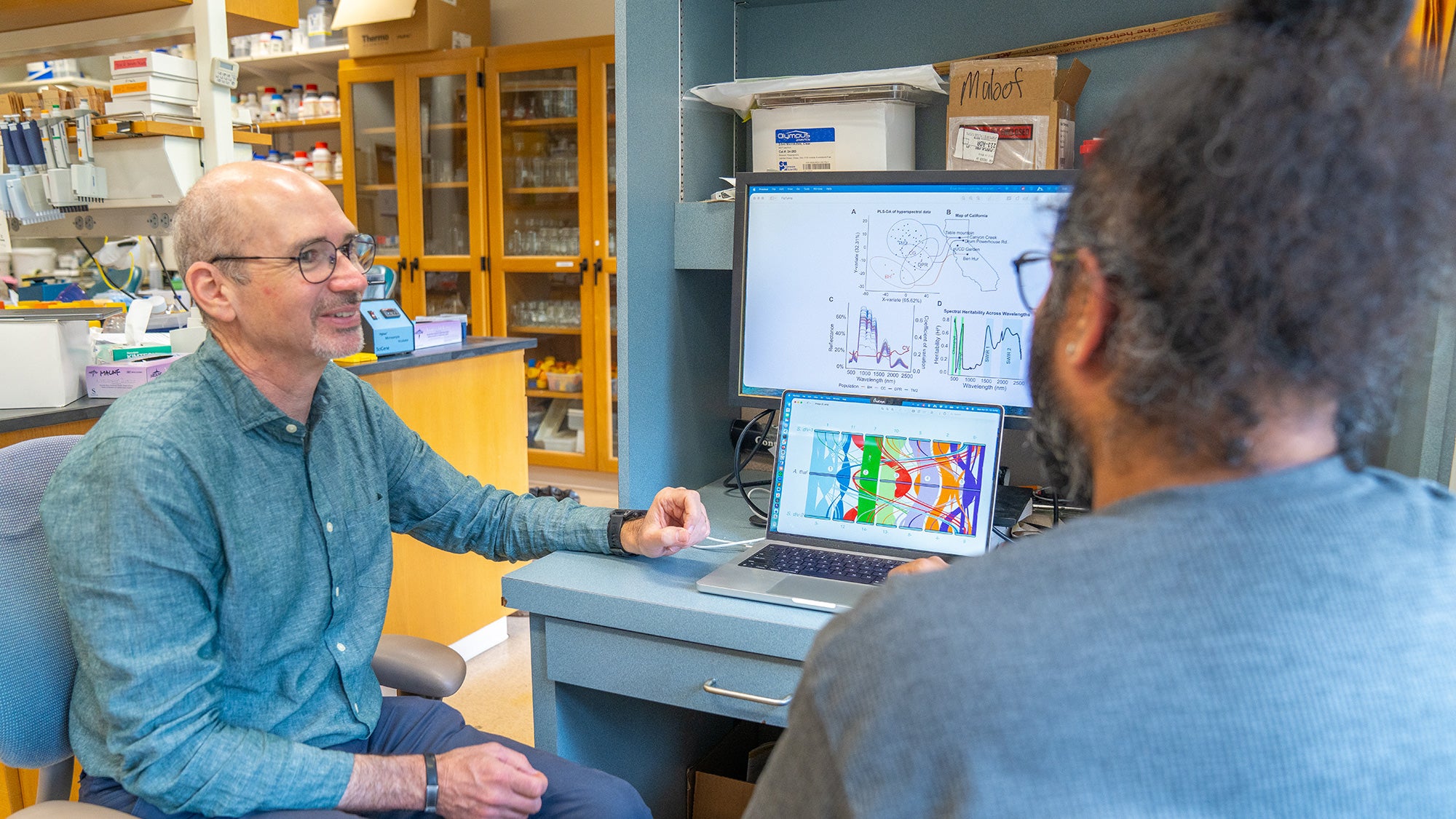
Rishav Ray, a UC Davis postdoc working with Maloof and Magney, has developed a prototype that reads the "spectral fingerprints" of leaves by analyzing the visible and infrared light that reflects off of them.
By reading signals invisible to the naked eye, the prototype can distinguish S. tortuosus plants from different regions of California, even though they belong to the same species, have near-identical genomes and are growing side by side in the same garden. Even more importantly, it can distinguish plants carrying genetic adaptations for different climate conditions, such as hotter days or more frequent droughts.
For now, Ray uses a spectral analyzer that he can carry in a backpack. But Magney said that under certain circumstances these methods could be scaled up to drones, airplanes or potentially even satellites.
The lessons learned from jewelflowers might then be applied to other plants that are more prominent in California landscapes such as grasses, oaks, maples, madrones, conifers or sagebrush. Some of these native plants will struggle - like jewelflowers - with environmental cues that no longer match the changing climate. By measuring spectra, biologists could quickly survey which plants are suffering most, and which plants might carry adaptive traits that could be bred into the vulnerable ones.
"The advantage of remote sensing is that we can map everywhere, all the time," said Magney. "We can see how these species are responding and better predict what might happen to them in the future."
The research projects described in this story are primarily funded by the National Science Foundation, with additional funding from the United States Department of Agriculture.


