

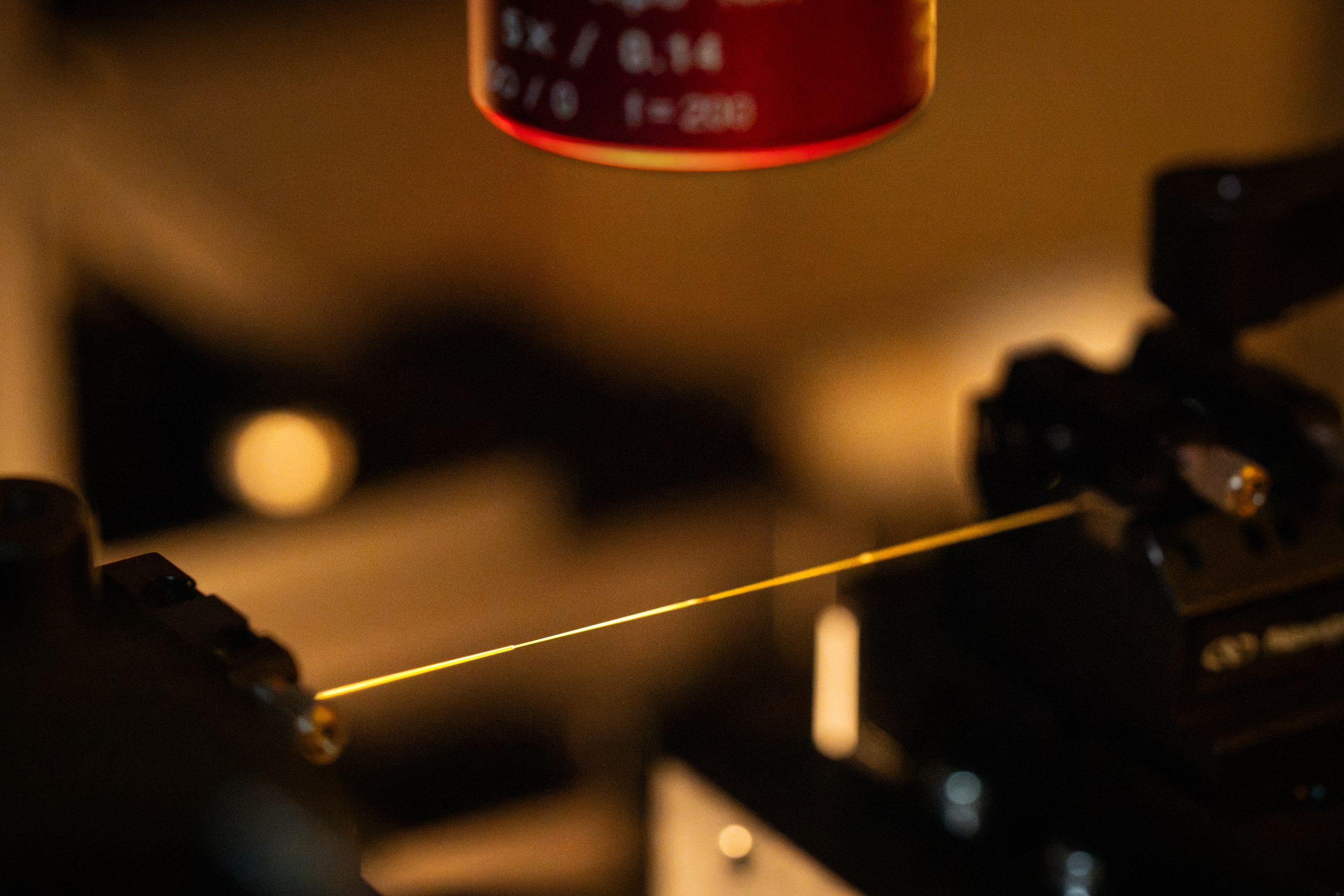
Within tiny halos of light clinging to a vanishingly thin wisp of optical fiber, scientist Jongmin Lee guides atoms like marbles through a narrow pipe. Rock the fiber and the atoms shift side by side; they just don't fall off. But don't be deceived by the seemingly delicate nature of his experiment. Lee is exploring how to measure motion precisely in rough-and-tumble environments.
A quantum sensing scientist at Sandia National Laboratories, Lee is an expert in a kind of motion sensor called an atom interferometer. In a lab, this device uses quantum mechanics to obtain exquisitely accurate measurements. Lee and his team are working toward building an extremely small, low-power version for field use - small enough to fit on a specialized kind of microchip called a photonic integrated circuit.
Their latest results were published in the journal AVS Quantum Science, where the team reported trapping cesium atoms on a fiber only 420 nanometers in diameter with just 5 milliwatts of optical power - about 2,000 times less power than is used by an LED bulb. With just 150 nanowatts, the researchers can also take measurements that mimic atom interferometry.
They also reported a new design for a heat-resistant membrane-waveguide, a next-generation prototype. Nanofibers provide a convenient, reliable testbed for the team's atom-guiding experiments but currently are impractical for real-world use.
"Our ultimate goal is to demonstrate this on chip with a photonic integrated circuit, but our nanofiber results show a clear potential path toward chip-scale quantum inertial sensing," Lee said.
The new trapping method uses roughly one-sixth to one-fourth as much power as previous approaches, marking a significant advance toward rugged, chip-scale atom interferometers that could help military vehicles navigate when GPS signals are jammed.
The project was funded primarily by Sandia's Laboratory Directed Research and Development program.
Sandia tech could get pilots out of a jam
If you want to jam satellite navigation signals, just let out an electromagnetic scream. Overwhelmed by noise that drowns out signals from positioning satellites, an aircraft will have to rely on onboard acceleration and attitude sensors. This can work for a while, but eventually the aircraft will drift from its intended flight path.
Quantum sensing offers a potential solution. Its measurements use quantum mechanics and can be much more accurate than those from conventional instruments. An atomic clock, for example, is a well-known kind of quantum sensor that can keep accurate time far longer than a quartz wristwatch before its timekeeping begins to drift.
Similarly, a quantum sensor that measures inertia could keep a vehicle on track much longer than current instruments when GPS is jammed or unavailable.
Tight light is not the only idea for propelling next-generation navigation, but it does offer a distinct benefit. For comparison, instead of thinking about marbles in a pipe, consider free-falling ones. This is the idea behind an alternative technology called a free-space atom interferometer. It releases ultracold atoms and uses laser pulses to measure their motion as they fall in a steady stream through a vacuum chamber. However, strong jolts or vibrations can cause lasers to momentarily lose sight of the atoms, disrupting measurements. By contrast, guided atom interferometry, like a narrow pipe, keeps atoms contained and therefore in constant view of the lasers.
Lee's guided concept, implemented on a photonic integrated circuit, is newer and less developed. But the physical guide offers a clear advantage because it holds onto the atoms even when the device is knocked around. That could be useful for navigation through strong turbulence or over rough roads.
However, Lee said, "This idea has not been fully realized by the community for decades, due to challenges in dissipating heat from photonic devices in vacuum and in efficiently loading atoms around them."
New component design balances tricky trade-offs
The problem is lasers. You need them to create the halo effect that catches and guides atoms. But the lasers also generate heat. And when you're dealing with ultrathin components - 200 times thinner than a human hair - heat builds up fast. It can crack the atom guide, like burning out the filament in an incandescent light bulb.
Until recently, scientists have had to choose between fragile designs that suspend waveguides to load atoms efficiently but shatter under high heat and sturdier designs that mount a waveguide on a solid substrate. These handle the heat well but load atoms poorly.
"Both heat dissipation and efficient atom loading are really important," Lee said.
The Sandia team found a solution with a platform that strikes a balance between the two approaches.
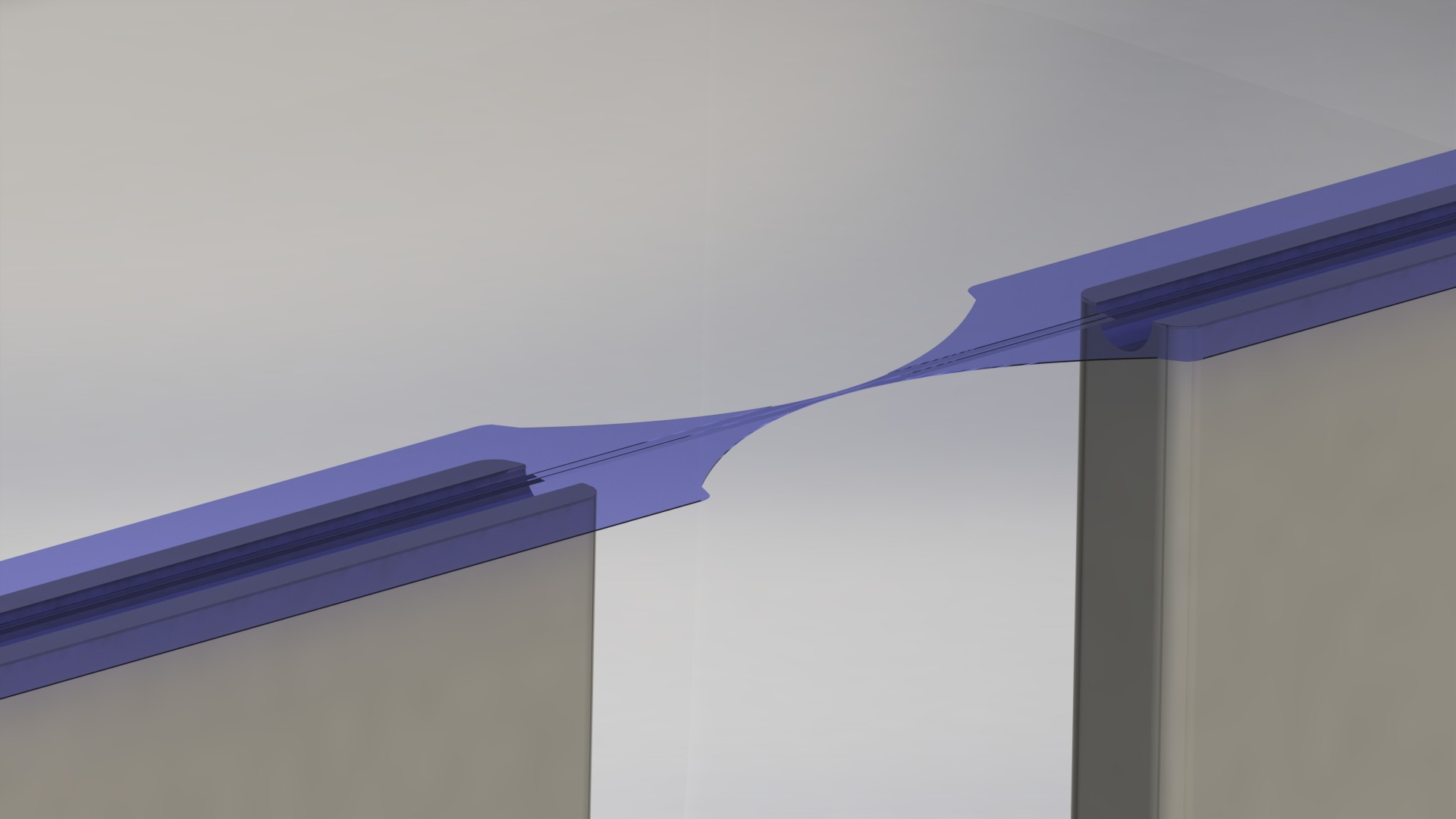
"What makes this new membrane-waveguide less susceptible to heat in a vacuum is that it is anchored on either end by small pins of silicon," Lee explained. Under a microscope, these little pins look enormous compared with the nano-thin membrane-waveguide. More importantly, they act as heat sinks, drawing heat away from the lasers.
Future plans
With heat no longer a deal-breaker, the Sandia team is now beginning to bring years of research together into a single workflow.
"Using laser cooling and trapping, our team produced a cloud of very cold, slow-moving atoms that drift into and accumulate within either a hole in the membrane or a gap between two silicon needles," Lee said.
Spanning that hole or gap, the membrane-waveguide performs the same job as an optical nanofiber: It creates halos of light to guide the atoms.
"Building on our nanofiber results, we showed cesium atoms can be trapped with just five milliwatts of optical power and that atomic coherence can be measured using sub-microwatt fiber-coupled beams, all while minimizing in-vacuum heat loads," Lee said. "This capability is feasible on the membrane-waveguide photonic integrated circuit platforms developed at Sandia."
Lee is still working out some kinks in the membrane, which is why he tested his measurement protocols on a nanofiber testbed rather than on the new platform. However, future research will gather atom-trapping and power data on the new atom guide, add momentum kicks to the atoms during measurements and integrate the guide with other components on a chip, moving closer to a chip-scale quantum inertial sensor array.
"Our concept is not fully demonstrated yet, but we're very close," Lee said.
For now, these atoms are buckled in and ready for the next stretch of quantum sensing, no matter what bumps in the road lie ahead.


