
Building on the success of the ongoing TPA-1 mission, the project to launch the Space Institute's TPA-2 satellite has now kicked off, preparing a suite of curated New Zealand-developed technologies for a ride to space in early 2028.
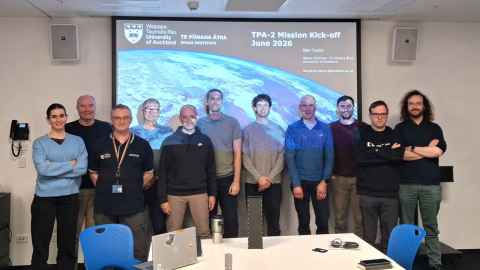
TPA-2 can be described as a "space shuttlebus", according to mission lead Dr Ben Taylor.
The satellite, named after Te Pūnaha Ātea, the Space Institute, is due to launch in early 2028 and will carry six curated payloads from industry, academia and education into orbit and give them a platform to test their technologies.
The mission was formally set in motion on 30 June, with payload providers meeting to begin the work of developing their hardware for flight.
"We're pleased to run the mission so New Zealand payload developers, from school groups and university researchers, through to emerging space companies, can get a ride to orbit and gain the flight heritage that's essential for growth," says Taylor.
TPA-2 was the recipient of $283,827 in round one of the Kiwi Space Activator pilot programme. Taylor says the support the mission has received is being channelled directly into creating flight opportunities for other groups.
"TPA-2 reflects the ethos of the programme in accelerating local capability and enabling more New Zealand space technology to get into space," he says.
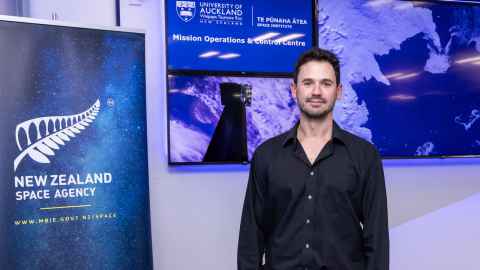
These are the six technologies hitching a ride on TPA-2:
Lune-digital - Modular Maritime Domain Awareness Payload of Opportunity Led by Stephen Fellner, Paul Mallinson
New Zealand oversees one of the world's largest ocean areas (roughly 20 times our landmass) and monitoring it effectively for fisheries, environmental health and other needs is a major challenge.
Lune Digital's miniature maritime-domain-awareness payload adds a space-based sensing layer to help agencies better understand activity across those waters.
Smaller than a can of Coke, the payload captures ocean imagery, uses onboard AI to flag areas of interest, and sends only relevant data to the ground.
Processing information in orbit makes the system fast, efficient, and well-suited to small satellites like TPA-2. Its modular design means it can fly on future missions without needing a dedicated spacecraft.
Reaching orbit is a key step for the Auckland-based team as they work to build world-class optical-sensing capability in New Zealand and join the companies already putting New Zealand on the global space map.
One Foot in the Clouds - Schools Education Payload
Supported by John Smith, Pranav Mistry
This mission will launch a payload dedicated to student-led scientific discovery. Its goal is to inspire young people to see space as a pathway for learning and to empower them to investigate issues that matter to their generation.
Rather than defining research questions in advance, the programme places curiosity and student leadership at its core. Students will help shape the scientific focus of the mission, design investigations, and contribute to real research outcomes.
The initiative is expected to involve at least 25 schools and 250-500 students nationwide, supported by educators, scientists, engineers and industry partners.
"New Zealand is an extraordinary country for students with an interest in science and particularly space. We have ready access to role models, technology, and a highly supportive aerospace community. This means that we perhaps live in the best place for our students to learn skills and work in this field," says Smith.
"We expect that among the students, there will be many whose lives will be directed towards STEM fields by the actions of the volunteers supporting this project and their collective endeavours to launch a successful mission."
University of Auckland, School of Biological Sciences - BioOrbix
Led by Anthony Phillips, Luke Tracy
BioOrbix is the first iteration of a flexible, remotely operated biological mini-laboratory designed to give New Zealand researchers practical access to CubeSat microgravity science. The payload has several aims:
- expose a wide range of biological and biomedical researchers to space-based experimentation
- encourage them to see microgravity as a viable extension opportunity for their existing work
- provide a new platform technology for researchers associated with the NZ Space Health Research Network
- evaluate key biological technologies for future missions
- run some proof-of-concept demonstration studies across biological, biomedical and biophysical domains
- compare space‑based results with identical experiments in Earth‑based microgravity simulators
Inside the payload, three small experiments will test whether plant material metabolism can be measured in microgravity, record how biomedical-like fluids behave without gravity, and monitor how the cell skeleton changes shape in space.
These studies will help validate some of the technologies on board to become proven platforms for New Zealand CubeSat biological and biomedical research.
"Travel to space is beyond most of us. However, putting our own experiments in space represents an exciting and unique scientific opportunity to be involved in doing some real "off-world" research for the first time," says Phillips.

University of Auckland, Department of Physics - Optical Comms beacon
Joseph Ashby, Nicholas Russell
The optical comms beacon will validate the team's implementation of the Extremely Low Resource Optical Identifier (ELROI) system and gain flight heritage for a new onboard computer architecture built around multiple low-cost processors.
The payload uses a novel software approach to continually select the healthiest processor to transmit the ELROI signal, extending system lifetime without heavy radiation shielding.
ELROI works like a barcode for satellites: tiny laser pulses encode a unique ID that can be read from the ground using a single-photo detector.
Flying this payload allows the team to prove both the ELROI implementation they've designed and gain flight heritage for the onboard computer's novel redundant architecture and use of commercial, cheap processors in low Earth orbit.
Te Pūnaha Ātea - Space Institute - Dragsail Hold Down and Release Mechanism
Marcus Bycroft, Liam Knight
The dragsail Hold‑Down and Release Mechanism (HDRM) is a student‑designed system that restrains TPA‑2's dragsail until deployment, using a Shape Memory Alloy actuator to release the sail when commanded.
Once deployed, the dragsail increases atmospheric drag and helps the satellite deorbit more quickly. TPA-1 hosts a dragsail for disposal, with this project aimed at demonstrating a novel release mechanism.
The project explores how compliant mechanisms, which rely on controlled elastic strain rather than complex moving parts, can be used reliably in aerospace environments. The goal is a simpler, lower‑cost release mechanism that can be reset more easily than existing solutions.
"An opportunity to take a design through from an initial concept all the way through to becoming real flight hardware is a huge learning experience," says Knight.
"Designing something that works on paper is vastly different than designing something that works reliably in a real space environment and integrates with the other components of the satellite."
Te Punaha Atea - Space Institute - Payload Interface Module & Highly Integrated Avionics
Kala Payinda, Louis Young, Shivam Desai
The Space Institute is developing a fully in‑house avionics package for future missions, replacing the third‑party commercial systems currently used.
The goal is a self‑reliant, scalable and low‑cost architecture that covers onboard computing, data handling, power, communications and payload interfacing - all designed and manufactured at the University. On TPA‑2, the new Highly Integrated Avionics (HIA) system will fly alongside the existing commercial stack to test its performance in orbit.
A key part of the project is the Payload Interface Module (PIM), a universal adapter that allows any payload to plug into a CubeSat without custom electronics. Different payloads often require different voltages, data buses and control signals; the PIM turns that complexity into a software configuration step rather than a hardware redesign.
In future iterations, the team aims to condense the entire avionics architecture onto a flat PCB mounted on the CubeSat wall, freeing most of the satellite's internal volume for payloads.
For the students involved, the project has been a rare chance to design flight hardware that will operate in space. It has offered hands‑on experience across the full lifecycle of a CubeSat mission - from electronics design to system integration - and represents a major step toward enabling more New Zealand science missions to fly on locally built spacecraft.


