
The physics and chemistry used at ANSTO is built upon, in significant part, by pioneering female scientists who were sidelined, expelled, or simply not credited appropriately for their achievements.
To acknowledge International Women's Day this month, we are providing short profiles of pioneers who faced historical challenges.
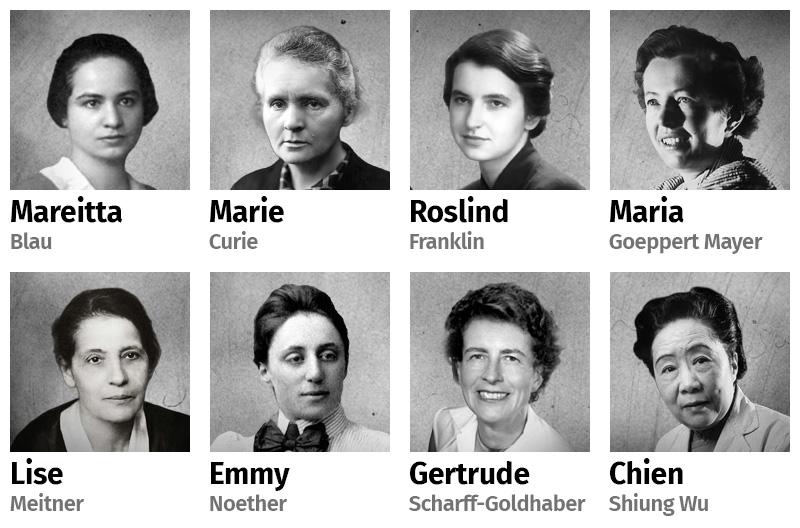
Marietta Blau spent fifteen years developing nuclear photographic emulsions, chemical films capable of recording and measuring the tracks of charged particles from nuclear reactions. She worked with manufacturers Agfa and Ilford to formulate emulsions sensitive enough to distinguish alpha particles from protons and to determine particle energies from track lengths measured under a microscope.
In 1937, she and Hertha Wambacher placed emulsion plates at an altitude of 2,300 metres on Hafelekar Mountain and discovered starbursts of particle tracks radiating from a single point, cosmic ray particles disintegrating heavy nuclei in the emulsion.
They named them Zertrummerungsterne (disintegration stars), and it was their discovery that launched particle physics. When they wrote up the result, her Nazi colleagues pressured her to list Wambacher's name before hers. Weeks later, the German annexation of Austria forced her out of the country.


