
An evolutionary 'trap' that has haunted crested and marbled newts for 25 million years: Leiden researchers have uncovered a mysterious DNA error that should not be able to arise - yet persists all the same. How is that possible? PhD candidate James France found new clues.
In Triturus newts, half of all offspring die. Scientists have long known that one part of their DNA - chromosome 1 - exists in two different versions. Animals need both versions to survive. During reproduction, offspring inherit one copy from each parent at random. By chance, half of the young will receive the same version twice, and those individuals do not survive.
'It's extremely disadvantageous if half of your offspring are doomed from the start,' says Ben Wielstra, who supervised France's PhD research on crested and marbled newts. 'You'd expect such a "mistake" to have disappeared long ago through evolution. But this system has been around for at least 25 million years.'
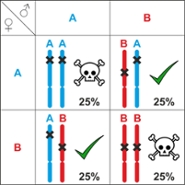
Why does this system persist?
This is the key evolutionary puzzle that Wielstra's group is trying to solve: why does something so harmful continue to exist in nature? The researchers discovered that both chromosome versions are missing large, unique chunks of DNA. Each animal only has a full set of essential genes when it carries both versions.
A hypothesis from the 1980s predicted that such errors arise from a rare faulty exchange between chromosomes. The researchers have now found the first direct evidence that this indeed happened. 'We discovered that this lethal system evolved from a single mutation in which a huge section of DNA was deleted from each of the two versions of chromosome 1, while the same region was duplicated on the opposing version.'
How did something so harmful manage to spread?
France investigated this using computer models, which showed that the "mistake" can arise in small, isolated populations-such as newts living in separate ponds. In such conditions, natural selection does not work efficiently, allowing harmful variants to slip through.
'As soon as the system is in place, it maintains itself. It's a kind of evolutionary trap.'
'In small populations, strange things can happen. If the one population in which this "faulty" system appears later goes on to colonise new areas, the disadvantage can spread,' Wielstra explains.
It remains rare, however: such systems occur in only a handful of species. Triturus newts are the best understood, but similar cases are known in some plants and insects.
An evolutionary trap
Once established, the system is almost impossible to eliminate. When a "healthy" newt breeds with a newt carrying the system, their offspring end up with three copies of some genes and only one of others. That is often lethal. 'As soon as the system is in place, it maintains itself. It's a kind of evolutionary trap,' says Wielstra.
Years of work in the lab
The research also required enormous amounts of laboratory effort from France. Newts have genomes ten times larger than those of humans, making it nearly impossible to sequence their entire DNA.
To gain insight nonetheless, teams in Poland and Serbia bred different newt species. By analysing how thousands of genes were inherited, the researchers could see which sections were missing. 'It sounds simple, but this was a massive task. Hundreds of animals, years of work-and of course, the pandemic didn't help,' the supervisor recalls.
'These newts show how strangely those natural laws can play out.'
What's next?
The next step is to uncover exactly which genes are essential - which developmental switches are missing in embryos that fail to survive? Modern genetic techniques may offer opportunities. 'As an evolutionary biologist, I simply want to understand what's happening. Can we make an animal "healthy" again? Or even give a healthy animal the same error, to understand why they die?'
Pure curiosity is what drives Wielstra's research group. 'Evolution is like gravity: it just happens. Sometimes helpful, sometimes disastrous. These newts show how strangely those natural laws can play out.'
James France defended his thesis titled Comparative genomics of the balanced lethal system in Triturus newts, on 3 April 2025 in the Academy Building. His supervisors were Ben Wielstra and Michael Richardson.


