
Khalilur Rahman took the gavel as President of the UN General Assembly's 81st session amid what he calls a crisis of confidence in the organization he has served - in one capacity or another - for 35 years.
The top Bangladeshi diplomat and sitting foreign minister has staked his one-year presidency on a single ambition: restoring trust.
It's a theme he returns to often, tracing it back to the optimism of the UN's founding in 1945 and the gap between what Member States expected then and what the organization has delivered since.
As High-Level Week gets underway - the busiest week of the UN calendar, the largest gathering of world leaders in one place anywhere on the planet - Mr. Rahman sat down with UN News to discuss what a "much needed transformation" would actually look like, why he believes artificial intelligence poses a test unlike anything the UN has faced before and what lessons from his work on the Rohingya crisis he is carrying into the role.
He also addressed critics who argue the assembly is toothless compared with a gridlocked Security Council , and reflected on the moment, more than four decades after serving his own foreign minister during a previous Bangladeshi presidency of the assembly, that brought him back to lead it himself.
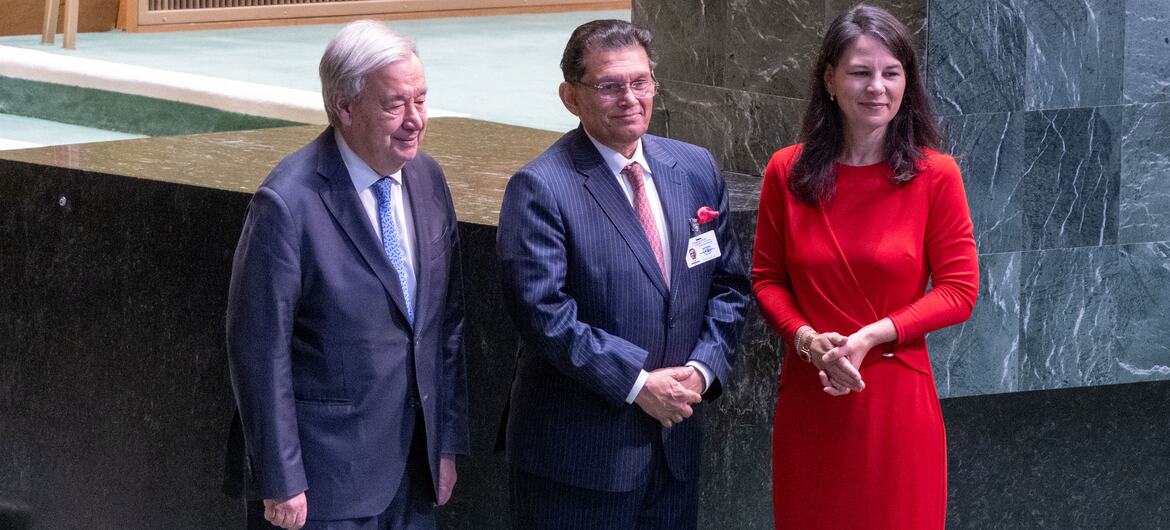
UN News: High-level Week is underway. What are your expectations, and what do you hope world leaders will take away from it?
Khalilur Rahman: High-level Week is the most powerful manifestation of the convening power of the United Nations. It's an opportunity to hear directly from those governing our societies - how they see the world, their regions, their own countries and what they expect from the UN.
One of the things I'm looking for most closely is what they say about reviving trust in the organization. That is the highlight of my presidency. I've made it my own theme, and I want to draw on their views as a guide for my work on this agenda.
UN News: Restoring trust is at the heart of your presidency. What does that look like in practice, and how will you know if you're succeeding?
Khalilur Rahman: Go back to 1945 at the time of creation of this Organization. In Yalta that year, President Roosevelt, Stalin and Churchill met for about eight days. Alongside arrangements for ending the war, they conceived of a world organization whose primary purpose was to prevent a repeat of the conflicts we saw in the two world wars.
When the UN was formally created in San Francisco, delegations gave it a standing ovation and kept standing for a while. That represented the aspiration that the UN would be able to give peace.
And I'm happy to say that in the eight decades since, we've avoided a large-scale global conflagration. Countries that weren't at the table then have emerged from colonial rule and built a robust development pillar within the UN.
But at the same time, we haven't prevented many conflicts, and progress on development has often been sluggish. We have to work hard to ensure that the Security Council works more coherently and delivers as it was expected to.
Both pillars carry major unmet expectations, and that breeds frustration - a sense that the UN isn't doing what people expected of it. That has fed declining trust.
I should also mention human rights, our third pillar: we spend only four per cent of our total spending on it. We've made major strides, but much remains to be done.
We have to work hard along all three pillars to bring back the confidence the organization had at its creation. It's a major challenge, and it will require all member states and stakeholders to work together.
UN News: You've said this is not 1945, and the world has moved on. What's one concrete change you'd point to?
Khalilur Rahman: Artificial Intelligence [AI]. It could be a great accelerator of human endeavour, but if you believe the doomsday predictions from some major figures, it could also pose serious dangers to humanity.
We shouldn't do anything to slow innovation - that has to continue. But it's vital that we put guardrails in place, so this innovation serves humanity rather than working against it.
That's a job not only for governments but for everyone practically involved in developing and using the technology. We need all of these communities to be part of the discussions and decisions ahead, so we find a safe pathway toward AI genuinely serving humanity.
UN News: Critics say assembly resolutions carry moral weight but no teeth, and that real power still sits with a gridlocked Security Council. What do you say to that?
Khalilur Rahman: If the assembly were useless, there wouldn't be a high-level week, and Heads of State wouldn't come. There must be some utility. What I see is the great convening power of a body that represents the entire world - there's no other place quite like it.
Diplomacy isn't always done in the open. The assembly gives Heads of Government and Heads of State a safe environment to discuss serious issues together and find ways to resolve them. It's also an authoritative way of hearing directly from those governing our societies.
I believe the assembly will continue to play an important role in setting norms and giving overall direction to the work of the international community.
UN News: You worked directly on the Rohingya crisis. What lessons are you carrying into the presidency?
Khalilur Rahman: It's a grave human crisis - a population attacked, their homes bombed, their villages burned, chased out by their own countrymen. Pregnant mothers' bellies cut open and the fetuses thrown into fire.
But I also saw their resilience, their ability to survive and their yearning to go home. When the Secretary-General visited Cox's Bazar last year, more than 100,000 refugees gathered on a Ramadan evening to share breakfast with him, each holding a placard reading: we want to go home.
The lesson I carry is this: violence will not solve any problem. It will only defer it and make it worse. Only through talks and negotiation, only by coming together, can we resolve these issues.
That's why I see such value in the assembly - a place where people gather at the highest levels, in a safe environment, to work out the best way forward.
UN News: Looking ahead to the last day of your presidency, what would you hope to look back on with pride?
Khalilur Rahman: This is what I told my team today - I'm not looking at today. I am looking at the day when I'm handing over the gavel to my successor. If I can help Member States agree on necessary reform of the organization, agree to keep it financially solvent and agree to speed up delivery at the local level - if I have some movement on any of these, I'll happily hand over my gavel to my successor.


