
Backed by a nearly $1.6 million investment from Allen Family Philanthropies (AFP) and the National Science Foundation (NSF), researchers at The University of New Mexico will help refine and implement an advanced model of environmental flows designed to strengthen resilience along the Rio Grande in New Mexico.
A team of water researchers including Tom Turner, Alex Webster and Becky Bixby from UNM Biology, Kim Eichhorst, director of the Bosque Ecosystem Monitoring Program (BEMP), Marisa Repasch from the Department of Earth and Planetary Sciences, and Sr. Program Manager Debbie Lee from the Accelerating Resilience Innovations in Drylands or ARID, the five-year project, Reconnecting water, land, and life: Enhancing environmental flow models and actions for river corridor ecosystem resilience, is part of the Partnership to Advance Conservation Science and Practice (PACSP) — a national collaboration that bridges basic scientific research with on-the-ground conservation.
The project looks at how shrinking snowpack and long-term drought are affecting river water flow variability, and key river and floodplain species in the intermountain west. UNM joins the University of Massachusetts Amherst, World Wildlife Fund and the National Audubon Society to improve the Rio Grande Futures model and guide water management decisions in an era of increasing scarcity. Overall, the project partners will study how different flow conditions affect key environmental factors and feed that information into the model, which will then help protect river ecosystems while balancing the needs of farmers, cities and Tribal communities and management agencies.
"Snowpack is essential to replenish water stores in upper Rio Grande Basin reservoirs but has been especially scarce over the last two decades with the Millennial Drought," said Turner. "The Rio Grande Futures Partnership (RGFP) connects modelers and ecologists to understand what features of the river and floodplain ecosystem can be maintained with lower snowmelt runoff."
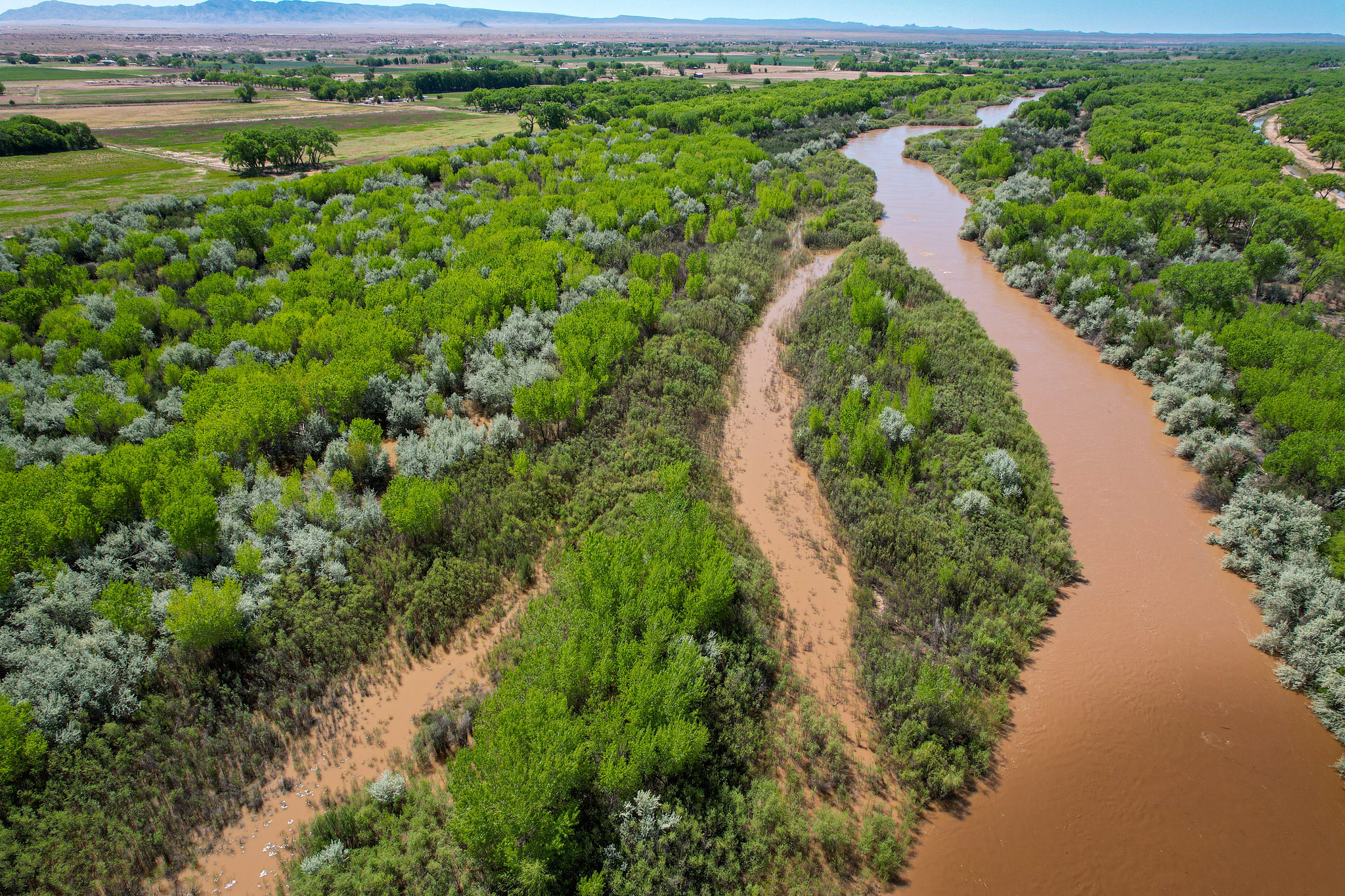
The RGF model builds on flow models developed by the U.S. Army Corps of Engineers, the U.S. Bureau of Reclamation, the N.M. Interstate Stream Commission and others. The existing Upper Rio Grande Water Operations Model (URGWOM) is computationally very complex and requires a long time to run. The RGF model will streamline features of URGWOM for rapid scenario testing in an effort to evaluate alternative water management strategies to provide ecosystem benefits alongside meeting water delivery obligations says Turner.
The project team will design, refine, test, and put the Rio Grande Futures (RGF) environmental flows model into action, which will help evaluate tradeoffs and potential ecological benefits for species and ecosystems under many different future water flow scenarios. Research partners are looking at how surface flows affect groundwater and vice versa, how sediment flows can introduce habitat variation into the river ecosystem that mimics floodplains, and how the Bosque, especially cottonwood trees, respond to different spring and summer flow regimes.
"UNM scientists are using long-term data and experiments to understand the effects of earlier and less snowmelt runoff," Turner said. "That information feeds back into the model to help optimize flows for ecosystem benefits. What makes the model especially powerful is that it connects these changing water patterns to real ecological outcomes. Instead of focusing only on how much water is in the river, the model examines how changes in timing and availability affect habitats, floodplains, and plants and animals. This helps communities understand not just how the river is changing, but what those changes mean for the ecosystem that depends on it."
Tradeoffs and ecological outcomes
The ecosystem includes a variety of species dependent on the Rio Grande including the silvery minnow and cottonwood seedlings. For example, researchers already know the silvery minnow needs a strong spring flow to spawn and rear hatchlings. Similarly, cottonwood seedlings must be flooded to germinate and must have groundwater access to thrive and grow.
"What we don't know," says Turner, "is when, how much and how long do we have to deliver water flows to realize these biological benefits? There is also a connection between the amount of flow in spring and summer, and the extent of river drying in the summer, probably through contributions of ground water. We know that some river sections are more likely to dry than others."
Early insights from existing data suggest that parts of the river system with access to groundwater or occasional floodplain flooding may be better able to withstand future water shortages. "Riparian areas where plants can tap into shallow groundwater, as well as habitats that retain water longer during dry periods, tend to be more resilient when river flows decline or become less predictable," said Turner.
Conservation groups will then work with water managers, Tribes, and local governments to further improve the model and develop a shared process for testing alternative water-delivery strategies in the Rio Grande. The model will help water managers evaluate tradeoffs between ecological outcomes and human water needs including agriculture, municipal supply, and Tribal water rights—without oversimplifying competing priorities.
"The model is a toolbox to simulate different water-management scenarios and their outcomes," said Turner. "For example, the model might indicate a biological benefit to the river by incentivizing farmers to fallow some fields in some years. It might also be better to save stored water to prevent drying, rather than deliver it in spring to mimic a flow pulse under certain scenarios. Scientific partners at UNM are tasked with understanding the biological outcomes of different scenarios to better inform the modeling process."
Coming together
By illustrating the potential outcomes of different decisions, the model will support informed discussions among water users and policymakers. "It does not prescribe a single "right" answer, but instead provides a shared, science-based picture of what different paths forward could mean," Turner said. "This helps communities balance ecosystem health with human needs in a more thoughtful and inclusive way."
As senior water right holders on the Middle Rio Grande, Tribal nations have a large stake in the conservation of riparian wildlife and biota and have already implemented restoration projects depending on water flows. Audubon Southwest and the World Wildlife Fund launched the Rio Grande Basin study and lead a basin-wide working group that unites water managers and conservation partners.
"Perhaps the most important takeaway is that water planning must look forward, not backward. By combining climate science, ecological understanding, and community collaboration, this project provides a model for how regions across the West can prepare for a future where water is increasingly scarce and decisions are increasingly complex."
— Regents' Professor Tom Turner
Additionally, UNM, Tribal nations, NGOs, and state and federal agencies have long collaborated through the Middle Rio Grande Endangered Species Collaborative Program to support species recovery while meeting water delivery requirements. Many of UNM's water researchers are now further connected through the Accelerating Resilience and Innovation in Drylands (ARID) Institute, which fosters collaboration within the university and with external partners. The ultimate goal of the Rio Grande Futures Partnership is to present water management scenarios that optimize benefits to ecosystems while acknowledging constraints of water delivery requirements.
"Perhaps the most important takeaway is that water planning must look forward, not backward," said Turner. "By combining climate science, ecological understanding, and community collaboration, this project provides a model for how regions across the West can prepare for a future where water is increasingly scarce and decisions are increasingly complex.
About the projects
UNM's project is among nine selected late last year and comprise the third year of grants awarded under the PACSP, a joint effort between AFP and the NSF designed to catalyze deep collaboration between researchers advancing basic science and on-the-ground conservation partners. AFP contributed $999,400 and NSF contributed $605,949 to UNM on the project. Each PACSP project addresses critical knowledge and data gaps that enable greater impact for understanding and protecting species and ecosystems. The projects funded as part of this program have far-reaching implications for biodiversity and conservation, policy and the economy.
"This unique partnership fosters valuable collaboration between academic institutions and conservation organizations to address pressing biodiversity challenges," said Lara Littlefield, executive director of Allen Family Philanthropies. "The on-the-ground results of the program's previous grants show great promise as we connect rigorous scientific theory and research with frontline conservation applications."
To learn more, visit Allen Family Philanthropies.


