
In the Altai Mountains of western Mongolia, rock holds the stories of ancient people.
Thousands of images were pecked and engraved into bedrock and boulders, thousands of years ago. Images of hunters and herders, alpine landscapes, yaks, wolves and wild horses. Scenes of conflict and everyday life painstakingly created by individuals who left traces of their lives across the land.
Esther Jacobson-Tepfer tells their stories.
For more than 30 years, the University of Oregon professor has studied prehistoric Mongolian rock art, illuminating the lives of people who lived 3,000 to 12,000 years ago through the imagery they left behind. She is one of the world's leading authorities on the subject.
The sheer volume of research by Jacobson-Tepfer, whose dozen books and 60-plus papers have traveled the globe, hints at her influence.
But to truly appreciate her impact across academia and beyond, consider the opinions of the scholars who build from her work. They describe a researcher whose unique, detail-oriented approach forces archaeologists to rethink assumptions. She is held in special esteem in Mongolia, where her work has helped bring about international protections for cultural sites she has long studied.
"She has made a truly significant contribution to the study, promotion and international recognition of Mongolia's historical and cultural heritage, particularly the natural and cultural heritage of the Mongolian Altai," said Urtnasan Norov, president of Mongolia's Foundation for the Protection of Natural and Cultural Heritage.
Jacobson-Tepfer, the Maude I. Kerns Professor Emerita of Asian art in the College of Design, is trained in art history. But her work reaches beyond the study of art to provide insights into how people lived.
As a doctoral student in Chinese art history at the University of Chicago, Jacobson-Tepfer found herself drawn to the nomadic world of central and northern Asia through its historical intersections with her field. She was fascinated by the artifacts and petroglyphic images of a free-roaming people - especially the focus on women and their mythic roles, mostly invisible in her study of ancient Chinese art.
The more she explored nomadic art, the more she began to see connections between an individual's work and the landscape. She began examining questions outside the realm of art history to better understand this relationship between the artist and the natural world.
Jacobson-Tepfer incorporates various disciplines into her research: archaeology, geography, geology, ethnography, paleoenvironment and history. While archaeologists often seek sweeping findings applicable to an entire ancient society, Jacobson-Tepfer focuses on individuals and what their art says about that society.
"There's no question whatsoever that when it comes to the pictorial record of these areas in Inner Asia, Esther is the preeminent scholar," said William Honeychurch, a professor of anthropology at Yale University. "Among archaeologists who study these areas, she is the go-to person."
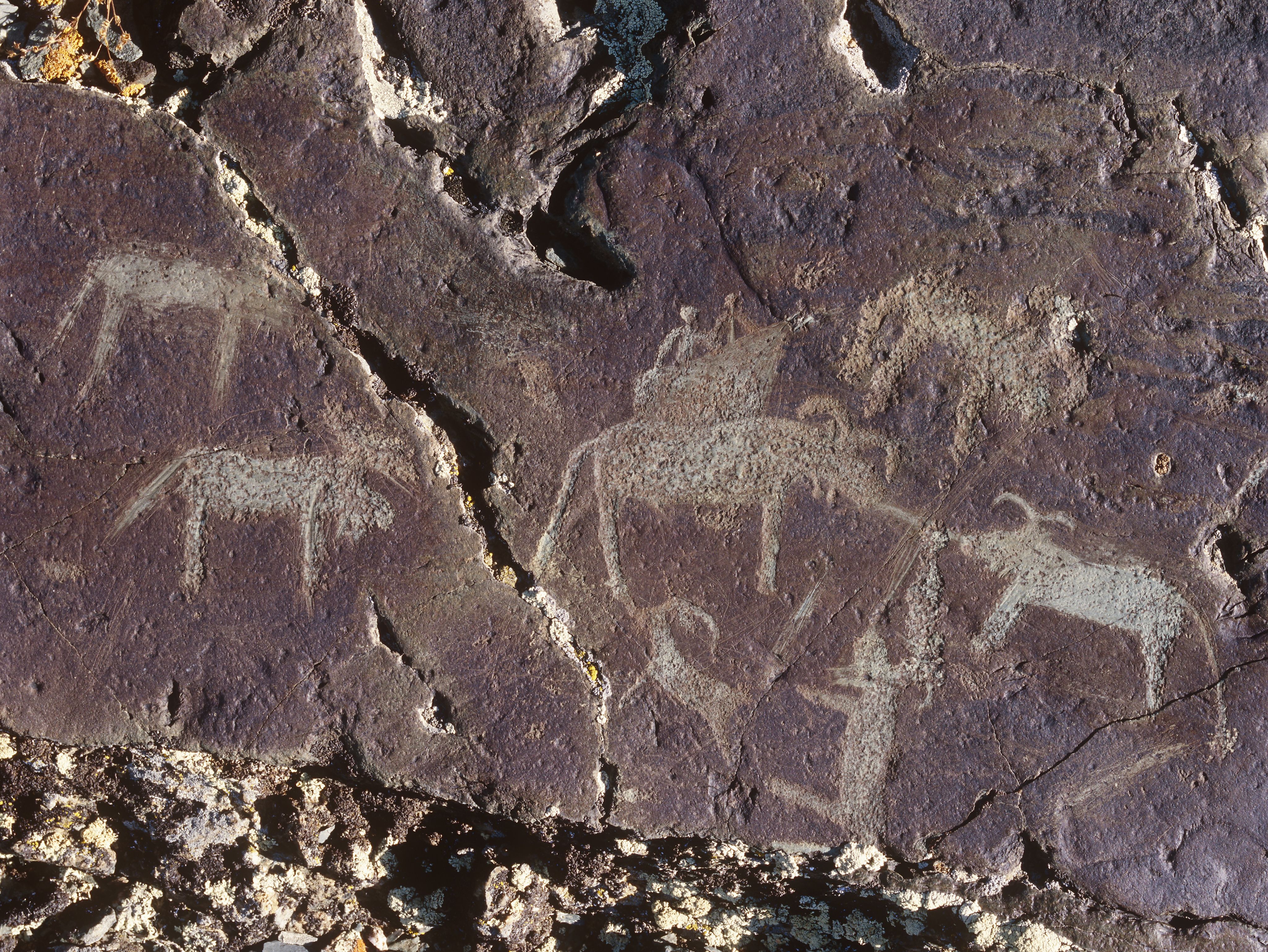
Consider a panel that Jacobson-Tepfer first examined in 1996: an image of children in baskets atop yaks.
The use of yaks to carry family loads indicated to Jacobson-Tepfer a Bronze Age image, made about 3,400 years ago. The coloration of the pecked surface was transitioning from white to brown, a degree of discoloration indicating the end of that period. Most importantly, Jacobson-Tepfer noted the moose on the left - an animal that required a wet, marshy environment, quite different from the dry land required for the movement of yaks.
"His world was disappearing," she said, "and [the nomadic world] was coming."
Honeychurch, a prominent archaeologist working in Mongolia, said Jacobson-Tepfer's multidisciplinary command of the subject can force archaeologists to rethink accepted theories.
"She challenges the normative assumptions that we might make," Honeychurch said. "She's raising alternative possibilities which archaeologists did not appreciate. This is how science works."
A key contribution, according to Honeychurch, is Jacobson-Tepfer's "scalar" approach.
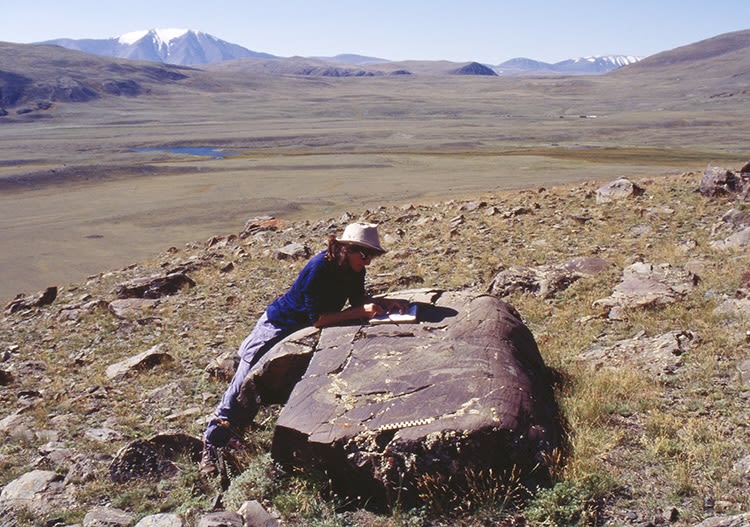
Working with her husband, Gary Tepfer, a professional photographer whose images of rock art support her publications, she examines not just the petroglyph but also the area immediately around it. She considers its viewshed, the local landscape and even the region holding the find - all to better understand, for example, the role of terrain or climate in peoples' movements. Archaeologists can conduct their own research from her work because she exhaustively annotates everything with site-specific maps and databases.
"No one else does that," Honeychurch said.
Jacobson-Tepfer's impact has spilled beyond academia, too. One example that still amuses her: her first book, published in 1993, "The Deer Goddess of Ancient Siberia," explored the symbolism of the stag in the art of Mongolian nomads. It quickly went out of print and years later sold for up to $1,000 on Amazon.
"Apparently every witch and wizard in Britain was interested in the subject," Jacobson-Tepfer said, laughing. "That's what I was told by a woman who wrote to me from England, desperate for a copy."
More telling of her influence is the stature Jacobson-Tepfer holds in Mongolia, particularly for what she has done to advance cultural preservation.
Australian archaeologist Robert Bednarik saw the respect for Jacobson-Tepfer firsthand during a rock art conference in Mongolia years ago. "I witnessed how the Mongolian colleagues focused their attention on her and admired her," he said. "I saw how highly she is valued there."
One Mongolian scholar, Chunag Amartuvshin, an associate professor in the Department of Archaeology, Anthropology and Demography at the National University of Mongolia, relies on Jacobson-Tepfer's landscape surveys and databases for his own work in the protection of cultural sites.
For Amartuvshin, who is training the next generation of Mongolian archaeologists, Jacobson-Tepfer's databases are "gold," he said. "It's what I need to preserve the heritage of Mongolia."
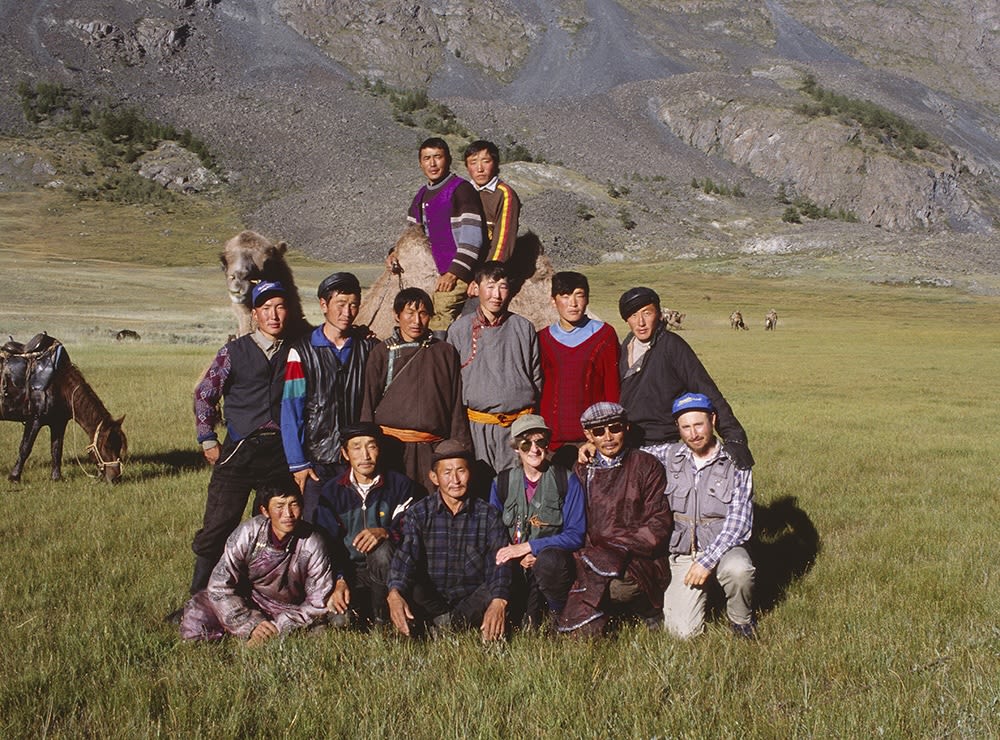
Urtnasan said Jacobson-Tepfer's research was especially significant in preparing the nomination of the petroglyphic complexes of the Altai region to the UNESCO World Heritage List, which identifies and protects properties with "outstanding universal value."
Jacobson-Tepfer drew on her knowledge and expertise to meticulously review and edit the nomination, Urtnasan said. In 2016, in recognition of her contributions to Mongolian cultural heritage, she received a presidential citation and the Kublai Khan Gold Medal, the highest honor offered by the Mongolian Academy of Sciences.
Reflecting on her many trips to the region over the years, Jacobson-Tepfer noted they were often adventurous: sneaking into a politically sensitive area bordering Russia, navigating precarious roads high in the mountains, and clambering across rugged ground in freezing temperatures to study rock art.
But it's the research itself - and its impact - that kept her coming back.
"The experience was wonderful - it's exciting, and everybody should have such an exciting life," Jacobson-Tepfer said. "But for me, the thing that I've been so passionate about is what we discovered and the work I did to share it with others."


