
By Anna Mayor, University Communications and Marketing and USF Health

John Storms with his wife Catherine and youngest son Gregory [Photo courtesy of John Storms]
At first, it was just halos appearing around the lights on the basketball court.
As a teenager, John Storms didn't think the subtle changes in his vision were serious. But glaucoma was slowly damaging his optic nerve - the pathway that carries sight signals to the brain. It's something he's been dealing with for nearly 30 years.
Known as the "silent thief of sight," glaucoma causes pressure to gradually build in the eye. It rarely feels urgent, and like Storms, many patients don't see a doctor until their vision loss has progressed significantly.
As his vision continued to get hazier into adulthood, Storms was prescribed eye drops that he used for the following 10 years. But the drops were not enough. At follow-up visits, his eye pressure continued to rise, and he was told he would need surgery to prevent vision loss.
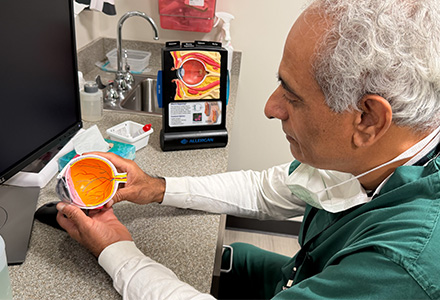
USF Health ophthalmologist Dr. Ramesh S. Ayyala [Photo by Anna Mayor, University Communications and Marketing and USF Health]
USF Health ophthalmologist Dr. Ramesh S. Ayyala saved Storms' vision and relieved the pressure by placing stents in both eyes.
Five years later, Ayyala continues to monitor Storms' condition every three months.
While the surgery preserved Storms' vision, managing glaucoma remains a lifelong process.
Monitoring changes in vision associated with glaucoma requires constant vigilance, with regular appointments and testing that can be time-consuming, costly and difficult for patients to maintain.
"Patients have to come to us for regular testing, using expensive equipment in specialized clinics and many simply don't come often enough," said Ayyala, the James P. and Heather Gills Endowed Chair and chair of the Department of Ophthalmology in the USF Health Morsani College of Medicine.

Patient analyzes the GlaucTest [Photo by Frederick Coleman, USF Health]
That challenge inspired Ayyala and his colleagues at the University of South Florida to rethink how, and where, glaucoma is detected.
He is leading a study of GlaucTest, an investigational AI-powered app that allows patients to perform visual field testing at home using their own smartphone, a low-cost virtual reality headset and a handheld clicker.
Currently in the research stage, Ayyala's goal is to replicate the gold-standard Humphrey Visual Field Analyzer found in clinics. Ayyala hopes the technology could transform the test that typically costs $30,000 in equipment into an at-home experience for about $42. After the patient performs the five-minute test per eye, results are securely uploaded for their ophthalmologist's review.

Traditional glaucoma exams are conducted using the Humphrey Visual Field Analyzer [Photo by Frederick Coleman, USF Health]
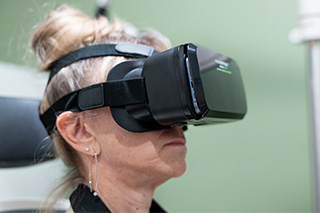
The patent-pending GlaucTest is designed for at-home use [Photo by Frederick Coleman, USF Health]

Paired with a virtual reality headset, the AI-powered app runs on the patient's smartphone [Photo by Frederick Coleman, USF Health]
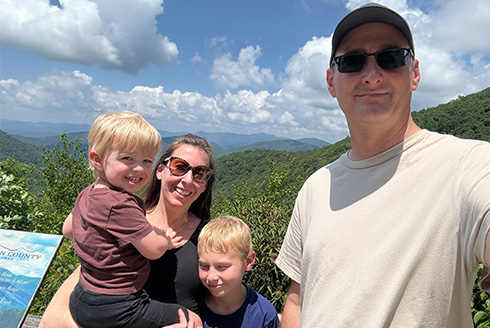
The Storms family [Photo courtesy of John Storms]
"We want to use technology to move to a place where physicians monitor patients remotely while they test themselves at home," Ayyala explained. "The goal is to give the power to the patient, the best way to manage chronic diseases like glaucoma."
For Storms, the technology represents more than convenience. It helps ease the uncertainty that comes with living with glaucoma.
"With a product like Dr. Ayyala's I could test much more frequently - every month, or even every couple of weeks - and see if anything has changed. With traditional testing once a year, a lot can happen in that time," Storms said.
"I'm very grateful to be able to work with Dr. Ayyala and his team at USF to trial GlaucTest and provide feedback. It has given me a feeling of having more control over my glaucoma and I'm hopeful it can help others very soon."
John Storms
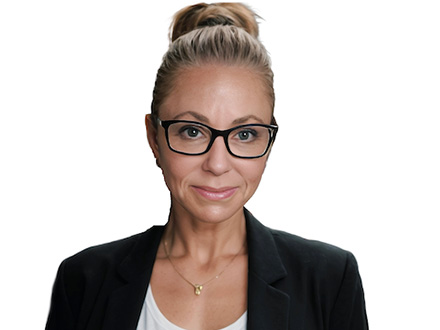
Diana Shapiro, executive in residence for USF Ventures
To help bring the technology to patients, Ayyala founded GlaucHome to license the patent-pending technology and advance GlaucTest toward commercialization. Developed at USF, GlaucTest is advancing through a new Technology Transfer Office initiative, the USF Ventures Launch Program, which moves USF's most promising inventions out of the lab and into companies best positioned to commercialize.
"Disruptive research shouldn't die on a lab bench," said Diana Shapiro, executive-in-residence for USF Research, Innovation and Commercialization and acting CEO for GlaucHome under the USF Ventures Launch Program. "Working with the commercialization triage team, we're deliberately selective, every technology has to clear our proprietary IP Commercial Assessment before it advances. GlaucTest cleared that bar, and GlaucHome is the company built to carry it forward."
For millions worldwide, GlaucTest could mean the difference between early detection and irreversible vision loss, a long-term goal Ayyala hopes to achieve upon completion of the research and regulatory review.
"This is a first step in the right direction, delivering technology to patients everywhere and making it possible for them to keep their vision," he said.


