
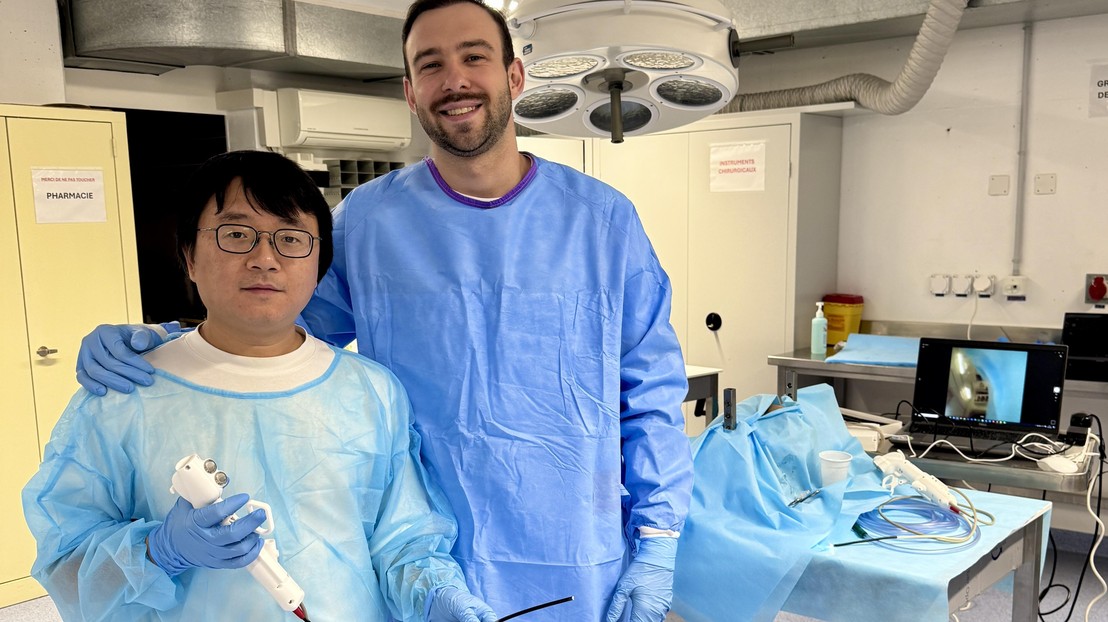
Yi Sun, CTO, and Yegor Piskarev, CEO of the start-up © Dexterous Endoscopes
Thanks to next-generation endoscope technology developed at EPFL, surgeons can navigate hard-to-reach areas of the human body with extreme precision, enabling new minimally invasive procedures.
Minimally invasive surgery is now standard practice for a range of conditions, and it's made possible by the use of endoscopes - long, thin tubes equipped with a tiny camera. Surgeons guide these instruments through narrow, winding parts of the body to diagnose and treat various pathologies. Nearly 190 million patients worldwide undergo this type of procedure every year. However, current endoscopes force a trade-off: rigid instruments provide the precision and force needed to dissect tissue, while flexible ones can reach difficult areas but lack stability, control, and the ability to apply sufficient force on tissue. As a result, surgeons are forced to convert minimally invasive procedures into open surgeries when they cannot both reach the target and perform effective treatment, particularly in procedures such as ENT (ear, nose and throat) sinus surgeries, where access is highly constrained. This leads to more severe interventions for patients and higher costs and longer procedures for hospitals.
To overcome this unmet clinical need, EPFL spin-off Dexterous Endoscopes has developed a new generation of variable-stiffness endoscopes that can switch from soft to rigid in a fraction of a second, combining reach with precise, stable intervention.
A mechanical approach to instant stiffness control
At EPFL, engineers have been exploring technologies for potential applications in surgical instruments. These include soft robotics approaches such as smart polymers and advanced metal alloys that change stiffness under thermal stimulation, as well as systems using thousands of fibers or granules embedded in a soft external substrate that can switch between soft and rigid states under vacuum. Building on this work, Dexterous Endoscopes developed a new approach based on a mechanically segmented architecture.
Their endoscope is designed to combine two normally opposing properties in a single instrument: high flexibility to navigate complex anatomy and high rigidity to apply force with precision once in position. It achieves this through a series of interconnected segments that move freely during navigation and can be rapidly compressed to lock together, transforming the device into a stable, force-transmitting structure. "This approach allows practitioners to effectively reach and treat multiple targets during a single procedure, thereby addressing a major challenge in ENT, urological, and gastrointestinal procedures, where it is necessary to operate in confined and hard-to-reach areas," explains Yegor Piskarev, CEO of Dexterous Endoscopes. "Some types of variable-stiffness endoscopes allow for a temporary increase in shaft stiffness to facilitate the insertion and positioning of instruments, but they do not allow the shape to be locked and do not offer the level of control needed to perform procedures with high precision."
The team has already performed preclinical trials with surgeons in conditions closely replicating real surgical procedures at hospitals in Lausanne, Munich and London. And the surgeons' feedback has helped the engineers refine the device to better meet clinical needs. "In our field, it's essential to work closely with surgeons before design freeze to ensure the device meets their needs and fits clinical practice, as making changes after that stage becomes very costly," says Yegor Piskarev, CEO of Dexterous Endoscopes, spin off of EPFL's Laboratory of Intelligent Systems.
A number of experts in Switzerland's startup ecosystem have taken an interest in the novel technology. Dexterous Endoscopes has just received CHF 100,000 in funding under the third and final stage of Venture Kick, and last year the team joined the St. Gallen's HSG Start Accelerator, where it was chosen as the only startup to receive investment out of over 130 startups. The accelerator program gave Piskarev the opportunity to work closely with experienced startup and investment experts over several months, rigorously challenging and refining the company's business case, financial plan, and overall positioning to prepare for investor discussions.
The team at Dexterous Endoscopes initially planned to develop technology for heart catheters, but that would've been a tough market to penetrate. "The go-to-market process is very costly with many regulatory hoops to jump through," says Piskarev. "And these medical procedures are often carried out with the help of specialized medical robots, which limits the size of the market." After speaking with hundreds of surgeons to get a better feel for the market, the engineers decided to pivot to variable-stiffness endoscopes for procedures in the ENT, the urinary tract, and GI. These are larger markets with a similar unmet clinical need but fewer hurdles to overcome.
Dexterous Endoscopes now plans to obtain regulatory clearances in the US and Switzerland to bring its device to clinical use in these markets. To achieve this, the company is raising a funding round this year to accelerate product development and certification.


