
Over the past two months, student teams from around the world have been working on a difficult question: how do you design a future for a landscape that is slowly disappearing?
The Mississippi River Delta is losing land at an alarming rate. Rising seas, subsidence, and decades of human intervention have reshaped the region and continue to do so. Now, with the Top 20 teams selected in the Nature-based Future Challenge, their ideas are starting to take clearer shape. In just a few days, on April 28th, 10 of them will move on to the finals. While their proposals are still evolving, clear patterns are already emerging.
A landscape in motion
One of the most striking shifts is how teams are approaching the delta itself. Rather than treating flooding, biodiversity loss, and land subsidence as separate problems, many now see the region as a connected, living system shaped by the movement of water and sediment, and by the communities that depend on it.
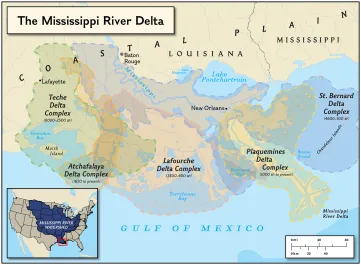
National Geographic
Source: https://education.nationalgeographic.org/resource/miss-delta-formation
"The strongest projects framed the delta as a living system with dynamic processes that must be understood and respected," says Eric Harris. This perspective shifts the focus from resisting change to working with it, allowing teams to design strategies that operate across scales, from coastlines to cities.
Working with nature on different terms
While teams share a nature-based approach, their interpretations differ. Some proposals take a long-term, transformative perspective. Team Reboot, for example, explores what it would mean to allow the Mississippi River to follow its natural course, gradually shifting development towards areas where new land is forming.
"Instead of trying to resist nature, we use it as a teacher, guiding us towards where we need to go"
- Yarnick Zoetekouw, Reboot
- TOP 20 Team in the Nature-based Future Challenge
This approach reflects a broader willingness among teams to think beyond short-term fixes and consider how large-scale change could be anticipated and guided.
At the same time, other teams focus on strengthening what already exists. Studio Bayou, one of the few teams based in Louisiana, combines wetlands, oyster reefs, and urban green infrastructure to protect communities in place. Their connection to the region shapes their perspective.
"We grew up here, we live here, so we have a higher stake in it. We want people to feel safe and not have to worry about losing everything after the next hurricane"
- Studio Bayou
- TOP 20 Team in the Nature-based Future Challenge
For them, resilience is not only environmental, but also social. "Without the community, there is no project. These are our communities, so their input and involvement are essential to making any solution work," says Studio Bayou.
Not one solution, but many layers
Across the Top 20, resilience is rarely framed as a single intervention. Instead, teams are designing layered approaches in which different nature-based solutions reinforce one another. Coastal ecosystems such as wetlands and barrier islands reduce wave energy and storm surge, while inland strategies, such as green infrastructure and water storage, help manage flooding and improve everyday living conditions.
These interventions often serve multiple purposes at once, linking environmental restoration with economic opportunities, public health, and long-term resilience. "The teams demonstrated a strong understanding of nature-based solutions and explored creative ways to apply them to complex challenges," says Gregory Grandy.
Moving from big ideas to specific fixes
As the challenge progresses, teams are moving from broad ideas towards more focused proposals, zooming in on specific locations and interventions. This shift is helping them identify where their ideas can have the most meaningful impact.
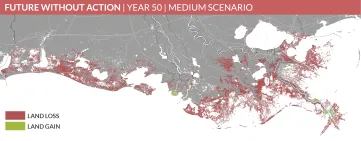
Coastal Protection and Restoration Authority
Source: https://coastal.la.gov/whats-at-stake/a-changing-landscape/
"We started with very broad ideas across the whole delta, but the challenge is helping us really narrow down and focus on where we can have the most impact," says Studio Bayou.
At the same time, several teams are confronting difficult realities. Not all land can be preserved, and adaptation may be necessary in some areas. Proposals like Reboot's reflect this shift, exploring how communities could adapt to change while maintaining cultural and social continuity.
What happens next
In the coming phase, teams will further develop their ideas into more detailed designs, showing how different interventions could work together over time.
"The next phase is about translating ideas into spatial designs, showing how these solutions can actually shape the future of the delta," says Harris.
In just a few days, 10 teams will move forward to the finals. What is already clear, however, is that there is no single solution for the Mississippi River Delta. The most promising approaches are those that are adaptive, layered, and grounded in both natural systems and the people who depend on them.


