
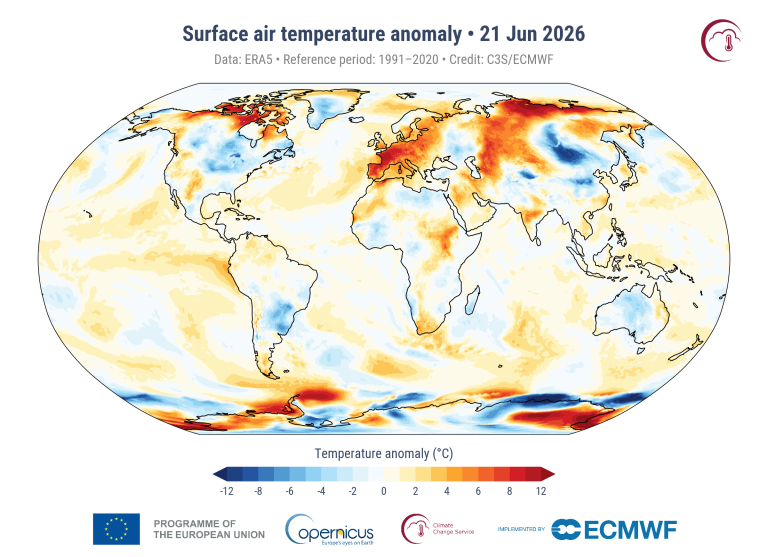
WMO, its members and partners are mobilizing with coordinated heat-health action plans against a strong late-June heatwave, which is impacting millions of people in Europe, with knock-on impacts on economic activities, infrastructure, agriculture and ecosystems.
The extreme heat - which is expected to occur with increasing frequency and intensity as a result of climate change - set the backdrop for a special address by UN Secretary-General António Guterres at London Climate Week .
"We have just lived through the eleven hottest years ever recorded. Climate disasters are becoming more frequent, more destructive, and more costly. And the World Meteorological Organization has warned we ain't seen nothing yet. El Niño is not just knocking on the door. It risks blowing the house down. Turning up the heat. Disrupting food and water systems. And hitting the vulnerable the hardest," Mr Guterres said.
WMO's El Niño Update issued at the start of June forecast that a rapidly developing El Niño will affect weather and climate patterns in the coming months. Impacts are typically greater in other parts of the world than Europe.
WMO is one of ten specialized United Nations entities supporting the United Nations Secretary-General's Call to Action on Extreme Heat . The initiative seeks to strengthen international cooperation and reduce heat impacts through improved science, early warning systems, public awareness and coordinated action.
Heatwave forecast to spread
The heatwave, which initially mainly affected Spain and France (driving temperatures above 40 °C, will spread over large parts of Western, Central, and Southern Europe within the next two weeks, according to one of WMO's regional European climate monitoring centres, which is led by Germany's national weather service, the Deutsche Wetterdienst (DWD). According to current forecasts, the focus of the heat is likely to shift more towards the Balkans, it said.
The regional climate monitoring centre, which is part of WMO's Regional Association VI (Europe) Regional Climate Centre Network, provides regularly updated Climate Watch guidance information for National Meteorological and Hydrological Services who are responsible for issuing advisories and warnings in their own territories.
The affected countries are: Portugal, Spain, France, Belgium, Luxembourg, Netherlands, southern United Kingdom, Germany, Switzerland, Austria, Italy, Czechia, Slovakia, Hungary, Slovenia, Croatia, Bosnia and Herzegovina, Serbia, Montenegro, Albania, North Macedonia, Greece, Bulgaria, Romania.
In southern Spain, temperatures were forecast to reach 44°C in some regions in Cordoba, according to the Agencia Estatal de Meteorologia, AEMET .
Meteo-France issued a top-level red alert for 54 departments - especially in the western part of the country - on 23 June, with daytime temperatures topping 40°C and high overnight temperatures.
Meteo-Swiss also issued a top-level red alert for large parts of the country, including its cities of Zurich and Geneva.
The UK's Met Office issued a red extreme heat warning for 24-25 June, with temperatures expected to climb to at least 39°C and with a chance of this being exceeded in places. It forecast that June's all-time daily record temperature of 35.6°C would be broken.
The Climate Watch issued by WMO's regional climate monitoring centre at DWD forecast that temperatures would be between 3 °Celsius and 10 °C above the weekly average for this time of year. Absolute daily maximum temperatures above 35 °C and daily minima above 20 °C (tropical nights) are expected in many parts on several days, towards the southwest locally above 40 °C. There will be an increased risk of heat stress and forest fires, but also locally strong thunderstorms with hail, it said.
A "tropical night" is a term widely adopted in some regions such as Europe and parts of Asia. It can be defined as a night where the temperature does not drop below 20°C (68°F). During heatwaves, these become increasingly common, particularly in cities.
Night time is when the body is supposed to recover. When we sleep, our core temperature drops, our cardiovascular system rests, and the cumulative stress of a hot day begins to ease. When nights stay warm, that recovery does not happen. The body remains under strain around the clock, explains Armel Castellan, Extreme Heat Services Technical Advisor of the WMO-WHO (World Health Organization) Climate and Health Joint Office.
"This is why, when assessing the health impact of a heatwave, minimum temperatures can be more telling than the peak afternoon high. A day that reaches 38°C but drops to 18°C overnight is very different from a day that reaches 36°C and stays above 25°C through the night. The second scenario carries a much higher health risk," he says.
WMO Response
In preparation of an increase in frequency, intensity and duration of extreme heat events in Europe, WMO is stepping up action.
Through the Early Warnings for All initiative , WMO and its Members are working to ensure that people at risk receive timely warnings and information on protective actions before dangerous heat occurs.
WMO and the World Health Organization (WHO) have jointly developed guidance on extreme heat and heat-health early warning systems. These systems and tools support Heat Action Plans and strengthen frameworks for extreme heat governance , helping governments, health authorities and communities prepare for and respond to extreme heat events. The WHO-WMO Climate and Health Joint Programme works to ensure that climate, weather and environmental information is accessible, timely and actionable for public health decision-making.
Through the Global Heat Health Information Network (GHHIN), WMO and other UN Partners are leading efforts to strengthen governance for extreme heat by providing national authorities and local governments with the technical guidance and concrete tools needed to prepare for and respond to this growing risk.
Heat stress occurs when the body gains more heat than it can release. Under normal conditions, the body manages its temperature through sweating and increased blood flow to the skin. But when the surrounding air is hot -especially when it is also humid- these cooling mechanisms struggle to keep up, and core body temperature begins to rise.
"Prolonged exposure over several days, particularly when temperatures remain high at night, means the body enters each new day already stressed. Older adults, young children, pregnant women, outdoor workers and people unhoused or living with chronic illness are among those most at risk, but heat stress can affect anyone when temperatures are extreme enough for long enough," says Lachlan McIver, Health Advisor, WHO-WMO Climate and Health Joint Office
IClimateAction
People living in cities are especially vulnerable because of what is known as the urban heat-island effect. Temperatures can be several degrees higher than in rural areas because of fewer green spaces and cooling winds and with heat-absorbing concrete and asphalt. Most urban authorities still lack either the climate information they need or the means to turn it into decisions that protect people.
Many tools already exist to help cities deal with extreme heat, from heat-risk maps and health impact models to planning and investment tools. The challenge today is no longer creating new tools, but understanding which ones work best in different contexts and how they can be adapted and scaled from one city to another.
That challenge was the focus of a two-day workshop held in April at WMO, convened under the European Union-funded iClimateAction project .
It brought together WMO, the Global Climate Observing System (GCOS) and the Group on Earth Observations (GEO) alongside climate scientists, public-health experts, satellite agencies, urban planners and private-sector technology providers - a deliberately broad mix, reflecting how many actors already work on urban heat.
The workshop took a first step towards identifying what is needed to build a future Global Heat Resilience Service. The goal is to help cities around the world access practical, reliable information and choose the most suitable solutions for their specific needs.


