
Members of the McCarthy team at EMBL Grenoble talk about BSxCuBE-Web, a web-based interface to automate BioSAXS experiments, and how the ARISE programme contributed to this project
EMBL is a home for interdisciplinarity, where colleagues from different backgrounds work together to push the frontiers of science and technology. This collaborative environment enables, among other things, method development to improve EMBL's scientific services to the community and has led to the ARISE Fellowship programme for technology innovation in the life sciences.
The McCarthy team at EMBL Grenoble has recently developed a web application called BSxCuBE-Web (for BioSAXS Customized Beamline Environment) to facilitate Biological small-angle X-ray scattering (BioSAXS) experiments and data collection. Described in the Journal of Synchrotron Radiation , this interface was designed for the BioSAXS beamline (BM29) at the European Synchrotron Radiation Facility (ESRF), jointly operated by EMBL and the ESRF as part of the Joint Structural Biology and BioImaging Group (JSBG).
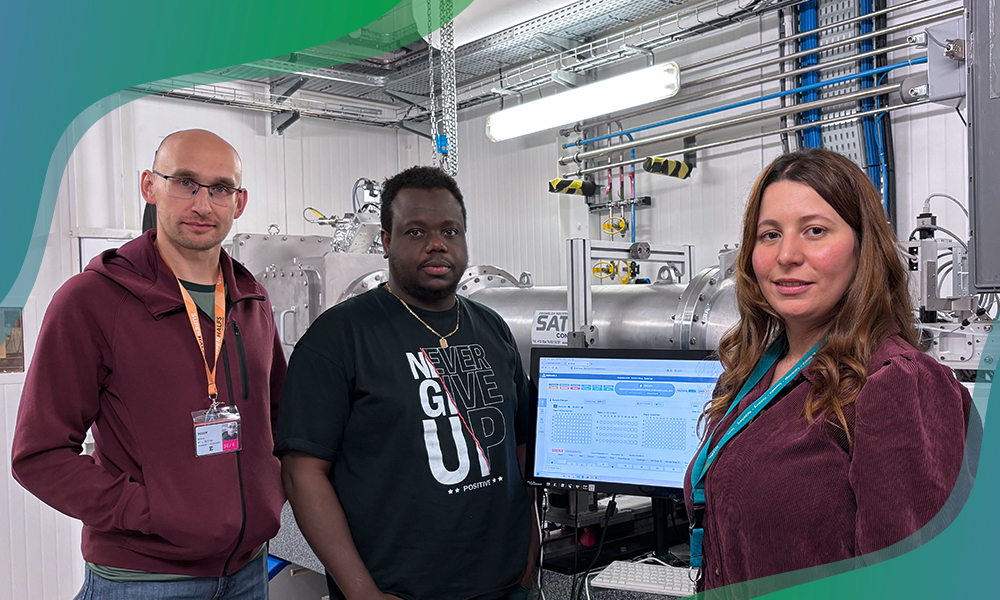
Jean Baptiste Florial, a full-stack software engineer who was formerly part of the McCarthy team, led the development of this web interface in collaboration with EMBL and ESRF colleagues. He worked alongside Anton Popov and Dihia Moussaoui, ARISE fellows in the team with backgrounds in engineering and biophysics, respectively. We talked to them about the new interface and the ARISE programme.
What is BioSAXS?
BioSAXS lets scientists determine the shape and dynamics of proteins and other biomolecules using X-rays. BioSAXS is very versatile - it can be used for samples in almost any form, e.g. solution state or soft condensed matter. It allows studying how molecules change their structure under different conditions and how they interact with each other.
What are the key features of BSxCuBE-Web?
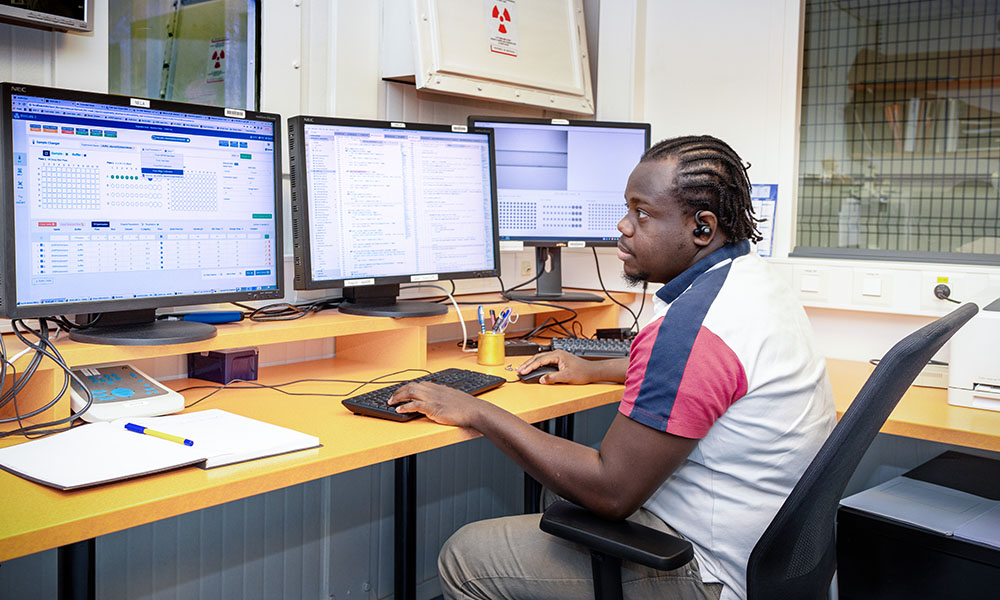
Jean Baptiste Florial: BSxCuBE-Web is a web-based application designed to simplify and automate Bio-SAXS experiments, making them usable by both experts and non-experts. They can set up and run automated high-throughput experiments using a queue system, which is really important for beamline efficiency. Users can also control all beamline parameters and sample conditions (e.g. energy, exposure time, or temperature), as well as more advanced workflows (such as spatial scans, microfluidics, and time-resolved experiments), from a single interface.
Another key feature is real-time monitoring - users can visualise their data as it's being collected, which helps them quickly assess data quality and adjust experiments. On top of that, the software integrates automated data analysis pipelines, so users get immediate feedback after data collection.
What were the main challenges that you faced in this project?
Jean Baptiste Florial: The main challenge was bridging complex beamline hardware with a simple and reliable web interface. That involves making sure everything stays synchronised in real time while keeping the system stable. We also had to deal with performance and scalability, especially since we're handling large data streams directly in the browser. Designing a robust queue system for unattended experiments was another key challenge, because it has to handle errors properly and keep running safely over long sessions.
Can you tell us more about how the ARISE programme contributed to this project?
Anton Popov: Dihia and I started our ARISE fellowships at EMBL Grenoble in spring 2024 to conduct projects at the BM29 beamline, but before this, we were actually both ESRF postdoctoral fellows working at the BM29 beamline, when Jean-Baptiste was developing this web interface! We then naturally continued collaborating on BSxCuBE-Web.
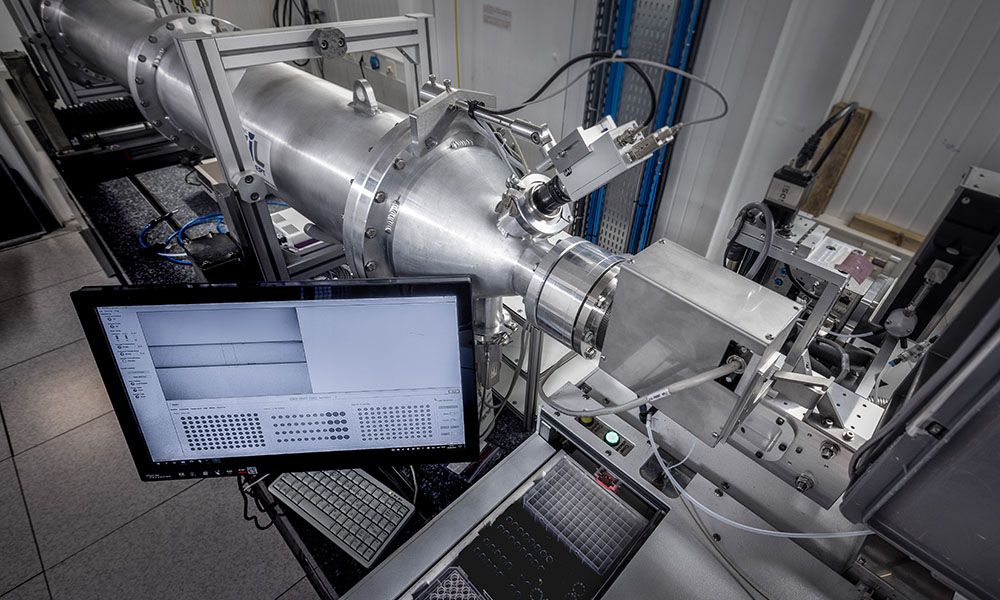
My ARISE project is to design, produce, and implement microfluidic devices and tools to use with the new vacuum sample environment (sample exposure unit) installed on the BioSAXS beamline. In simple terms, it's a vacuum chamber, a sort of 'free room', which allows users to conduct new types of experiments that you couldn't do with a classical beamline environment. With these microfluidic devices and sample environments, users can, for example, conduct different types of mixing experiments and time-resolved studies. They can observe liquid-liquid phase separation and run more viscous samples, like gels and nanoparticles, in the liquid phase. We've ensured that BSxCuBE-Web is compatible with all parts of this experimental setup.
Dihia Moussaoui: I collaborated with Jean-Baptiste by testing the interface, collecting data from my own ARISE project, and giving feedback to improve the software's functionality. I find this new software really intuitive!
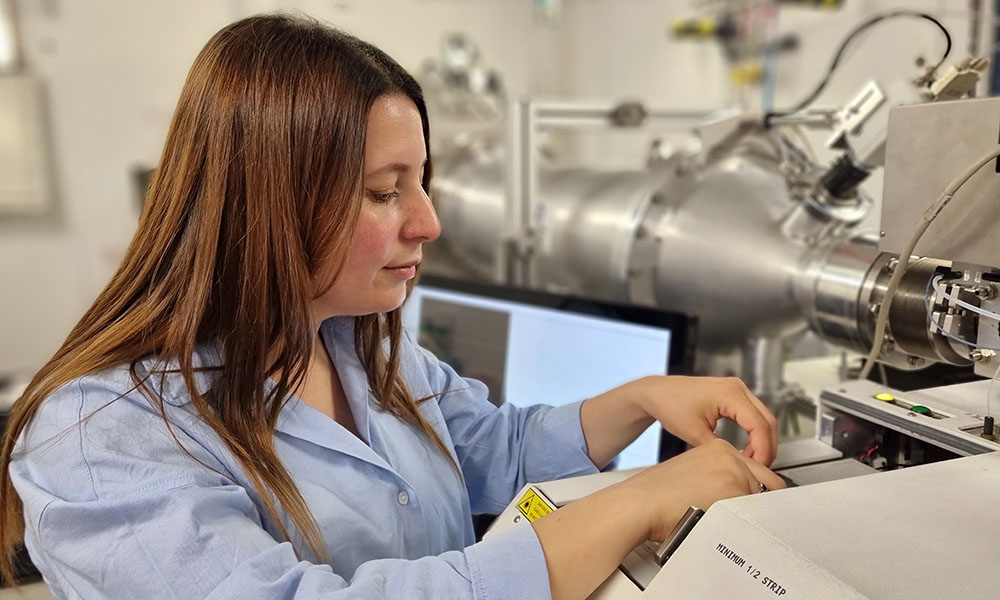
My project focuses on the development of X-ray footprinting coupled with mass spectrometry (XF-MS). It's a high-resolution technique that could complement BioSAXS and other methods in structural biology, so it was interesting to test the setup I am developing using BSxCUBE-Web. XF-MS aims to study molecular interactions and dynamics by irradiating samples with X-rays without damaging them. This irradiation creates hydroxyl radicals, powerful oxidants that interact with some parts of the molecule (typically protein side chains or nucleic acid backbones). Then, with mass spectrometry, it is possible to identify the macromolecule regions that are exposed to the solvent, as well as those involved in interactions or conformational changes. This technique is already well established in the United States, but less so in Europe.
What do you enjoy most in the ARISE programme?
Dihia Moussaoui: I really value having access to a collaborative environment on campus, as well as several tools and resources we need to conduct our projects and analyse our data. The ARISE programme also gives us opportunities to expand our professional network and receive feedback from research infrastructure managers during the ARISE management training, learning from their experience. It also includes secondments in academia and industry, which allow us to gain experience in both environments.
Anton Popov: I totally agree with Dihia. Thanks to the ARISE programme, we get access to interdisciplinary science by connecting with many people with different opinions or knowledge on workflows, not only at EMBL but also across the whole EPN campus. The possibility of gaining experience both within EMBL sites and in the industrial sector is a great opportunity, as it would be more challenging without EMBL's support.
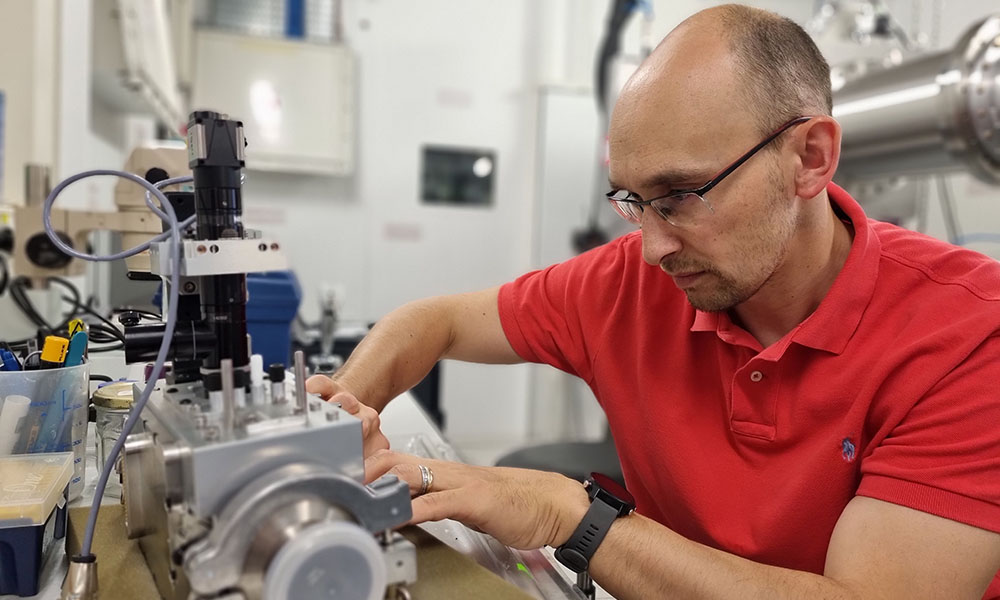
How did the collaboration between ARISE fellows and engineers shape this project?
Jean Baptiste Florial: It's always good to collaborate with scientists to really understand what they need. We wanted to build a general application framework useful for scientists and for other synchrotrons doing BioSAXS experiments. The feedback is that BSxCuBE-Web is user-friendly, so I think we have reached our objective!
This project has received funding from the European Union's Horizon 2020 research and innovation program under the Marie Skłodowska-Curie grant agreement No. 945405.


