
Wageningen University & Research (WUR) has strengthened its collaboration with Egypt through a new partnership with the Agricultural Research Centre (ARC). The agreement was formalised with the signing of a Memorandum of Understanding (MoU) at the Netherlands-Egypt Agricultural Partnership Summit in Cairo.
The conference, organised by the Dutch Embassy in Cairo, was part of a broader economic mission led by Minister Sjoerd Sjoerdsma (Foreign Trade and Development Cooperation) and brought together governments, knowledge institutions and businesses from both countries. The aim was to deepen collaboration on climate-resilient agriculture, water use, food security and innovation.
The partnership underscored the importance of long-term international collaboration. By combining knowledge with local expertise, solutions can be better tailored to challenges such as water scarcity, soil salinisation and food security.
Building on 50 years of collaboration
The agreement built on the longstanding relationship between the Netherlands and Egypt, in which WUR has played a role for fifty years. What began with research into irrigation and drainage has grown into a broad systems-based approach to water and food systems.
This approach is highly relevant in Egypt, where agriculture accounts for more than 80% of water use and is heavily dependent on the Nile. Effective water management therefore requires an integrated approach in which agriculture, water, economics and policy converge.
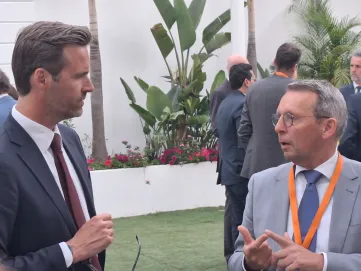
André van Lammeren in conversation with Sjoerd Sjoerdsma (Minister for Foreign Trade and Development Cooperation).
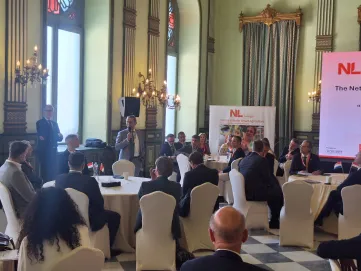
André van Lammeren giving his presentation to the room full of guests.
From collaboration to a shared agenda
Prior to the signing, a WUR delegation, led by André van Lammeren, worked with Egyptian partners to define the scope of the collaboration. During a workshop with ARC researchers, the foundation was laid for shared priorities.
These outcomes were presented at the conference and form the basis for a joint work plan that will be further developed in the coming months.
The Wageningen approach as a foundation
Van Lammeren emphasised the strength of the Wageningen approach: combining fundamental and applied research within a single organisation, in collaboration with governments, businesses and civil society organisations - the so-called 'diamond approach'.
"By connecting fundamental and applied research and linking it directly to practice here in Egypt, we can develop solutions together with our partners that work in the local context," said André van Lammeren.
This way of working makes it possible to translate knowledge into applications more rapidly. The collaboration aligns with themes in which WUR is active globally, such as climate-resilient agriculture, biodiversity and sustainable food systems.
A focus on real-world impact
During the summit, WUR contributed to sessions on topics including water management, biodiversity, plant breeding and food systems. Opportunities were also explored for how research can better connect to the needs of Egyptian businesses.
The Cairo summit thus provided space for knowledge exchange and for strengthening ties between science, policy and practice.


