
AI can help farmers, growers and researchers make better decisions. Yet its potential in agriculture is still only partly used. In the project AgriScienceFM, Wageningen University & Research and European partners are developing foundation models that combine data more effectively and make agricultural AI more reliable for practical applications, research and policy.
Smart soil and water management, autonomous harvesting robots, disease and pest control: AI is already visible in agriculture. Yet its large-scale application is challenging. According to Ioannis Athanasiadis, Chair of AI at WUR, there are several reasons for this. "Agricultural systems are, by their very nature, highly diverse. You are dealing with diversity in crops, soils, climatic conditions and available tools. As a result, the AI solutions that exist are often one-off solutions or work only under specific conditions."
Athanasiadis also highlights the multidisciplinary nature of agriculture. "What is unique and at the same time challenging about agriculture is that it involves an interaction between humans, nature and biology. This means you have to connect knowledge and information from different fields, such as water and soil systems, genomics, the environment and climate, and diseases and pests. Currently, models are built and data collected separately within each discipline. As a result, the complete picture required for AI that operates under a variety of agricultural conditions is often still missing."
Foundation models for agriculture
According to Athanasiadis, foundation models (FM) are needed to overcome this fragmentation: basic models capable of combining large amounts of data from various sources. Within the AgriScienceFM project - launched in June - researchers will work on three interrelated foundation models centred on the core elements of agricultural systems: biological material, such as plants and animals; the natural environment, such as soil, water and climate; and human activity, such as management and cropping choices.
Athanasiadis: "These models form the basis for tools that enable farmers to make well-informed decisions in all kinds of circumstances, using combined datasets. This delivers benefits not only for farmers themselves, but also for nature and society, such as sustainable and more efficient food production, a healthier environment and better climate adaptation."
European project
AgriScienceFM is a Horizon Europe project for AI in agricultural sciences. The project is part of the European commitment to make greater use of AI in scientific fields as well. WUR is coordinating the project. According to Athanasiadis, WUR has both extensive domain knowledge and expertise in the field of AI. "That combination makes us unique in the world. At the same time, there are many other institutions with valuable expertise. That is why joining forces in a consortium. We are collaborating with universities and institutes from Greece, Germany, Spain, the UK and Belgium, among others."
Strategic autonomy
Liesbeth Luijendijk, who is involved in the integration of Robotics & AI into the agri-food sector through WUR, cites another reason why this European cooperation is important: our strategic autonomy. "Given the geopolitical developments, Europe needs to be as independent as possible from major powers such as China and the US. This is especially important for technologies used in food production. It is therefore essential that we develop knowledge and technology for AI in agriculture within Europe." According to her, AgriScienceFM demonstrates that the European Commission recognises this and sees the importance of strong European cooperation on this important theme.
It is also important for the Netherlands to position itself in this field, Luijendijk continues. "In the national investment and innovation agenda Food 2040, in which we at WUR are involved, we have agreed that the Netherlands wants to remain a frontrunner when it comes to high-tech and sustainable food production. If we want to achieve this, we really need to invest in AI. We cannot afford to rely solely on domain expertise and leave the AI aspect to other parties or countries. We must ensure that we have both in-house."
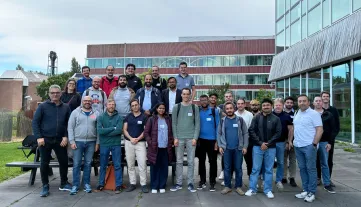
Members of the AgriScienceFM consortium during the project kick-off meeting in Wageningen (photo: WUR).
From satellite imagery to soil advice
In the first half of the three-year project, the researchers will compile and harmonise existing public datasets: from satellite imagery and weather data to field measurements, livestock farm data, crop data and genetic material. The models will be tested in practical applications, such as satellite monitoring of crops and water scarcity, local soil advice for farmers, faster breeding of resilient crops, and precision agriculture relating to diseases, pests and animal health.
AgriScienceFM therefore focuses not only on new AI models, but also on how well those models perform in the face of real agricultural challenges. To this end, the consortium is also developing so-called benchmarks: tests that enable researchers to assess whether a model delivers usable results in the field. Athanasiadis: "AI only truly delivers value if the results are reliable across different regions, cropping systems and real-world situations."
Bridge between AI and agricultural research
With AgriScienceFM, Athanasiadis hopes not only to develop useful foundation models, but also to build a bridge between AI and agricultural scientists. "Many scientists are now aware of the importance of AI, but still lack sufficient knowledge. That is why there is also an educational aspect to the project. Through AgriScienceFM, we provide a platform where we can develop a shared understanding of why agri-food challenges and AI are inextricably linked, and how developments in AI can offer solutions to existing problems."


