
The UConn Collaboratory on School and Child Health celebrates 10 years
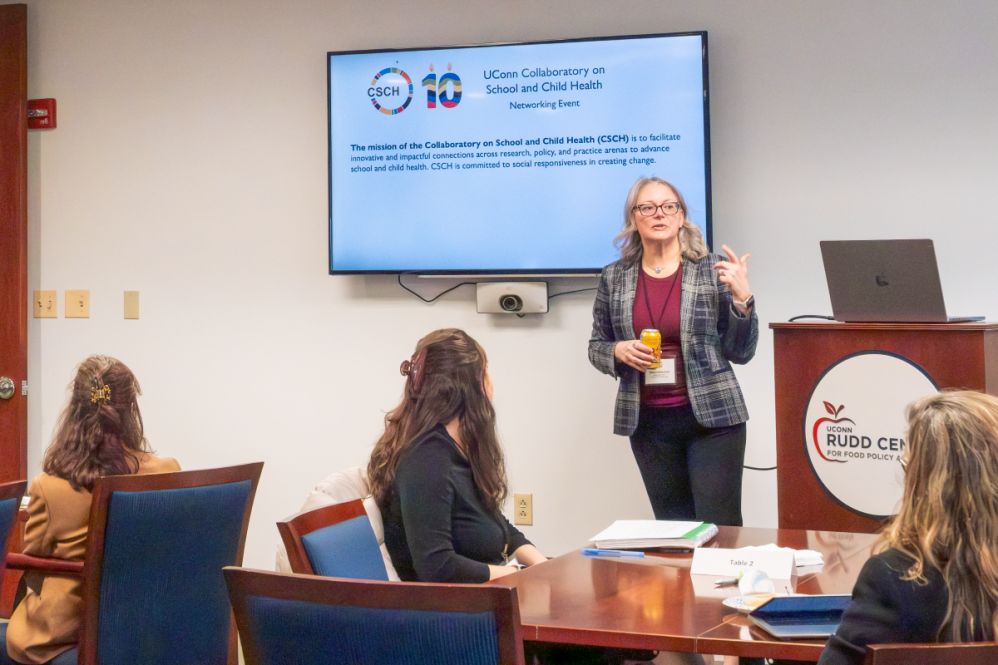
Sandra Chafouleas, Board of Trustees Distinguished Professor and Neag Endowed Professor in the Department of Educational Psychology speaks at the networking event in Hartford. (Photo courtesy of Danielle Faipler)
The UConn Collaboratory on School and Child Health (CSCH) marks its 10th anniversary this year and kicked off the celebrations with an affiliate event in Hartford on March 31.
CSCH was formed in 2016 by a multi-disciplinary steering committee made up of UConn faculty and community members. The subsequent inclusion of hundreds of affiliates has resulted in substantive collaborations, initiatives, tools, and publications that focus on championing whole child success.
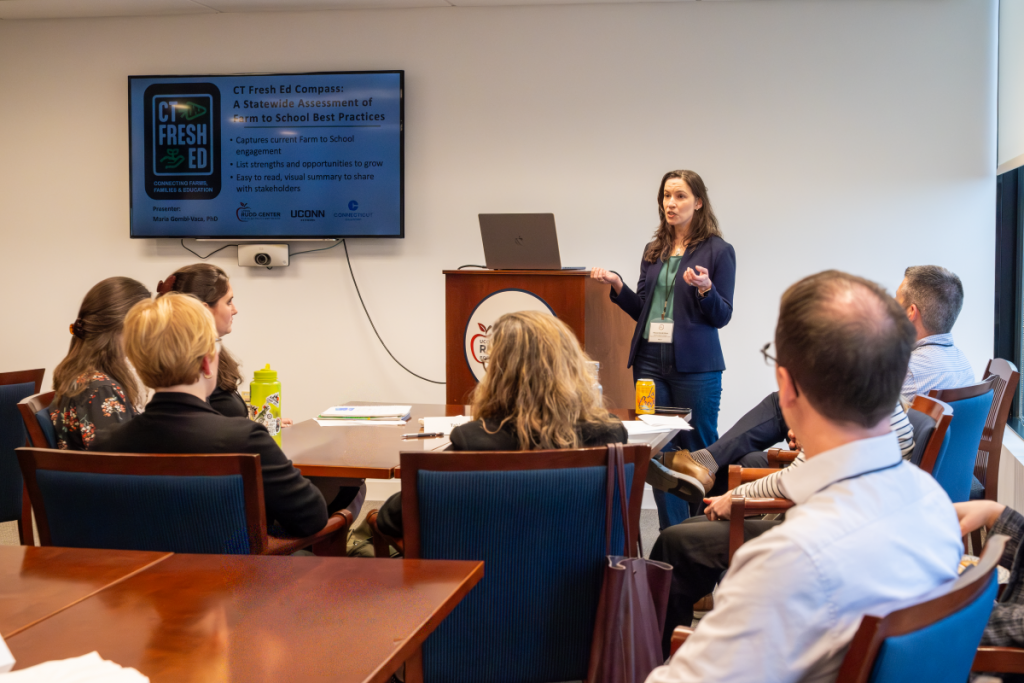
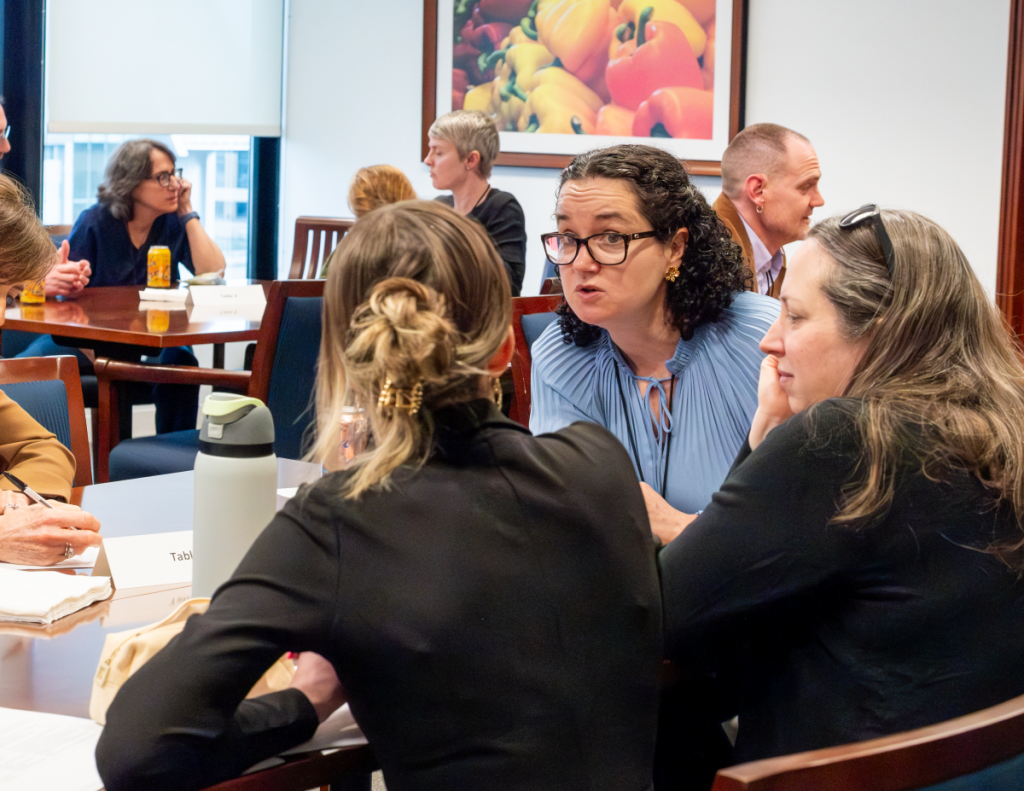
The 2026 CSCH Affiliate Networking Event was the third of its kind during which affiliates come to connect with colleagues and listen to "flash talks," five-minute presentations about topics involving a wide range of school and child health issues.
"The event is a wonderful opportunity to reconnect with CSCH colleagues year after year, to hear how projects have progressed, brainstorm creative collaborative opportunities, and celebrate a truly multi-disciplinary approach to improving outcomes for children and adolescents in our communities," says Ravit Stein, Director of Consultation & Professional Learning at EASTCONN Regional Education Service Center, and CSCH steering committee member.
Over 300 individuals have been CSCH affiliates at some point over the decade. CSCH currently has over 200 affiliates who represent 7 UConn schools, 25 departments, as well as several UConn Centers, outside universities, and community organizations. Three steering committee members are from community groups. Over the years, CSCH has published briefs, reports, tip sheets, videos, podcast episodes, and tools that have collectively been downloaded and distributed thousands of times. A large part of its focus has been helping affiliates publish research briefs in plain language for public consumption.
In the mid-2010s, Carol Polifroni, Professor Emeritus in UConn's School of Nursing, and then Director of the Office of Community Engagement, and Sandra Chafouleas, Board of Trustees Distinguished Professor and Neag Endowed Professor in the Department of Educational Psychology didn't know each other well.
We realized that we were asking the same fundamental questions about what kids and communities need to thrive. The more we talked, the more we questioned whether those differences were a barrier or were actually the point. That's really where CSCH began.
"Carol and I kept finding ourselves in the same rooms" says Chafouleas. "Although she brought background in nursing and community engagement and I was coming from school psychology and education, we realized that we were asking the same fundamental questions about what kids and communities need to thrive. The more we talked, the more we questioned whether those differences were a barrier or were actually the point. That's really where CSCH began."
Both inspired by the 2014 Whole School, Whole Community, Whole Child (WSCC) Model, which prioritizes the necessity of collaboration across education and health sectors to accomplish child well-being, and by a Provost competition for the development of new interdisciplinary initiatives, Polifroni and Chafouleas began meeting to discuss how to bring researchers from different disciplines and community partners together to focus on school and child health.
"I had a grant at Hartford Public High School and knew there were significant health needs for the students. Health was more than the absence of illness, and I reached out to Sandy, knowing of her work through our connections. We brainstormed what was possible, bringing her skills and mine together," says Polifroni.
Chafouleas and Polifroni first convened faculty and community partners in late 2015 to form a steering committee and to give the group a name. In February 2016, through a partnership between the UConn Neag School of Education and the UConn School of Nursing, CSCH became an entity with logistical operations under the UConn's Institute for Collaboration on Health, Intervention, and Policy (InCHIP); developed the CSCH mission; and began inviting other researchers to join as affiliates.
Later that year, CSCH received a three-year grant from the UConn Provost Office to enhance research and education initiatives. The grant helped CSCH gain its footing and enabled it to host two "Encore" Conferences and to distribute seed grants to six interdisciplinary teams. These grants resulted in collaborations that led to both the development of the WellSAT WSCC, a school policy evaluation tool, and the Total Teacher Health Project.
"CSCH pilot funding made the Total Teacher Health project possible," says Alicia Dugan, CSCH Affiliate and Assistant Professor of Occupational and Environmental Medicine at UConn Health. "That early investment enabled us to demonstrate the feasibility and impact of our participatory approach to reducing teacher stress, paving the way for our current five-year grant and expansion into six elementary schools across two Connecticut districts."
CSCH has spawned several other partnerships formed through affiliate connections. After the development of the WellSAT WSCC, for example, Chafouleas and UConn Rudd Center Director and CSCH Steering Committee member Marlene Schwartz continued to collaborate to support schools in creating or expanding whole child initiatives. This partnership eventually led to the formation of the Connecticut WSCC Partnership, which received CDC funding in 2023 to support the implementation of whole child initiatives across the state of Connecticut.
Another focal area for the work of CSCH has been work in emotional well-being. A collaboration between CSCH, the M3EWB project, and UConn Student Health and Wellness resulted in the development of the UConn pop-up course Feeling Well: The Science and Practice of Emotional Well-Being, which was later turned into a free online learning series.
Perhaps CSCH's best-known partnership, Feel Your Best Self, with the Ballard Institute and Museum of Puppetry, grew out of a popular CSCH report about simple emotion-focused coping strategies. The initial collaboration that started in 2021 has continued to grow exponentially, with estimated reach of over 4,000 caregivers and 250,000 youth with profiles in national media and as part of the UConn Out of the Blue campaign.
CSCH partnerships with community-based organizations also resulted in three CSCH-sponsored Trauma-Informed School Mental Health Symposiums at UConn, and the development of the Plan4Children website, which lays out the state's plan for creating a behavioral health system in Connecticut. "We've been a longstanding partner of CSCH, particularly though collaborative efforts in the school mental health area," says Jeana Bracey, Associate Vice President of School and Community Initiatives at the Child Health and Development Institute and a CSCH steering committee member. "We have continued to build on that work as a foundation for advancing evidence-based multi-tiered systems, schools, and communities that center student well-being."
"It's remarkable to reflect on the reach of CSCH through new collaborations, research briefs, and practical tools," says Jessica Koslouski, Assistant Research Professor in Educational Psychology in the UConn Neag School of Education and CSCH Co-Director. "Time and again, school personnel tell us how practical the information is to their day-to-day work. Supporting the whole child requires a multi-faceted approach and the range of expertise and tools cultivated within CSCH is invaluable in moving the work forward."


