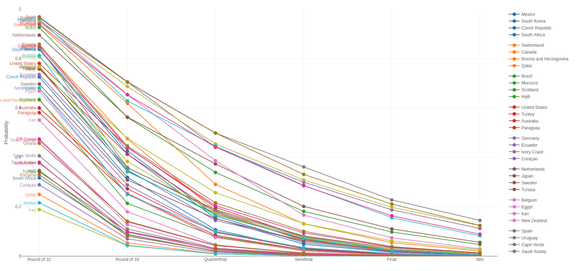
An international team, including researchers from the University of Innsbruck and TU Dortmund University, has once again produced a data-driven prediction for the World Cup. According to the statistical analysis, Spain is the top favorite with a 14.5 % probability, followed closely by England and France, both with 12.4 %, and Germany with 11.2 %.
Ahead of major soccer tournaments, a research team led by Achim Zeileis of the University of Innsbruck and Andreas Groll of TU Dortmund University calculates the chances of winning for all participating teams . For the 2026 World Cup in Canada, Mexico, and the United States, their model identifies Spain as the slight favorite with 14.5 %. Closely behind are England (12.4%), France (12.4%), and Germany (11.2%). Somewhat further back are Portugal (8.9%) and Argentina (8.2%), as well as the Netherlands (5.6%) and Brazil (4.7%). "Compared to previous tournaments, this year's title race is very tight," confirms Achim Zeileis.
A large amount of data and a comprehensive model
The forecast is based on a broad range of data: the teams' performance in past international matches, bookmaker odds for the upcoming tournament, player ratings from club and international matches, and the average market value of the squads. This information is combined with all other available data using a machine learning algorithm. In the process, the research team faced two major challenges: "On the one hand, we had to compile all this data, some of which is only available very shortly before the tournament. For example, we've only known the final rosters of all 48 teams for a few days," explains Achim Zeileis from the Department of Statistics .
The challenge was also to combine statistical expertise and machine learning in such a way that a robust model of the tournament could be built. "We then used this model to simulate the entire World Cup 100,000 times: game by game, following the tournament draw and all FIFA rules," adds Rouven Michels from Andreas Groll's team at TU Dortmund University. Michels is currently a visiting researcher at the University of Innsbruck, where he also teaches a course on "Soccer Analytics". Researchers from the Technical University of Munich and Molde University College in Norway also participated in the study.
Probabilities, not certainties
In the team's predictions so far, the top favorite has actually gone on to win the title on several occasions-for example, at the 2010 World Cup, Euro 2012, and the 2019 Women's World Cup. For Groll, however, that is not the decisive factor: "The probability that the top favorite will actually win the tournament is usually no more than 20 percent, which conversely also means that some other team wins with a probability of 80 percent. As a statistician, I'm therefore more interested in whether, on average, many of the teams we predict to go far will actually do so."
Innsbruck-based statistician Achim Zeileis is an avid fan himself and is really looking forward to the World Cup. "That's what drives me personally. But professionally, something else excites me: a tournament like this is a wonderful opportunity to spark an interest in probability among a huge number of people who would otherwise not come into contact with it."