
New evidence dragged from the nation's sewers by the Australian Bureau of Statistics has revealed decades of sustained health campaigning to reduce smoking rates have been thwarted.
Commencing in the 1980s, Australian authorities have successively banned smoking indoors, mandated plain packaging and graphic health warnings, imposed advertising restrictions and strict age limits, and legislated one of the highest tobacco excise rates in the world.
But data released by the ABS last Wednesday found after years of slow declines, nicotine consumption increased by almost 40 per cent between 2017 and 2025.
The population grew 14 per cent in that time, while tobacco taxes surged by a third – around $22 per packet - thanks to hefty annual excise increases.
The sudden uptick in smoking is despite household spending on legal tobacco falling dramatically over the same period. As the legal industry declined, the ABS analysis points out "estimated prices of illicit tobacco products have remained relatively constant."
Illicit nicotine products – including cigarettes, vapes, and loose-leaf tobacco – have moved from a tiny sliver of the market to comprising 80 per cent of consumption in Australia in 2025, up from 12 per cent in 2017.
Calculating the full extent of this black-market tar hasn't been easy.
The experimental estimates are based on "nicotine metabolite concentrations" detected in wastewater samples, combined with data showing household spending on legal cigarettes and vapes dropped back to 2016 levels after peaking at the end of 2020.
Under-the-counter cigarettes, imported in vast quantities from Asia and the Middle East, retail for $11 to $25 a pack, while legal brands cost $45 to $65 on average.
Lighthouse asked Macquarie University respiratory medicine experts Brian Oliver and Matthew Peters what the difference is between ingredients found in a legal packet like Marlboro or Winfield versus illegal imports like Double Happiness and Manchester.
"In the absolute best-case scenario, counterfeit cigarettes are tobacco and nothing else," says Professor Oliver, Head of the Respiratory Cellular and Molecular Biology Group at the Woolcock Institute . "But to be clear, when you smoke an illegally imported tailor-made, what you're actually doing is playing Russian Roulette.
"Unlike big tobacco companies — which, despite their history, have strict quality control and can be held accountable — illegal producers have none."
The China National Tobacco Corporation strictly regulates legal tobacco production in China, meaning many illegal imports bought by Australians are "more likely to be grown illegally in areas of industrial wasteland," Prof. Oliver says. "This may expose smokers to heavy metals such as lead and arsenic."
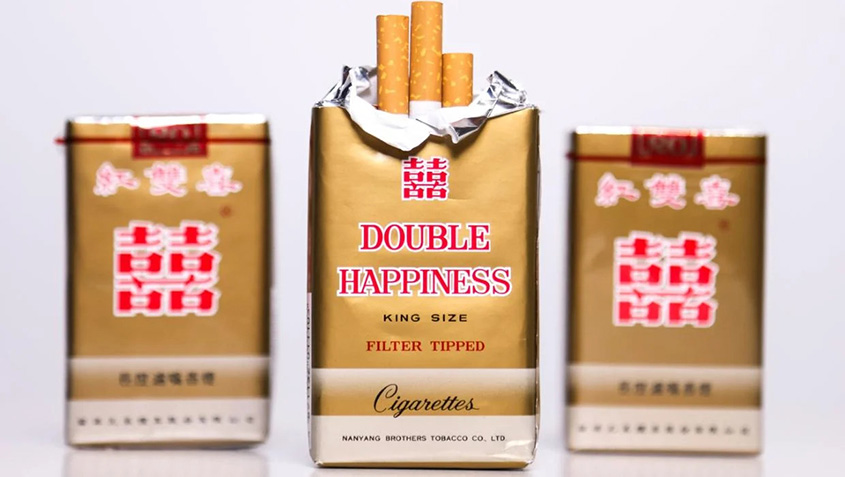 Double Happiness cigarettes, made in China, are distinctive as they lack the drab plain packaging mandated by Australian law. Photo: Jonathan Killick/The Post.
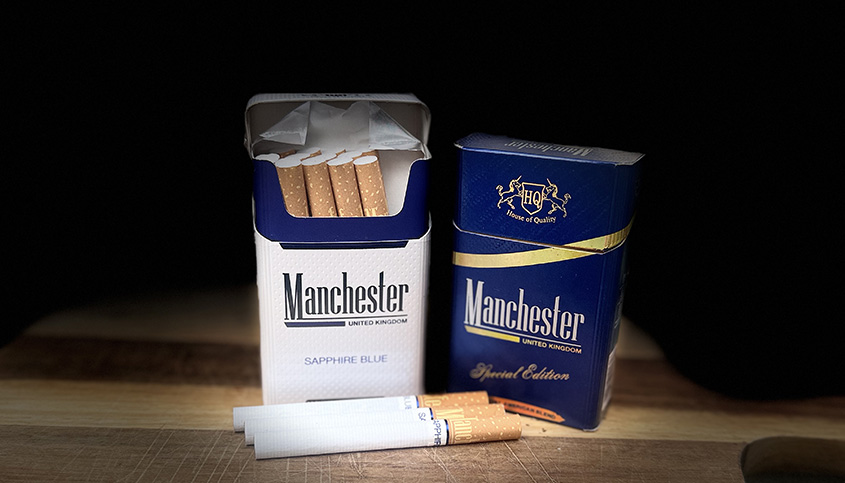 Manchester is a cigarette brand manufactured in the UAE and Europe. In Australia, however, they are classified as an illicit "white market" product because they do not comply with plain packaging laws. Photo: Mikaela Wilkes.
Exposed to air pollution, toxins from industrial smog and vehicle emissions settle into the soil and ultimately into the tobacco itself. Illicit tobacco is often dried improperly and left in fields or sheds without safeguards. This leads to fungal contamination that can trigger respiratory infections and long-term lung disease.
"The great irony is we're seeing more young people take up cigarettes now because they've been unable to quit vapes," Prof. Oliver says. "They 're heavily addicted to nicotine and don't like the taste of smoking. My patients tell me they think it'll be easier to quit with smokes, which are also cheaper. What we would've seen in Australia, if you could only buy legal cigarettes, is people opting out because of the price."
What's more, researchers like Prof. Oliver have no reliable way of determining what's in them.
"We could analyse a packet of illegal cigarettes to find the exact chemical composition, but the problem with any illicit product is, we could not say with any degree of certainty that the next packet, batch, or brand, would be the same," he says.
"If I was going to be a bit nefarious, literally all I'd need to do is collect any old leaf and add nicotine as a raw chemical. There is a very real chance that what you're smoking isn't even from a tobacco plant."
He says cigarettes made from the wrong plant species can introduce new and unstudied risks.
This uncertainty has immeasurable consequences for public health. "Both illegal vape and cigarette products are going to be a nightmare for the epidemiologists," Prof. Oliver says.
"We know, for instance, that vapes cause a totally different profile of diseases to cigarettes. Children who vape are much more likely to get bone fractures. We could see an upsurge in breast cancer, and that wouldn't necessarily point to smoking, so this is where it becomes very difficult from a health perspective. There are signals there, but we can't connect what they're signalling to.
"My best educated guess is the risks involved with smoking illegal cigarettes are somewhere between two and ten-fold."
Matthew Peters, Professor of Respiratory Medicine at Macquarie Medical School, says a bigger concern is that Australian smoking rates are rebounding — with a new generation of smokers developing deadly habits.
"Every cigarette and vaping product is toxic," he warns. "The emergence of illicit tobacco is countering so many of the effective strategies Australia has used to reduce smoking, which include price, plain packaging, and aversive pack warnings.
"Whatever negative views you might hold about Big Tobacco, they have reputational pressures to ensure that the limited number of banned constituents are not on their Australian products.
"There is no control over what's in illicit tobacco. Absolutely none. We don't know what's in it, we don't know if it's any worse, but I think legal cigarettes are bad enough."


