Key Takeaways
- Berkeley Lab scientists have developed Digital Twin for Chemical Science (DTCS), an AI-powered platform that could compress discovery timelines from months to minutes, enabling researchers to observe chemical reactions, adjust experimental parameters, and validate hypotheses simultaneously during a single experiment.
- DTCS creates a digital replica of ambient-pressure X-ray photoelectron spectroscopy (APXPS) techniques, allowing a real-time analysis of chemical compounds formed on the surface of an operating device such as a battery.
- DTCS provides rapid feedback during experiments, helping researchers make data-driven decisions about what to measure next. The advance could transform chemistry research across energy storage, catalysis, and materials science applications.
Understanding what complex chemical measurements reveal about materials and reactions can take weeks or months of analysis. But now, an AI-powered platform developed by researchers at the Department of Energy's Lawrence Berkeley National Laboratory (Berkeley Lab) could reduce this interpretation cycle to minutes, enabling much faster insight into chemical processes relevant to energy storage, catalysis, and manufacturing.
The new platform, called "Digital Twin for Chemical Science" (DTCS), allows researchers to observe chemical reactions, adjust experimental parameters, and validate hypotheses simultaneously during a single experiment. Traditional approaches require researchers to first develop a hypothesis, and then design an experiment to collect data and develop theoretical models to analyze that data before they can finally conduct follow-up experiments to validate the model.
"A common challenge that many researchers face during complex experiments is that although we have sophisticated tools that collect data, interpreting that data is another beast," said Jin Qian, a computational chemist and staff scientist in Berkeley Lab's Chemical Sciences Division who designed the DTCS platform. "Traditionally, we collect as much data as possible, then run simulations to analyze it offline. This back-and-forth process often takes months before theory and experiment reach consensus. DTCS could help overcome this bottleneck."
The advance is a significant step toward autonomous chemical characterization, where AI-guided experiments could accelerate the timeline for discovering and characterizing new materials and chemical processes for useful applications.
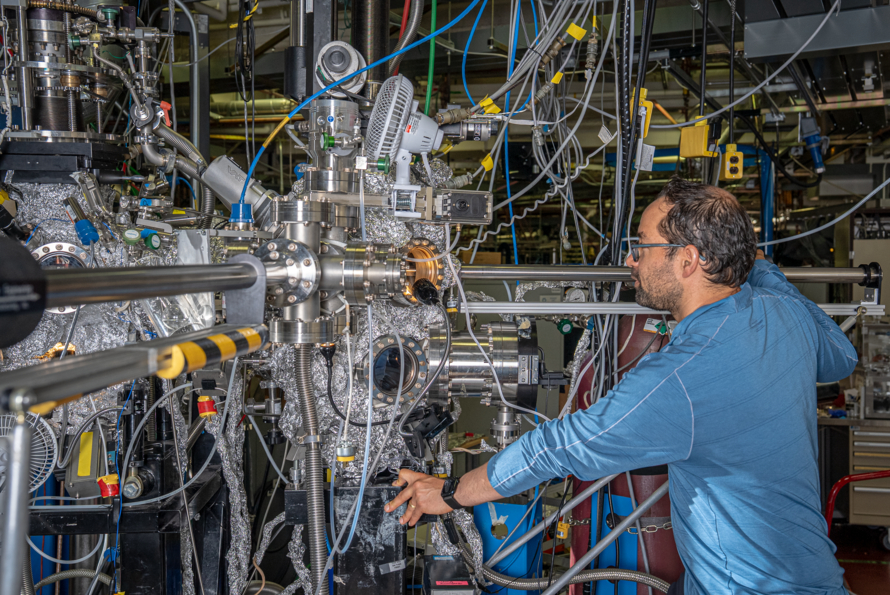
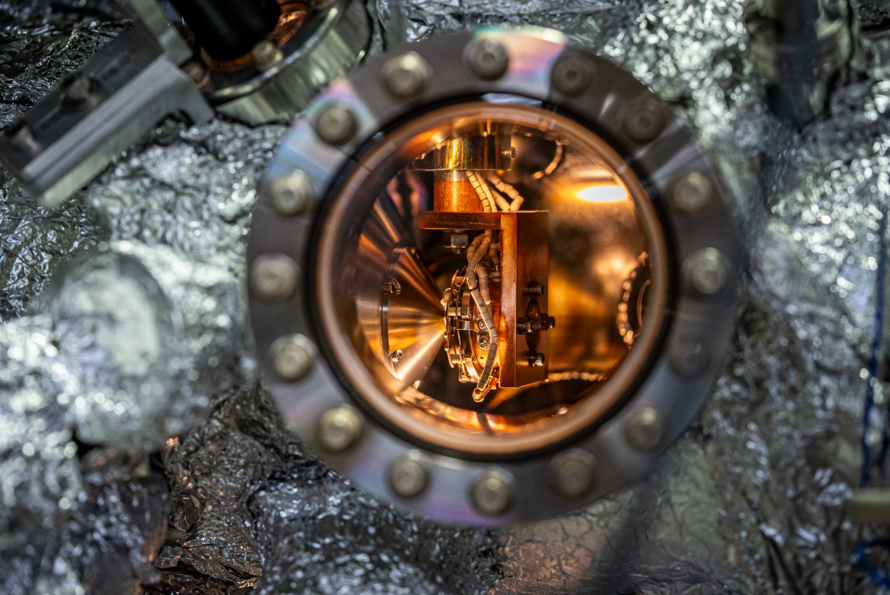
"The Digital Twin for Chemical Science platform represents a new capability for Berkeley Lab's Advanced Light Source (ALS) and DOE's scientific user facilities," said Ethan Crumlin, a staff scientist at the ALS and program lead specializing in interface chemistry and characterization. "The idea of partnering with a computational, machine-learning construct will be the future for how science is done."
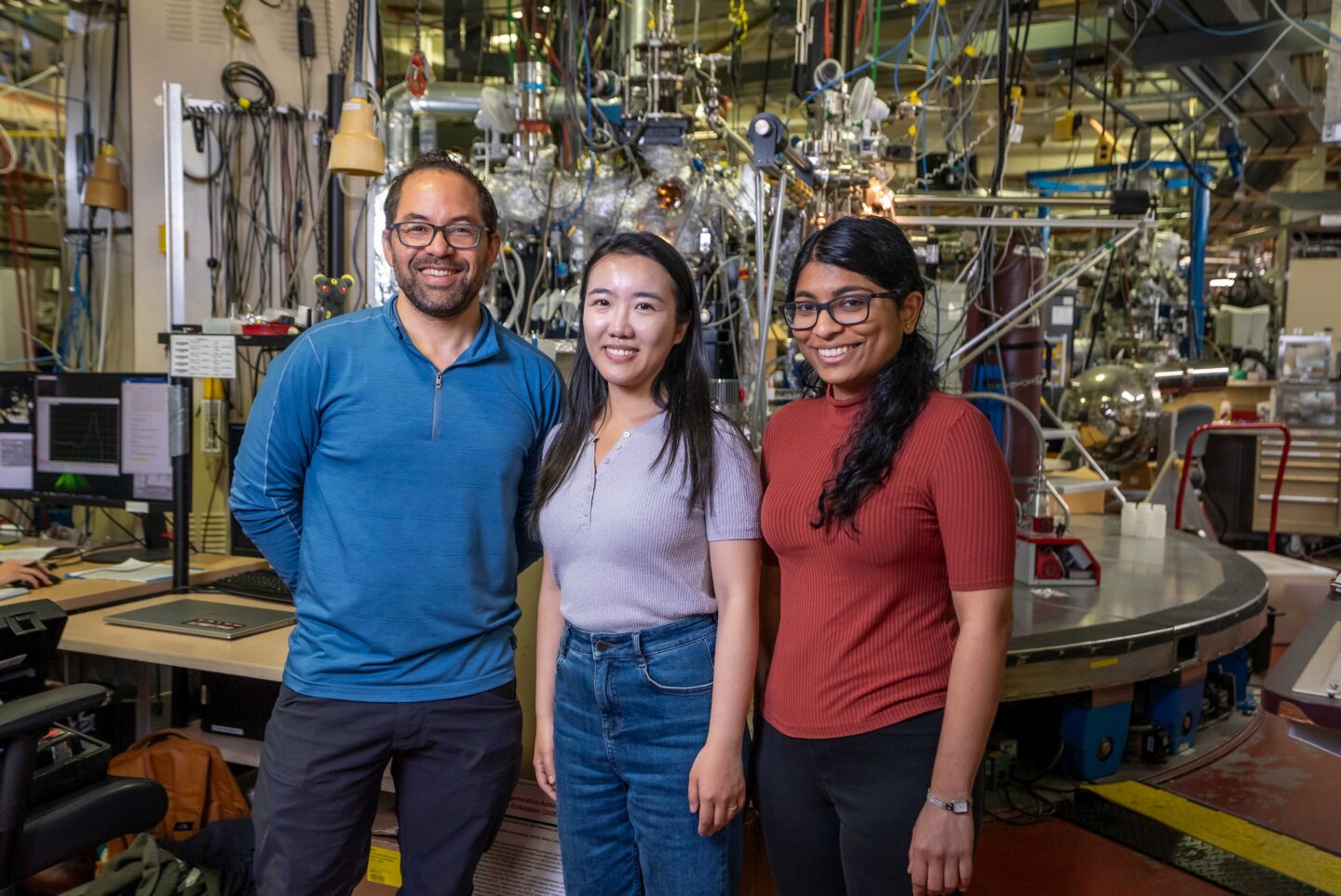
Crumlin and Qian are co-lead authors of a study and research briefing on DTCS published in the journal Nature Computational Science.
Digital twins for the win
Chemistry is entering a new digital era, from automated synthesis labs to voice-activated quantum calculations, Qian explained. And yet chemical characterization - which guides everything from material design to performance optimization - has been left behind. The DTCS platform is changing this by enabling chemical insight with digital twins.
Broadly defined, digital twins are virtual replicas that use real-time data from physical systems to model a complex system's performance and predict future behavior.
While digital twins have been used for decades in aerospace, healthcare, and manufacturing, DTCS is one of the first digital twins designed specifically for chemical research, and one of the first digital twins to augment the characterization of chemical reactions at interfaces. DTCS is one of several digital twin technologies that the Department of Energy is developing to accelerate innovation across various sectors, including nuclear energy, smart grids, and the chemical sciences.
"The Digital Twin for Chemical Science platform represents a new capability for Berkeley Lab's Advanced Light Source and DOE's scientific user facilities."
- Ethan Crumlin, Deputy for Science in the Chemical Sciences Division and Advanced Light Source staff scientist
DTCS could bring new insights into interface science and catalysis - chemical processes critical to batteries, fuel cells, and chemical manufacturing. By pairing DTCS with state-of-the-art spectroscopy instruments, researchers can now understand step-by-step reaction mechanisms in real time.
Building on decades of innovation
For the study, the Berkeley Lab team created a digital replica of ambient-pressure X-ray photoelectron spectroscopy (APXPS) techniques at the ALS, Berkeley Lab's synchrotron X-ray user facility, available to scientists around the world. Synchrotrons are specialized particle accelerators that produce ultrabright X-ray light for scientific research.
To develop the DTCS code, Qian used computing resources at the National Energy Research Scientific Computing Center (NERSC), the mission computing facility for the U.S. Department of Energy Office of Science at Berkeley Lab. "NERSC, especially NERSC's JupyterHub, has been instrumental in hosting the DTCS platform to rapidly connect supercomputer-generated theoretical data and facility-specific experimental data," she said.
Over the past two decades, the ALS has advanced the field of surface science by innovating APXPS instruments that have been adopted by synchrotron facilities worldwide and commercialized for energy applications. APXPS is one of the best ways to study interfacial chemistry because it shows how chemical species evolve during reactions. It identifies molecular compounds by their unique chemical "fingerprints" or spectra as they form on the solid surface of an operating device such as a battery. APXPS advances at the ALS have enabled powerful techniques for characterizing a wide array of interfaces - including solid/gas, solid/liquid, solid/solid, and liquid/vapor interfaces - under real-world operating conditions.
However, with conventional APXPS, researchers cannot practically use experimental spectra in real time to gain insights into how different chemical species are physically interacting at the atomic level on a surface. DTCS offers a powerful yet approachable alternative: By comparing experimental spectra and theoretical modeling, the DTCS platform gains insights about the dynamics of the reaction overall, the concentration of each species, the chemical potentials driving the reaction, and even the real-world likelihood of different molecules being in proximity to one another, representing an enormous leap in the power of interpreting APXPS spectra in real time.
In this one-minute clip, Ethan Crumlin, Deputy for Science in the Chemical Sciences Division and a staff scientist at the Advanced Light Source, explains how APXPS, a specialized technique at the Advanced Light Source, identifies a "rainbow" of interfacial chemistry products essential to high-performance batteries and other energy technologies.
Putting DTCS to the test
By optimizing experiments on the fly with real-time simulations of the interface, DTCS works through two connected pathways: The "forward loop" matches simulated spectra with experimental observations, while the "inverse loop" takes experimental data and solves for the underlying chemical mechanisms.
Data collected by an APXPS instrument teaches DTCS's AI algorithms which chemical reaction mechanisms and kinetic parameters led to the current observation. The platform's physics-based simulations provide real-time snapshots of a reaction and predict which experimental parameters within this "chemical reaction network" will be explored next.
To test the platform, the researchers studied a fundamental catalytic system - a silver/water interface relevant to batteries, catalysis, and corrosion prevention. The results were striking: DTCS's predictions matched established experiments and theory, and the platform could predict how, when, and where oxygen-containing species would appear on the silver surface within minutes.
"This lets you see how the concentration profiles within the reaction network and spectra will evolve over time, and then you can compare that with what you're observing at the instrument," Qian said. "Instead of waiting weeks or months to analyze results, researchers can validate hypotheses and change experimental plans based on new findings in real time."
Looking ahead to DTCS 2.0
The research team is already developing DTCS 2.0, preparing it for broader community use and training its AI algorithms with new data. They're also building digital twins for other analytical techniques including Raman and infrared spectroscopy, which complement APXPS by providing information about chemical bonds.
The researchers expect to make DTCS available to other scientific institutions and user facilities within the next few years, potentially transforming how chemistry research is conducted worldwide.
The work was supported by the DOE Office of Science, including funding from an Early Career Award in the Condensed Phase and Interfacial Molecular Science Program, and Berkeley Lab's Laboratory Directed Research and Development Program.
The researchers used computing resources at the National Energy Research Scientific Computing Center (NERSC) to develop the DTCS code.
The Advanced Light Source and NERSC are DOE Office of Science user facilities at Berkeley Lab.