
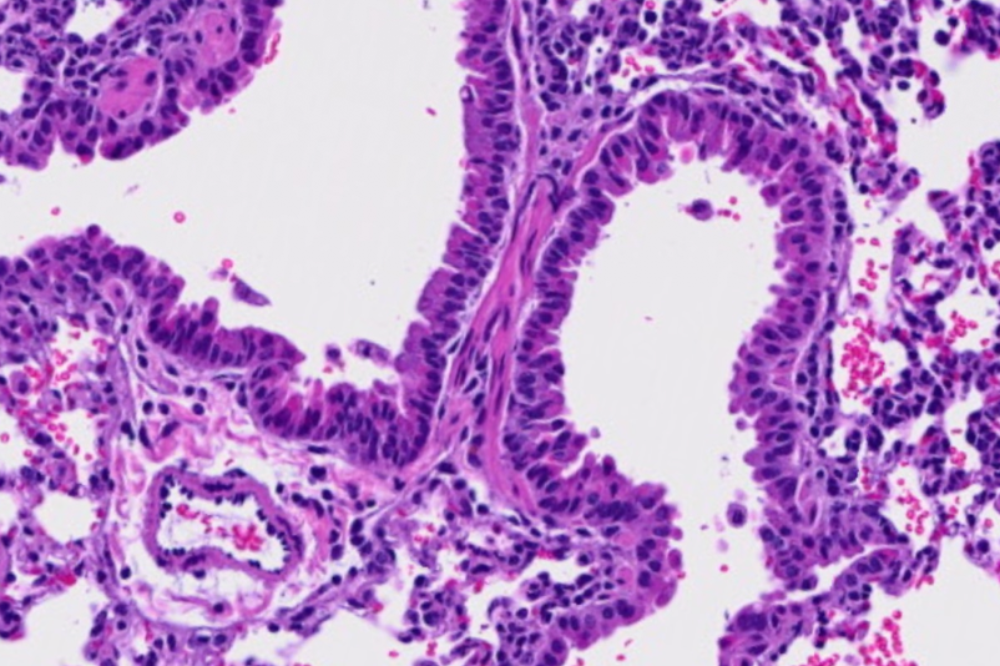
Histological image of lung tissue from a SARS-CoV-2-infected mouse fed an arginine-restricted diet. (Courtesy of Tavazoie lab)
The amino acid arginine helps to keep the human body humming, most notably by synthesizing proteins that carry out a range of cellular processes. It's produced by our bodies and found in common high-protein foods. Low levels of arginine are associated with a number of diseases, including colon cancer.
Sohail Tavazoie, head of Rockefeller University's Elizabeth and Vincent Meyer Laboratory of Systems Cancer Biology, has been investigating that connection for years. In 2023, Tavazoie's team found that starving colon cancer cells of arginine increases the number of mutations they accumulate. Now they've discovered that an arginine-deficient diet also impacts the immune system by stalling the production of the MHC-1 protein, which alerts the immune system to dangers such as a mutating cell or an invading virus.
Intriguingly, they also found that a moderate dose of arginine-about as much as found in a couple of over-the-counter tablets-could potentially rescue expression of the genes responsible for MHC-1 production. They published the results in Cell.
"Our work reveals how a lack of arginine interferes with the immune system, and suggests that upping arginine intake could prove beneficial," says first author Qiushuang Wu, a postdoc in the lab. "Perhaps that means it could be used in combination with other therapies to treat both cancer and viral infections."
"Arginine supplementation could be readily tested in patients receiving immunotherapies or given to high-risk populations exposed to viral pathogens," Tavazoie suggests. "Considering that arginine is inexpensive and readily available, we hope that therapeutic and preventative studies could be undertaken soon."
Codons and translations
Amino acids are the building blocks of proteins, but they too have their own building blocks, called codons. These triplets of DNA bases each contain the recipe for producing a single amino acid. Arginine's usefulness is underscored by the fact that six different codons carry its recipe card.
While it's well established that fluctuations in amino acid levels can influence cellular metabolism and signaling, whether these changes can alter gene expression is poorly understood.
For the current study, which was supported in part by the Stavros Niarchos Foundation (SNF) Institute for Global Infectious Disease Research at The Rockefeller University and the Weill Cancer East Hub, Wu explored whether changes in arginine levels caused by diet or disease can alter gene expression in a variety of disease models, including colon cancer, influenza, and SARS-CoV-2, all of which have been documented to have abnormal amounts of various amino acids.
"One of the most dramatic patterns to emerge was that arginine was the most depleted amino acid in all of these diseases," she says.
Using cell cultures, she tracked which genes were affected by lower levels of arginine. She discovered 414 proteins that were abnormally low in number, most of which had been coded by genes connected to arginine's known molecular roles. More surprising, however, was that a lack of arginine hampered the expression of a trio of HLA genes that code for MHC-1 (major histocompatibility complex class I) proteins. Found on cell surfaces across the body, MHC-1 presents foreign proteins to T cells, which in turn signal other immune cells to mount a defense.
Because the MHC-1 protein is composed of many arginine codons, it made sense that a lack of arginine would be detrimental to the production of proteins in some way, but where the problem lay was still unclear. Through additional experiments, Wu discovered that in an arginine-starved environment, ribosomes-the molecular machines that make proteins-stalled when attempting to translate MHC-1, unable to produce the protein because it lacked arginine. That in turn led to far fewer proteins being produced that could alert T cells to the presence of cancer or viral proteins, allowing them to evade notice.
"These findings are exciting because they reveal that consumption of a specific amino acid can directly regulate gene expression in an organism by increasing production of a protein enriched in that amino acid," Tavazoie says. "We believe that such selective translational tuning of gene expression through dietary manipulation likely extends to many other proteins and amino acids."
Using mouse models, Wu tested the impact of different levels of dietary arginine. Mice with low levels of arginine in their diet developed more colon cancer tumors, while those with a higher amount developed fewer colon tumors.
In collaboration with Heinz-Heinrich Hoffman, a research assistant professor in Charles Rice's Laboratory of Virology and Infectious Disease, Wu then repeated these dietary experiments with influenza and SARS-CoV-2 mouse models. The pattern held-and also revealed an unexpected new twist.
"Not only did mice with an arginine-rich diet have milder symptoms from viral infections, giving the mice arginine after influenza infection improved their outcomes too," Wu notes. "That was very surprising. From our genetic models, we knew manipulating arginine levels had a strong effect on gene expression, but we didn't expect the dietary manipulation to be equally impactful."
"Qiushuang's findings illuminate how poor diet and aging-during which arginine levels naturally decline-could create the perfect storm for the initiation of colon cancer. Similarly, age-related arginine loss could partially contribute to the greater mortality caused by respiratory viruses," Tavazoie says. "We're also investigating whether making dietary changes in other amino acids has beneficial effects in a variety of disease contexts. There are no doubt more discoveries to come."


