
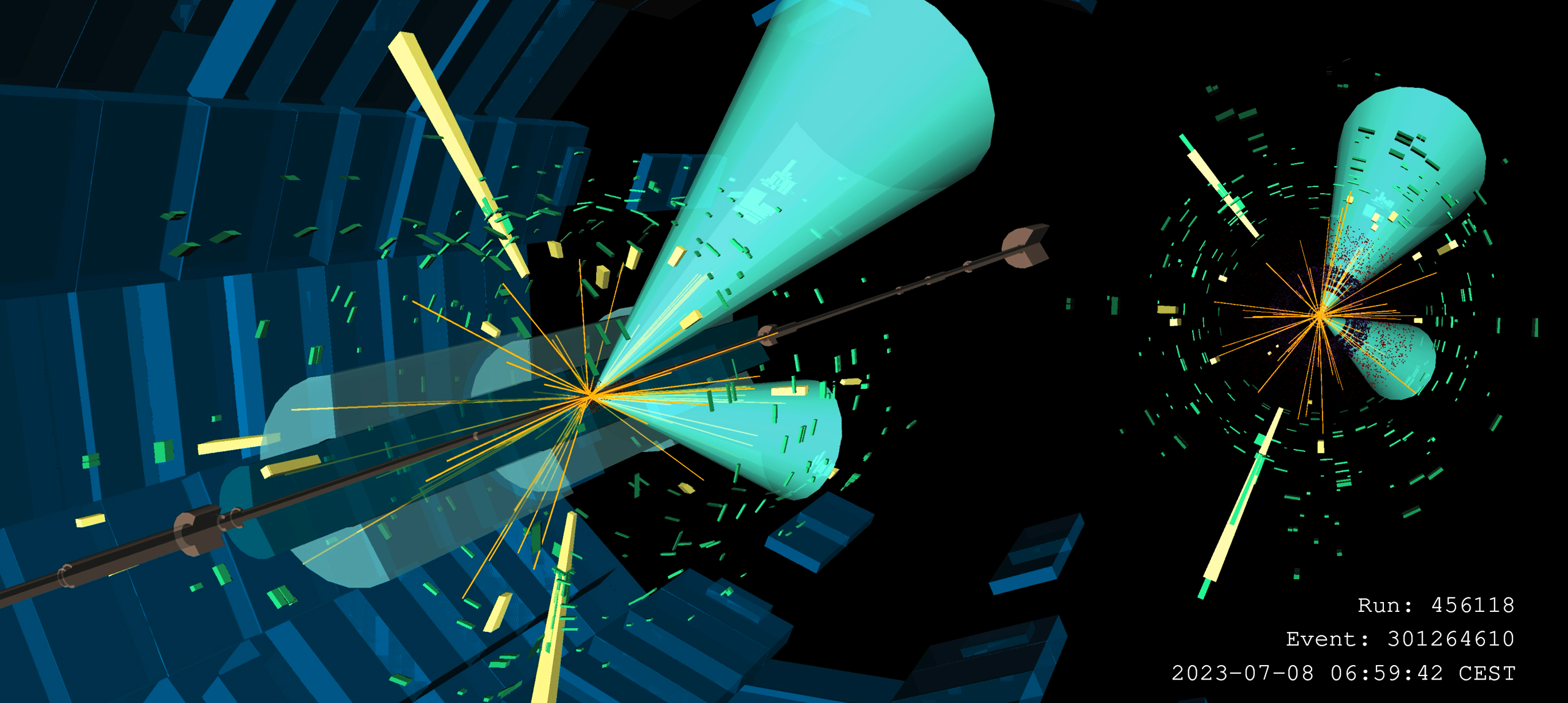
One of the biggest open questions in particle physics today is how the Higgs boson interacts with itself. This "self-coupling" could help explain the evolution of the early Universe and the mechanism that gives mass to elementary particles. To try to shed light on this fundamental interaction, the ATLAS Collaboration has recently studied one of the "golden" decay channels of a pair of Higgs bosons, where one Higgs boson decays into two photons and the other into a pair of bottom quarks.
By combining the entire LHC Run 2 dataset (2015-2018) and a partial Run 3 dataset (2022-2024), the ATLAS team has significantly enhanced the statistical power of the analysis of this decay channel. The result, just published in Physics Letters B, marks the first ATLAS measurement based on over 300 inverse femtobarns (fb⁻¹) of proton-proton collision data, where one inverse femtobarn corresponds to approximately 100 trillion collisions.
Studying this decay channel is particularly challenging due to the extremely rare nature of Higgs boson pair production - predicted to occur once in a trillion proton-proton collisions - and the significant background from Standard Model processes that mimic this decay mode. To overcome these challenges, ATLAS physicists used advanced data analysis techniques, such as machine learning, to help to isolate the decay signal from the background.
As a result of these advancements and the addition of the partial Run 3 dataset, the ATLAS researchers set more stringent limits than they did before on the signal strength (the observed signal divided by the Standard Model prediction) and two key interaction parameters. These are the magnitude of the Higgs boson's self-coupling divided by its Standard Model prediction, limited to be between −1.6 and 6.6, and the interaction strength between two Higgs bosons and two vector bosons (W or Z bosons) divided by its Standard Model prediction, limited to be between −0.5 and 2.6.
The results underscore the ATLAS Collaboration's growing ability to explore Higgs boson pair production in this golden decay channel. They also lay the foundation for future measurements of the Higgs boson's self-coupling - key to understanding the evolution of the Universe after the Big Bang. With the full Run 3 dataset soon to be available and the High-Luminosity LHC on the horizon, ATLAS is well positioned to push these studies even further - sharpening our understanding of the Higgs boson and exploring potential signs of physics beyond the Standard Model.


