
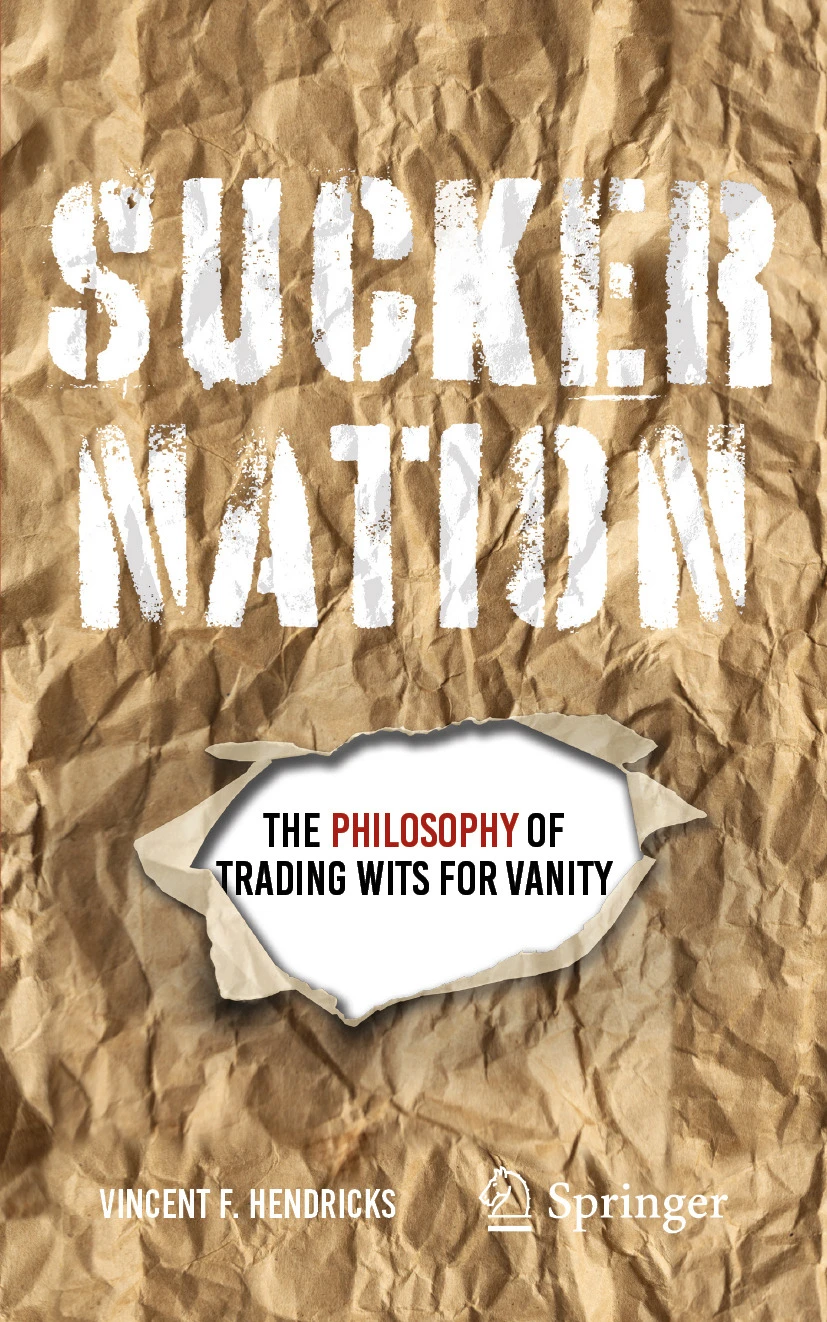
Vincent F. Hendricks' new book Sucker Nation shows why rational and well-informed people end up as suckers in a world governed by visibility, algorithms and attention.

We like, share, invest and engage. Often, we are well aware that we are being exploited, and that our online attention functions as currency for others in the virtual world. Yet we keep going. And we allow ourselves to be exploited again and again.
In his new book Sucker Nation: The Philosophy of Trading Wits for Vanity, Vincent F. Hendricks argues that this is not due to stupidity or a lack of critical thinking, but to the structures we are all part of. Every day, we participate in digital communities, markets and public spheres where our attention has value to others.
If one feels the urge to jump off the hamster wheel, Sucker Nation explains why it is difficult to opt out alone, and why knowledge of the exploitation does not in itself offer protection against it.
Hustlers and suckers
In the book's prologue, Vincent F. Hendricks draws on a scene from The Godfather. Here, Michael Corleone refuses to be manipulated. He refuses to be a sucker. A sucker is not merely a loser, but someone who is deceived because they fail to see how things really work. And a sucker can be exploited by a hustler.
The hustler and the sucker are the two main characters in Vincent F. Hendricks' book. The point is not that some people are smart while others are naïve, but that modern systems create roles that we move in and out of. Suckers provide engagement and trust, while hustlers exploit these resources strategically.
"Hustlers and suckers are not different kinds of people, but different positions in a social game where visibility is the price of admission," says Vincent F. Hendricks, Professor of Formal Philosophy at the University of Copenhagen.
Why rational people get trapped
A central contribution of Sucker Nation is its analysis of why even rational actors remain stuck in games they know to be risky. Drawing on game theory, Hendricks shows that the problem is often a lack of common knowledge.
"Many people are aware that they are being exploited, but they continue anyway because they do not know whether others are also ready to withdraw. Without common knowledge, opting out alone becomes too risky," Hendricks explains.
This applies to financial bubbles, social media and political communication alike: individual insight is not enough to change a system that rewards participation.
The book traces connections from financial bubbles to cryptocurrencies, meme stocks and the attention economy on social platforms. Here, likes, trends and virality are taken as signs of value and consensus - even though they often mask strategic behavior.
A recurring theme is how the digital public sphere is increasingly owned and governed by private platforms. According to Hendricks, the major digital platforms function as hustler/sucker machines: they depend on many people continuing to act as if trust, authenticity and shared understanding prevail, while a small number of actors exploit the rules of the game.
"Society cannot function without trust. But that very trust makes us vulnerable. This is not a flaw in the system. It is a precondition," says Vincent F. Hendricks.
About the Book
- Sucker Nation: The Philosophy of Trading Wits for Vanity was published in 2026 by Springer Nature. It is available in English only.
- Sucker Nation is the second volume in a trilogy. The third and final book, Nobody Cares: The Philosophy of Indifference, will be published in 2027.


