
Vaccine research, development of an early warning system for pathogens, establishment of a Long COVID register: these are some of the goals of the new Bavarian Centre for Preventive Infection Medicine.
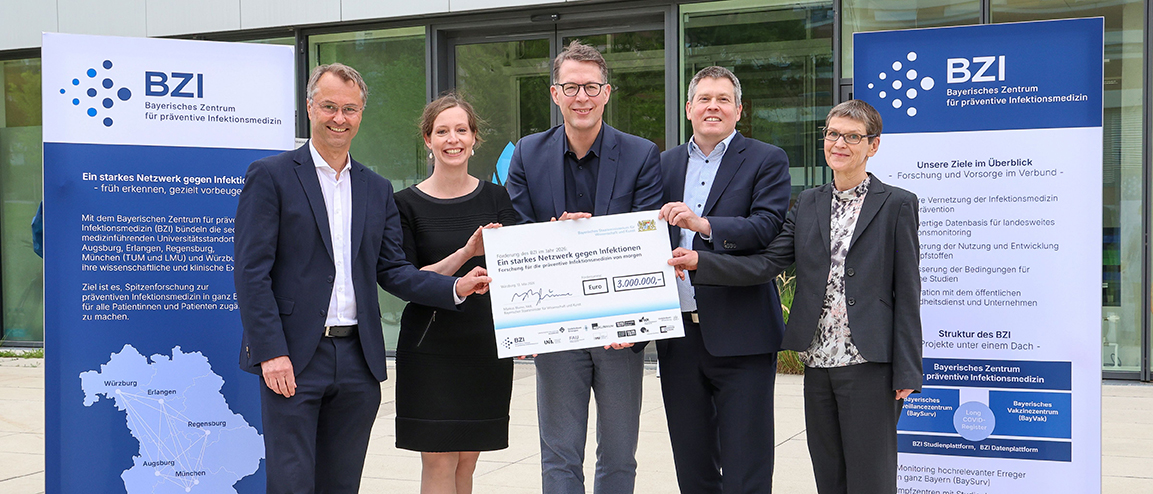
The new Bavarian Centre for Preventive Infection Medicine (Bayerisches Zentrum für präventive Infektionsmedizin, BZI) was officially opened in Würzburg on 13 May 2026. The state-wide and cross-location centre, which was significantly promoted by Universitätsmedizin Bayern e.V., is intended to sustainably strengthen research, care and prevention in the field of infection medicine.
The BZI networks all Bavarian universities with a Faculty of Medicine, the Bavarian university hospitals and the public health service in Bavaria. It is funded by the Bavarian State Ministry of Science and the Arts with around three million euros annually.
Bavaria's Science Minister Markus Blume: "The BZI is a direct consequence of the experiences of the pandemic - but with a clear view to the future: from new pathogens and resistance to post-viral long-term consequences. The fact is: Infection risks are not going away. The public actions of those affected are making the suffering of many patients visible. This makes it all the more important for Bavaria to take decisive action now in the areas of prevention, research and early detection. With the Bavarian Long COVID Registry, we want to improve research, care and knowledge gain in this area in a targeted manner."
Early detection, targeted action, effective prevention
The BZI is characterised by two central fields of action that are closely interlinked. These include measures to prevent infections, i.e. prevention and early detection and monitoring of the spread of highly relevant infectious pathogens in the population and in Bavarian hospitals. Close cooperation between a wide range of disciplines, from infectiology, microbiology and immunology to healthcare research and public health, is crucial for this.
The central programme areas of the BZI are also structured according to these fields of activity:
- Bavarian Surveillance Centre (BaySurv): Modern and continuous surveillance of relevant pathogens, including molecular analytics and data-based evaluation.
- Bavarian Vaccine Centre (BayVak): Research on vaccines, vaccination strategies, clinical studies and science-based communication on all aspects of vaccination.
- Cross-sectional project: Bavarian Long COVID Register (BAY-LCR): Systematic recording and scientific investigation of post-acute infection syndromes such as Long COVID.
Increasing development of resistance as a challenge
Professor Oliver Kurzai, Director of the Institute of Hygiene and Microbiology at the University of Würzburg, is President of the Bavarian Centre for Preventive Infection Medicine.
He emphasises the pioneering role of the BZI: "Treating infections is becoming increasingly difficult due to the growing development of resistance, and for some pathogens there is no targeted treatment option at all. That's why we at the BZI are focussing on prevention and networking! The bundled expertise of Bavarian University Medicine in close cooperation with the public health service forms a unique network for the early detection of new and dangerous pathogens and the development and implementation of effective countermeasures."
It is precisely these tasks that characterise the BZI's developed programme areas. Professor Klaus Überla, Director of the Harald zur Hausen Institute of Virology at Erlangen University Hospital, is Section Spokesperson of the Bavarian Vaccine Centre (BayVak) at the BZI.
"Vaccinations have been used for over 100 years to protect us from infectious diseases. With the Bavarian Vaccine Centre at the BZI, we want to make a contribution to reviewing the efficacy and safety of approved vaccines and to developing new immunisation procedures. We want to provide expert information on the benefits and possible risks of immunisation," says the Erlangen virologist.
Early warning system for the spread of pathogens
The aim of the Bavarian Surveillance Centre (BaySurv) within the BZI is to establish an early warning system for the spread of pathogens. Professor Stefanie Kampmeier, Head of the Central Facility for Hospital Hygiene and Antimicrobial Stewardship at the University Hospital of Würzburg, is the BZI section spokesperson for this focus.
"Early detection of spreading pathogens is a central component of infection prevention. The Bavarian Surveillance Centre (BaySurv) creates an early warning system for the real-time detection of outbreaks and the transmission of resistance. BaySurv thus enables continuous, representative and timely detection of highly infectious and multi-resistant pathogens, targeted infection control measures and thus strengthens evidence-based pandemic prevention in Bavaria," explains the Würzburg expert for hospital hygiene.
Long COVID register as a basis for improved care
The establishment of the Bavarian Long COVID Register (BAY-LCR) is a cross-sectional project under the umbrella of the BZI. Professor Uta Behrends from TUM Klinikum Rechts der Isar, the university hospital of the Technical University of Munich (TUM), is in charge of the project.
"Long-term consequences of infections cause a high burden of disease worldwide. Many of those affected have reduced social participation and quality of life. The aim of the Bavarian Long COVID Registry (BAY-LCR) at the BZI is to record Long COVID and similar post-infectious diseases in Bavaria in a structured manner, to better understand them and thus create the basis for improved care," says the head of the Munich Chronic Fatigue Centre for Young People.
"An important lesson of the coronavirus pandemic was that the great strengths and expertise in infection medicine at the Faculties of Medicine and university hospitals need to be even more closely networked and bundled. With the BZI, a structure has now been created in university medicine in Bavaria that serves as a role model. The BZI will thus contribute to the rapid application of the latest findings in healthcare and thus to the expansion of infection protection," emphasises Professor Matthias Frosch, Dean of the Faculty of Medicine at the University of Würzburg.
Website provides information about the BZI's goals and projects
On the website www.bzi-bayern.de the BZI presents (in German language) its programme areas, projects and current developments and makes information on the centre's research, networking and activities publicly accessible.
The BZI is supported in the coordination of cross-site collaboration between research, clinical care and the public health service by an office based in Würzburg and a branch of the office at Erlangen University Hospital, which coordinates the BayVak programme.


