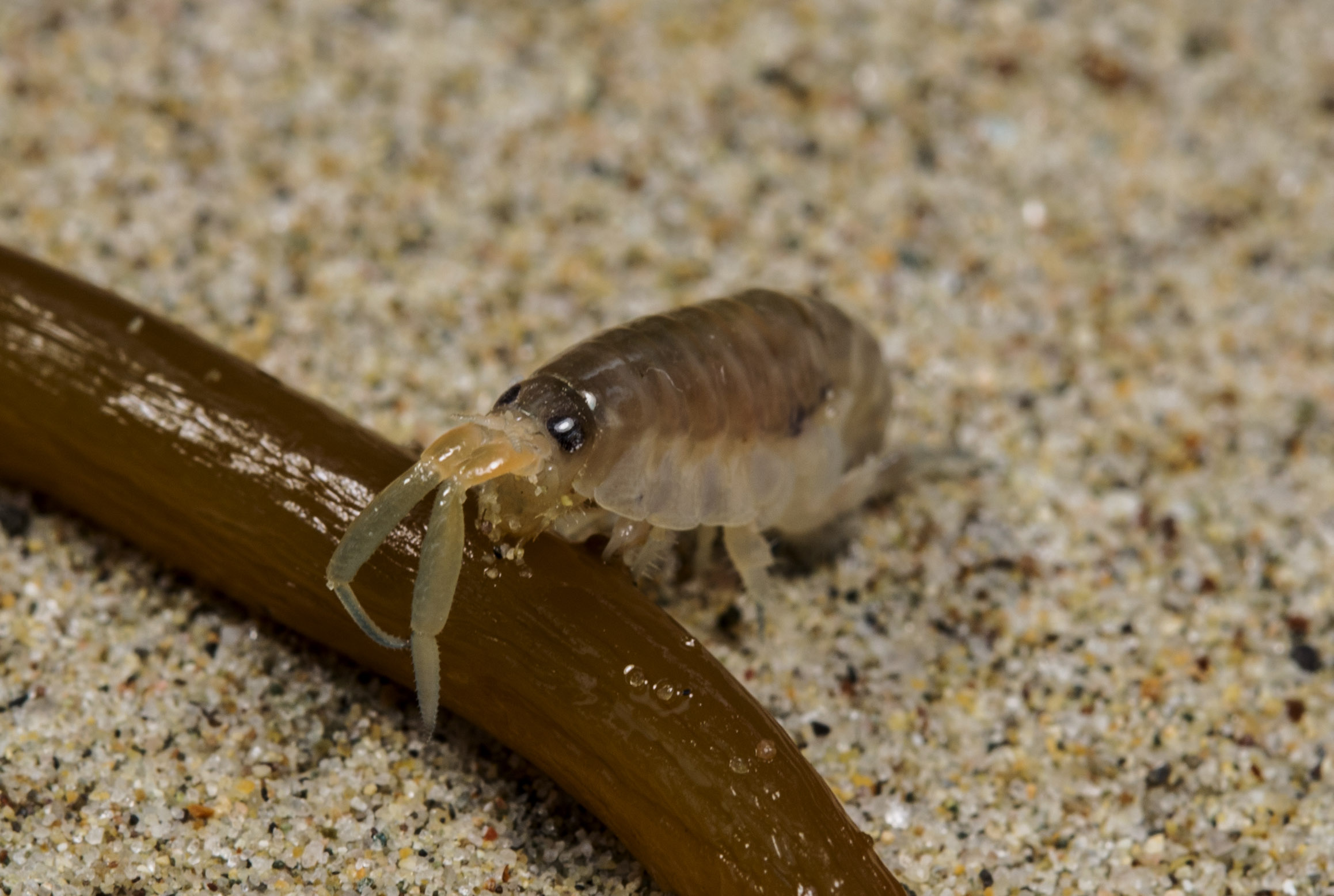
A sand hopper feasting on washed up seaweed. Credit: Nicholas Schooler.
At only an inch long, the sand hoppers skipping across California's Isla Vista Beach at dawn don't exactly look like a force of nature. But a new study reveals that these shrimp-like creatures might be doing more to shape the landscape in which they live than any other animal on Earth.
"The impact of animals on beaches is a really understudied area, especially considering how much work they're doing," said Tim Baxter, a physical geographer at the University of Oxford's Pitt Rivers Museum and the study's lead author. "Sand hoppers are often overlooked or considered as a bit of a nuisance. We wanted to try and look at them in a different light."
The study is published in Journal of Geophysical Research: Earth Surface, AGU's journal for the physical, chemical and biological processes that affect the form and function of the surface of the Earth.
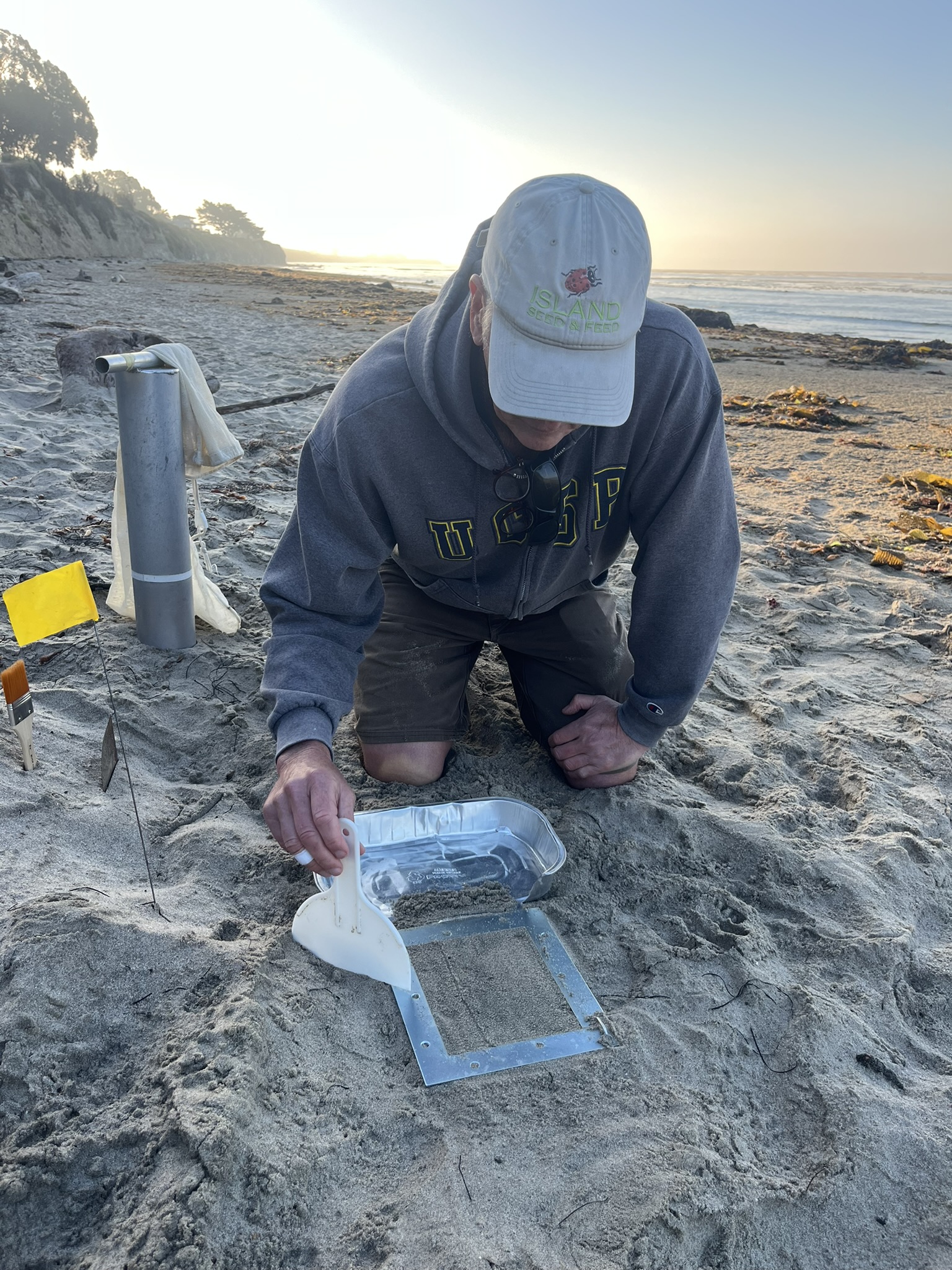
A researcher scrapes sand hopper mounds into a container for weighing. Credit: Timothhy Baxter.
Strength in Numbers
Sand hoppers are nocturnal crustaceans living in sandy beaches all over the world, feeding on washed-up seaweed and kelp. Each industrious little hopper digs a new home every night, kicking up mounds of fluffed-up sand onto the beach by dawn. Burrowing helps them find food, stay moist, and hide from predators.
To measure hoppers' influence on the landscape, researchers staked out study plots on the beach at night after high tide, then scraped off all the sand the hoppers had piled up by morning. The team bagged up and weighed the excavated sand, then dug up chunks of beach sand to make hopper headcounts in each study plot.
Based on the amount of sand and the total mass of hoppers, each hopper digs up more than ten times its own body weight for every burrow. For every three feet (one meter) of coastline, around 21,450 sand hoppers collectively move around 110 pounds (50 kilograms) of sand - about 16 half-gallon sandcastle buckets' worth - every night.
By combining these numbers with eight years of previous measurements of hopper populations up and down the beach, the team was able to extrapolate the crustaceans' full influence across 15.5 miles (25-kilometers) of beaches near Isla Vista, California. All told, the sand hoppers in that stretch have as much sediment-shifting power as some nearby rivers, moving around 310 tons of dry sand per day.
"I have to admit, I did go back through the numbers multiple times just to double check my calculations. I was extremely surprised by how much they dug up," Baxter said.
"It's a really good example of how individually small animals occurring in high numbers can have really substantial landscape-shaping impacts," said Gemma Harvey, a physical geographer at Queen Mary University of London who was not involved with the study.
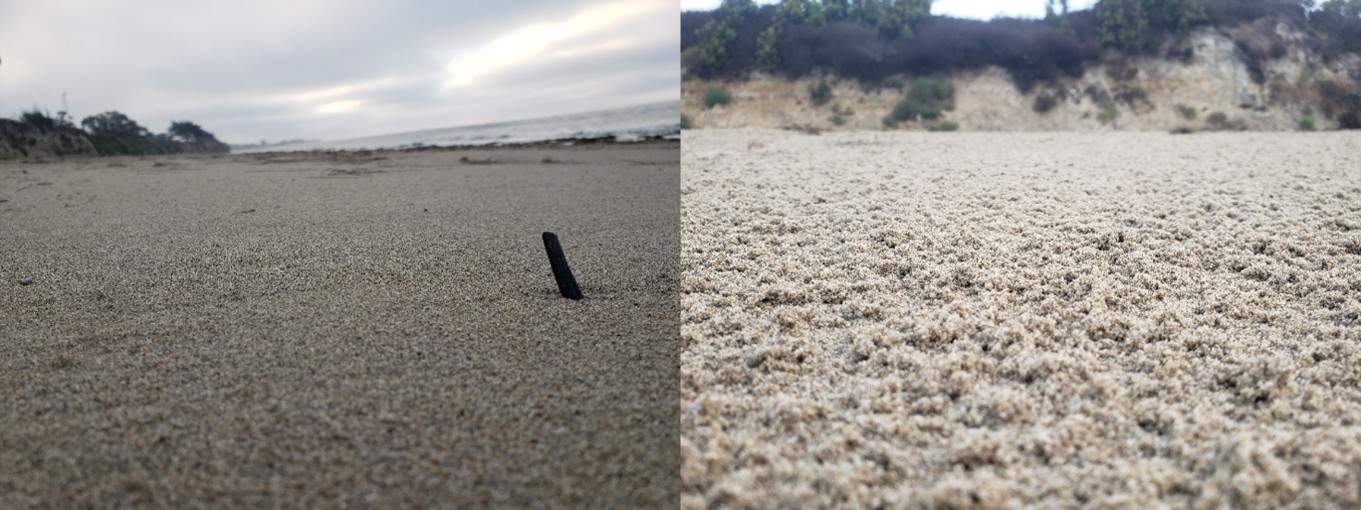
Left: Smooth, un-burrowed sand. Right: Mounds of sand kicked up by sand hoppers after a night of digging. Credit: Sean Cummings, AGU.
The Sand-Shoveling Olympics
Although Charles Darwin was already espousing the soil-shaping powers of English earthworms more than 150 years ago, scientists are still establishing the best ways to measure and compare the work of animals in their environments. "It's a minefield with the different ways things are reported and measured in this field," Harvey said.
Currently, though, of all digging and burrowing animals studied, California's sand hoppers only have one potential rival. A previous study documented a South African sand prawn that mixes as much as 9 pounds of sand per square foot of beach per day (12 kilograms per square meter per day).
But Dave Hubbard, an ecologist at the University of California Santa Barbara and co-author on the study, is firmly team hopper: "If we had measured the sand hoppers' total churn rate, it would have been more than the sand they were putting in mounds on the surface. They would probably win against the sand prawns."
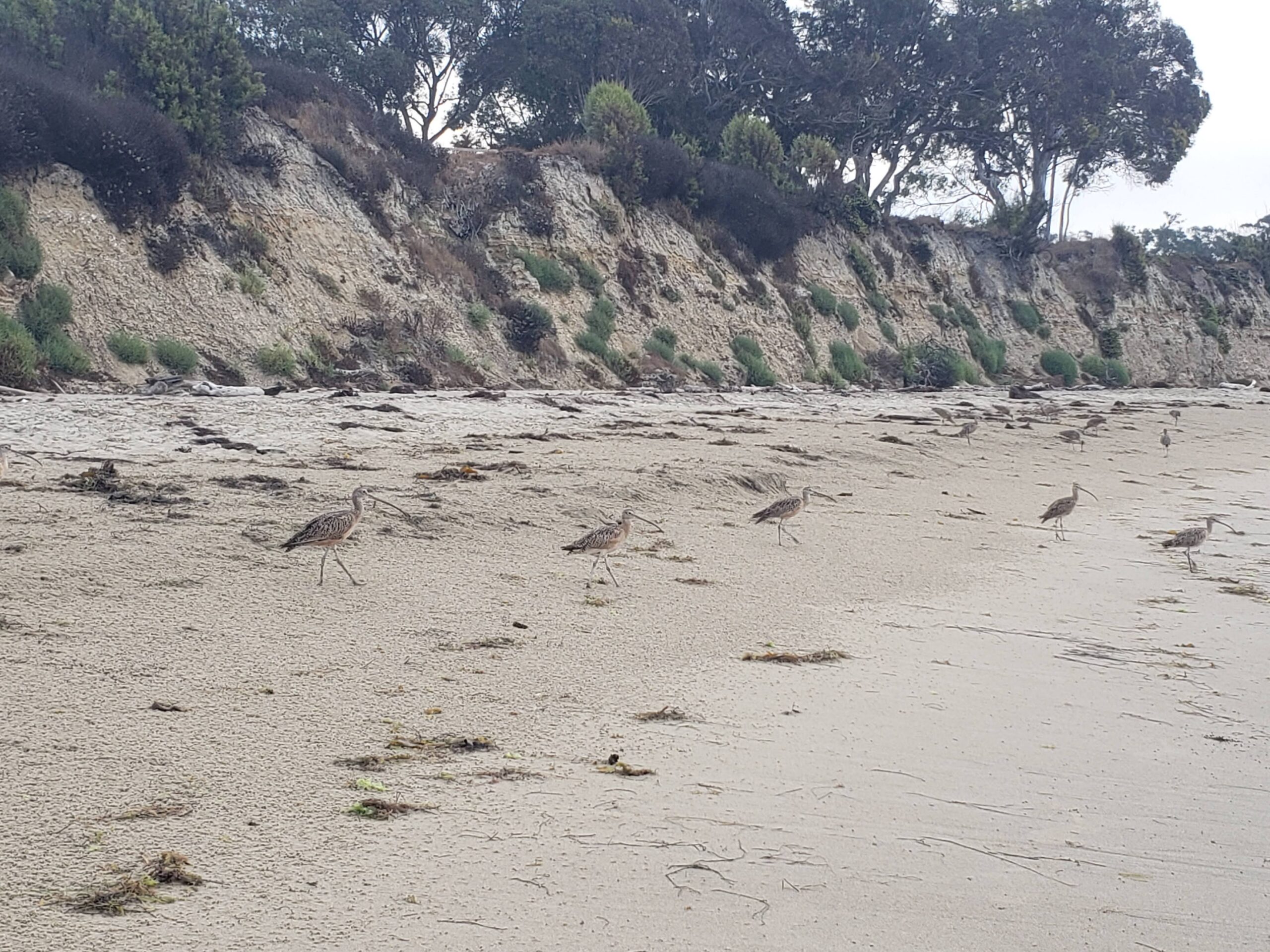
Hungry shorebirds scouring the slightly darker stretch of mounded sand in the middle of the beach for a sand hopper snack. Credit: Sean Cummings, AGU.
Stewards of the Environment
The sand hoppers' hard work has knock-on effects on the entire beach. Their burrowing brings plankton and oxygen-rich seawater into the sand providing nutrients for other beach-dwellers. Their excavated mounds create loose grains of sand that might be blown around by the wind, potentially helping build dune habitats higher up the beach. The hoppers themselves are even a favorite food for shorebirds.
Sand hoppers also aren't the only critters at work. Just a few feet closer to the water, blood worms and sand crabs mix and move sand, but without leaving behind easy-to-measure mounds for researchers to collect. Not only could these creatures be moving underappreciated quantities of dirt, their efforts could also be interacting with the sand hoppers' burrowing - something that Hubbard is keen to study next. Accounting for the combined effects of all the animals together would enable scientists to fully see the importance of animals compared to physical processes like the action of wind and waves. "The beach ecosystem involves both the organisms that live in it and the landscape that forms it - they're components of the same thing," Baxter said.
These interwoven systems are easily disrupted by practices like beach grooming, where tractors rake the sand to smooth out the beach and remove seaweed for human visitors, tearing up hoppers and their burrows.
"They disturb the whole thing. You end up with kind of a desert," said Hubbard, who visits Santa Barbara's beaches almost every morning. As scientists learn more about the creatures that shape our favorite coastal places, Hubbard and Baxter hope to see beach management approaches take these overlooked engineers into account.
"Animals aren't passive inhabitants of our landscapes, they're actively shaping them and can help restore them," Harvey said. "The first step is knowing they're there and having these significant impacts so we can adapt accordingly."
Notes for journalists:
This study is published in Journal of Geophysical Research: Earth Surface, an AGU journal. https://agupubs.onlinelibrary.wiley.com/doi/10.1029/2026JF009312
Additional images and video of sand hoppers, the experimental setup, and the beach location are available upon request.
Paper title:
"Mega Mounders: Burrowing Talitrids (Megalorchestia spp.) Excavate Large Quantities of Sand on California Beaches."
Authors:
- Timothy Baxter, Pitt Rivers Museum, University of Oxford, Oxford, UK.
- Dave Hubbard, Marine Science Institute, University of California Santa Barbara, Santa Barbara, California, USA.
- Kyle Emery, Marine Science Institute, University of California Santa Barbara, Santa Barbara, California, USA.
- Jennifer Dugan, Marine Science Institute, University of California Santa Barbara, Santa Barbara, California, USA.
- Winter Adams, Marine Science Institute, University of California Santa Barbara, Santa Barbara, California, USA.
- Sebastian Alvarez, Department of Geography, University of California Santa Barbara, Santa Barbara, California, USA.
- Ian Walker, Marine Science Institute, University of California Santa Barbara, Santa Barbara, California, USA; Department of Geography, University of California Santa Barbara, Santa Barbara, California, USA.
AGU (www.agu.org) is a global community supporting more than half a million professionals and advocates in Earth and space sciences. Through broad and inclusive partnerships, AGU aims to advance discovery and solution science that accelerate knowledge and create solutions that are ethical, unbiased and respectful of communities and their values. Our programs include serving as a scholarly publisher, convening virtual and in-person events and providing career support. We live our values in everything we do, such as our net zero energy renovated building in Washington, D.C. and our Ethics and Equity Center, which fosters a diverse and inclusive geoscience community to ensure responsible conduct.
Subscribe or change your emailing preferences for the AGU Newsroom