

A large-scale international study, led by researchers from the Gray Faculty of Medical and Health Sciences at Tel Aviv University, has uncovered a mechanism that allows breast cancer to send metastases to the brain - a highly lethal occurrence for which there is currently no effective treatment. The findings could enable the development of new drugs and personalized monitoring for early detection and treatment of brain metastases.
The groundbreaking study was led by Prof. Uri Ben-David and Prof. Ronit Satchi-Fainaro, along with researchers Dr. Kathrin Laue and Dr. Sabina Pozzi from their laboratories at the Gray Faculty of Medical and Health Sciences at Tel Aviv University, in collaboration with dozens of researchers from 14 laboratories in 6 countries (Israel, the United States, Italy, Germany, Poland, and Australia). The article was published in the journal Nature Genetics.
Why Do Some Cancers Spread to the Brain?
Prof. Satchi-Fainaro explains: "Most cancer-related deaths are not caused by the primary tumor but by its metastases to vital organs. Among these, brain metastases are some of the deadliest and most difficult to treat. One of the key unresolved questions in cancer research is why certain tumors metastasize to specific organs and not others. Despite the importance of this phenomenon, very little is known about the factors and mechanisms that enable it. In this study, we joined forces to deepen our understanding and seek answers."
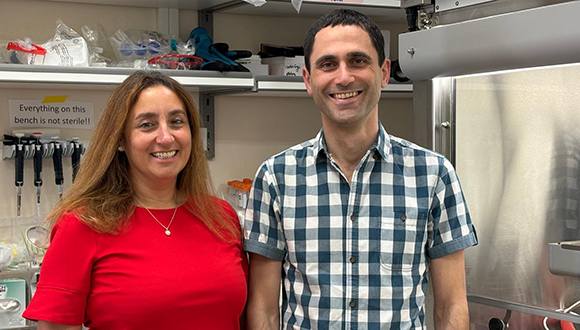
Left to right: Prof. Satchi-Fainaro & Prof. Uri Ben-David.
Combining Genetics and the Tumor Microenvironment
The current study combined two distinct approaches to cancer research: Prof. Satchi-Fainaro's lab, which studies the interactions between cancer cells and their surrounding environment (the tumor microenvironment), and Prof. Ben-David's lab, which investigates chromosomal changes that characterize cancer cells. The complex study involved numerous scientific methods and technologies, including clinical and genomic data analysis of tumors from breast cancer patients, genetic, biochemical, metabolic, and pharmacological experiments in cultured cancer cells, and functional experiments in mice.
The researchers first identified a specific chromosomal alteration in breast cancer cells that predicts a high likelihood of brain metastases. Prof. Ben-David explains: "We found that when chromosome 17 in a cancer cell loses a copy of its short arm, the chances of the cell sending metastases to the brain greatly increase. We also discovered that the reason for this is the loss of an important gene located on this arm. This gene is p53, often referred to as 'the guardian of the genome,' and it plays a crucial role in regulating cell growth and division. We discovered that the absence of a functional p53 is essential for the formation and proliferation of cancerous brain metastases. When we injected mice brains with cancer cells with or without functional p53, we found that cells with disrupted p53 activity thrived much more. We sought to understand the mechanism causing this."
How Cancer Cells Adapt to the Brain Environment
Prof. Satchi-Fainaro adds: "The brain's environment is fundamentally different from that of the breast, where the primary tumor develops, and the question is how a breast cancer cell, adapted to its original environment, can adjust to this foreign one. According to our findings, this adaptation is closely linked to the impairment of the p53 gene. We found that p53 regulates the synthesis of fatty acids, a metabolic process particularly vital in the brain environment. This means that cells with damaged p53, or without p53 at all, produce more fatty acids compared to normal cells, which in turn enables them to grow and divide more rapidly in the brain."

Left to right: Dr. Kathrin Laue & Dr. Sabina Pozzi.
Hijacking Brain Cells to Fuel Tumor Growth
The next phase of the study focused on the components of the brain environment and the communication between brain cells and cancer cells. The researchers identified heightened interaction between cancer cells with damaged p53 and astrocytes - support cells in the brain that secrete substances aiding neurons. In the absence of p53, the cancer cells hijack the substances secreted by the astrocytes and use them to produce fatty acids. The researchers identified a specific enzyme named SCD1 - a key enzyme in fatty acid synthesis - whose expression and activity levels are significantly higher in cancer cells with impaired or missing p53.
Prof. Ben-David: "Once we identified the mechanism and its key players, we sought to use the findings to search for a potential drug for brain metastases. We chose to focus on the SCD1 enzyme and tested the effectiveness of several drugs that inhibit its activity and are currently under development. These drugs were originally indicated for other diseases, but we found that SCD1 inhibition in brain metastatic cells with impaired p53 was effective and significantly hindered the development and proliferation of cancerous metastases - both in mice and in samples from brain metastases of women with breast cancer."
The researchers add that their findings may also assist doctors and patients in predicting disease progression: even at an early stage of breast cancer, it is possible to identify whether there is a p53 mutation (or deletion of the short arm of chromosome 17), which significantly increases the risk of brain metastases later on. For example, doctors could avoid prescribing aggressive biological treatments with severe side effects for patients not at high risk of brain metastases, while opting for aggressive treatment when the risk is elevated. In addition, physicians can tailor monitoring to the patient's risk level - such as frequent brain MRI scans for patients at increased risk of brain metastases. This type of intensive monitoring would allow for early detection and treatment, significantly increasing the chances of recovery.
Looking Ahead
The researchers conclude: "In this study, we joined forces in an extensive international effort to address a highly important question: What is the mechanism that enables breast cancer to metastasize to the brain? We identified several characteristics of cancer cells causally linked to this deadly phenomenon, and the findings allowed us to propose new drug targets for brain metastases - a condition for which no effective treatment currently exists. Moreover, we tested drugs that inhibit a specific metabolic mechanism, SCD1 inhibitors, and found them to be effective against brain metastases. Additionally, our findings are expected to enhance oncologists' ability to identify patients at elevated risk and prepare accordingly. While the road ahead is still long, the potential is immense."
The project was supported by competitive research grants from the Israel Science Foundation (ISF), the Israel Cancer Research Fund (ICRF), and the Spanish bank Fundacion "La Caixa." It is also part of broader research being conducted in Prof. Satchi-Fainaro's lab, supported by an Advanced Grant from the European Research Council (ERC), ERC Proof of Concept (PoC), and the Kahn Foundation, as well as broader research being conducted in Prof. Ben-David's lab, supported by an ERC Starting Grant.


