
Since the Moon's formation, asteroid impacts have been the dominant exogenous geological process, creating craters and basins across its surface and profoundly altering its topography and geochemical properties. However, the extent to which large-scale impact events affected the Moon's deep interior remains poorly constrained.
Recently, a research team led by Prof. TIAN Hengci from the Institute of Geology and Geophysics of the Chinese Academy of Sciences (IGGCAS) reported a key finding: lunar basalts collected by Chang'e-6 (CE6) from the South Pole-Aitken (SPA) basin exhibit significantly heavier potassium (K) isotopic compositions than all previously documented lunar basalts from Apollo missions and lunar meteorites. Published in Proceedings of the National Academy of Sciences (PNAS) on January 12, the study attributes this isotopic signature to the giant impact that formed the SPA basin.
The isotopic systems of moderately volatile elements, such as K, are prone to volatilization and fractionation under the high-temperature conditions generated by impacts. Their compositions can record information such as temperature, pressure, and material sources during impact events, making them key evidence for revealing impact scales, thermal histories, and their modifications to the lunar crust and mantle materials.
The team conducted high-precision K isotope measurements on four basalt clasts using sapphire collision-cell multicollector inductively coupled plasma mass spectrometry (MC-ICP-MS). The CE6 samples consistently showed elevated δ41K values, ranging from 0.001 ± 0.028‰ to 0.093 ± 0.014‰ (mean: 0.038 ± 0.044‰, 2SE). This average is approximately 0.16‰ higher than that of Apollo lunar basalts (-0.13 ± 0.06‰, 2SE), which are widely regarded as representative of the composition of the lunar mantle and the Bulk Silicate Moon.
To clarify the cause of the unusual K isotopic composition, the team systematically assessed three potential modifying mechanisms-long-term cosmic-ray irradiation, magmatic differentiation, and meteoritic contamination. Their analysis showed these processes exert only minor effects, well within analytical uncertainties, and cannot explain the observed enrichment of heavy K isotopes.
Further research showed that extensive volatile loss (specifically K evaporation) was associated with the SPA-forming giant impact. Such volatile depletion may have suppressed magma generation and volcanic activity on the lunar far side, potentially accounting for the long-recognized asymmetry in volcanic activity between the Moon's near and far sides.
Numerical simulations further confirmed that the giant impact not only excavated deep crustal and possibly mantle materials but also generated substantial thermal energy capable of inducing mantle convection.
Overall, the findings confirm that the SPA-forming giant impact exerted a profound influence on the Moon's deep interior, and highlight the fundamental role of large-scale impact events in shaping the chemical evolution of planetary mantles and crusts.
This research was supported by the National Natural Science Foundation of China, the CAS Youth Innovation Promotion Association, and other sources.
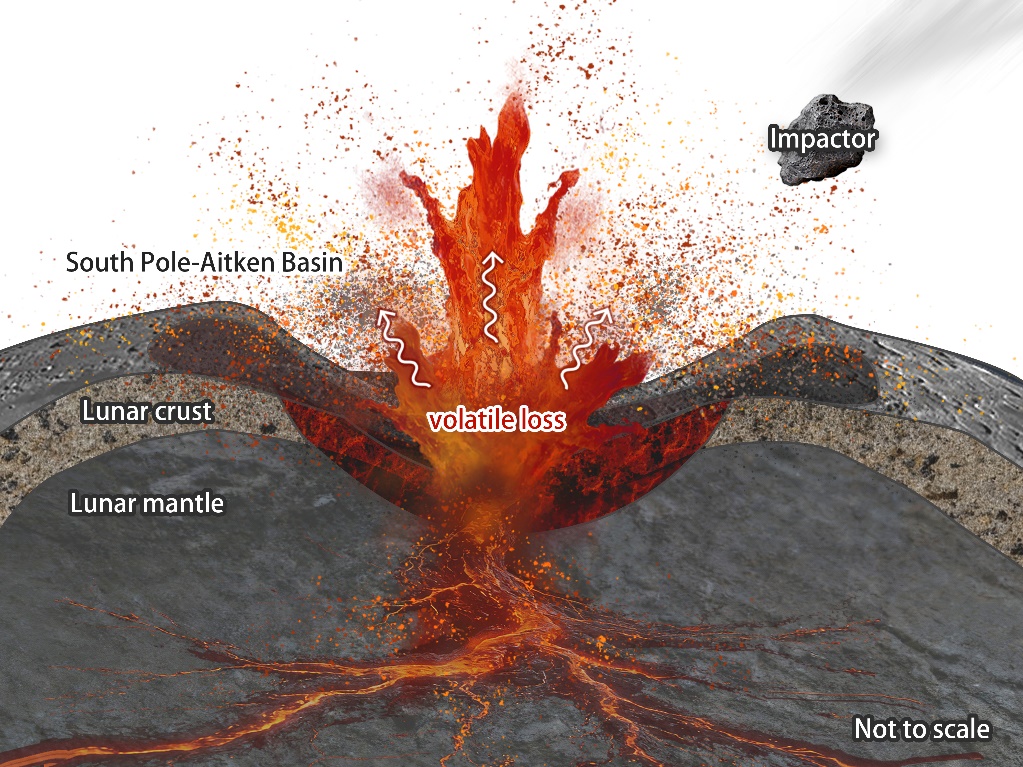
Schematic illustration of how the SPA basin-forming impact modified the lunar crust and mantle and led to volatile loss during the event. (Image by Prof. TIAN Hengci)


