
Under hot and humid weather conditions, civilian and military first responders in full protective gear moved carefully through simulated chemical emergency scenarios during the CHEMEX GRULAC exercise: collecting samples, carrying out decontamination procedures, and rescuing victims. Nearby, inside field medical tents, doctors, nurses, paramedics and midwives worked against the clock to assess and treat mock patients exposed to toxic chemicals.
With temperatures exceeding 30 degrees Celsius, even routine tasks became physically demanding while wearing heavy protective suits, gloves and respiratory masks, reflecting the harsh reality of a chemical emergency. Participants trained in environments designed to mirror the conditions of a real chemical incident aftermath, where responders must operate quickly, accurately and in close coordination, under intense pressure.
"Disasters and catastrophes will always happen; we just don't know when or where," said Heitor Castro Jr, Cardiologist and Intensive Care Medical Doctor in Brazil and instructor in CHEMEX GRULAC. "Chemical emergencies may be rare, but when they do occur, every second counts. Effective response depends on preparation, coordination and training."
Building preparedness through realistic scenarios
CHEMEX is the OPCW's flagship capacity-building programme on chemical emergency preparedness and response, and CHEMEX GRULAC marked the Organisation's first large-scale multi-component exercise in Latin America and the Caribbean. Co-organised with and hosted by the Dominican Republic in Santo Domingo from 27 April to 7 May 2026, the exercise brought together participants from 23 countries across the region to strengthen preparedness for chemical incidents through an integrated training in realistic conditions.
Over eleven days, participants learnt theory and practice, progressing through increasingly complex scenarios designed to test technical skills, communication and decision-making. Training began with the fundamentals of operating in contaminated environments, including the use of personal protective equipment, toxic chemical detection, decontamination procedures and hazardous material containment. The participants also learnt about what role emerging technologies, including AI, could play in re-shaping chemical security.
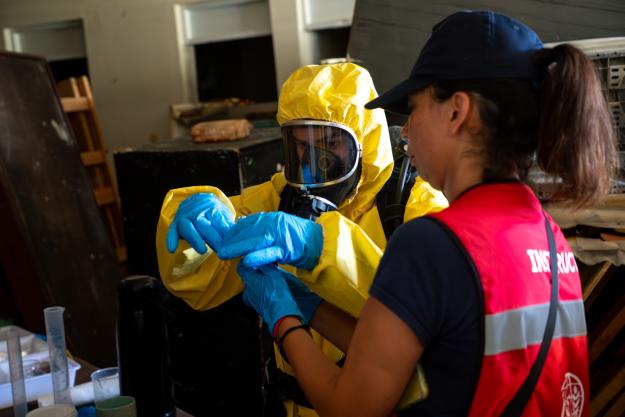
A first responder wearing protective equipment conducts sampling during a simulated chemical leak in a laboratory scenario as part of CHEMEX GRULAC in Santo Domingo, Dominican Republic. The exercise trained participants from across Latin America and the Caribbean in chemical detection, hazardous material response and coordinated emergency operations under realistic conditions. (Photo: Ministry of Defence of the Dominican Republic)
As the exercise intensified, participants progressed through increasingly complex chemical emergency scenarios. First responders conducted rescue and sampling operations involving laboratory chemical leaks, explosions with toxic industrial chemicals and improvised chemical release devices, including a scenario simulating toxic agents spread by drones on an outdoor basketball court and another requiring the evacuation of casualties from a darkened auditorium with limited visibility.
Healthcare personnel managed realistic casualty simulations involving toxic chemical exposure, mass casualty incidents and emergency patient transfers. The exercise also incorporated advanced medical training phantoms capable of reproducing symptoms caused by toxic chemicals, including a pregnant patient able to communicate symptoms in real time, helping medical teams strengthen clinical decision-making during complex emergencies.
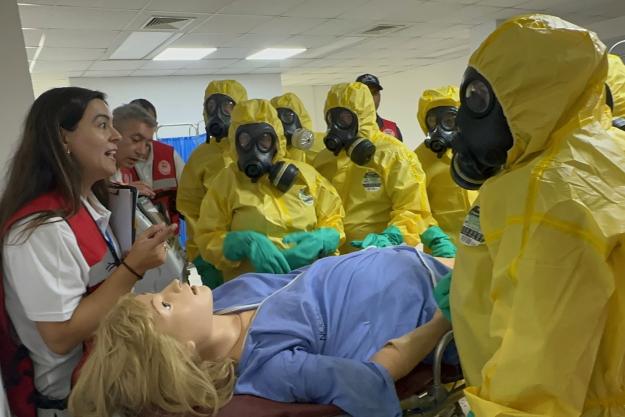
Medical personnel take part in a simulated chemical emergency scenario during CHEMEX GRULAC using an advanced training phantom representing a pregnant patient exposed to toxic chemicals (Photo: OPCW)
CHEMEX GRULAC culminated in a final exercise that integrated all elements of the response chain into one coordinated operation, where participants demonstrated what they had learnt during the intense training phase. The Minister of Defence of the Dominican Republic, Lieutenant General Carlos Fernández Onofre, and OPCW Deputy Director-General, Ambassador Odette Melono, opened the final exercise, both highlighting the importance of international cooperation in strengthening preparedness and response to chemical emergencies.
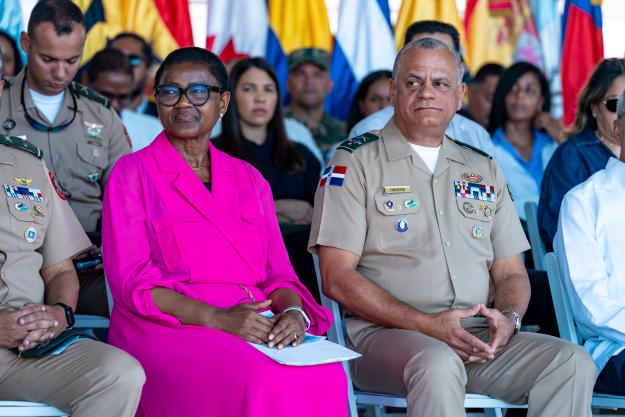
OPCW Deputy Director-General, Ambassador Odette Melono and Minister of Defence of the Dominican Republic, Lieutenant General Carlos Fernández Onofre, at the opening of the CHEMEX GRULAC final exercise. (Photo: Ministry of Defence of the Dominican Republic).
"In an increasingly complex global environment, multinational cooperation not only strengthens our capabilities, but also sends a clear message: we stand united against any threat that endangers the lives, health and security of our people," said Minister Onofre.
"CHEMEX GRULAC demonstrates what we can achieve when we work together across borders, disciplines and institutions… [it] represents a milestone for the OPCW and our States Parties," underlined Deputy Director-General Melono.
Integrating medical response into chemical emergency preparedness exercises
A defining feature of CHEMEX GRULAC was the integration of a medical segment. In many countries, first responders and healthcare personnel train separately, limiting opportunities to build the coordination needed during a real crisis. CHEMEX GRULAC addressed this gap.
"Coordination is essential not only for treating victims, but also for preventing secondary contamination and ensuring hazardous chemicals are not inadvertently carried from the incident site into ambulances, hospitals and healthcare facilities," explained Lt. Col. Dr. Javier Membrillo, Head of the CBRN - Infectious Diseases Unit at Central Defense Hospital "Gómez Ulla" in Spain, and instructor in CHEMEX GRULAC.
For the first time in an OPCW exercise of this scale, the medical component extended beyond physicians to include nurses, paramedics and midwives, recognising that effective chemical emergency response depends on the entire healthcare chain.
"I have participated in different OPCW trainings over the years, but this was the training that truly brought all the technical expertise together in an integrated approach," said Carlos Bishop, Officer at the Barbados Fire and Rescue Service and participant in CHEMEX GRULAC. "It has opened my eyes to what is really required to respond to a chemical emergency - the coordination, infrastructure and resources needed across the entire system."
International cooperation supporting preparedness
CHEMEX GRULAC was co-funded by the European Union (EU) and the Governments of Canada and Spain, demonstrating the shared commitment of OPCW Member States and partners to strengthening chemical emergency preparedness through multilateral cooperation.
"[CHEMEX GRULAC] is responding to the need for capacity-building with a view to improving protective capacities and best practices at national level. At the same time, it is responding to the need for enhancing cooperation at the Latin American and Caribbean regional level," said Ambassador Stephan Klement, EU Special Envoy for Disarmament and Non-Proliferation, at the closing of the event.
"This, because any accidental or intentional release of hazardous and toxic chemicals can easily have cross-border effects," he added.
Why do chemical emergency preparedness and response exercises matter?
"OPCW efforts to support States Parties through exercises like this one, are of particular importance in the current global context […] Preparedness is not a one-time effort. It is a continuous process that requires commitment, investment and adaptation. Our collective security depends on our collective preparedness," said Deputy Director-General Melono.
Chemical emergencies unfold rapidly and often under highly chaotic conditions, leaving little time for deliberation once an incident occurs. At the same time, rapidly evolving technologies - including AI and emerging methods of chemical dissemination - are reshaping the chemical security landscape and increasing the complexity of potential threats faced by countries and responders. Through initiatives such as CHEMEX, the OPCW works with its Member States and other partners to strengthen global preparedness for chemical emergencies, helping ensure that countries have the expertise, coordination mechanisms and operational capabilities needed to respond effectively when a chemical incident occurs.
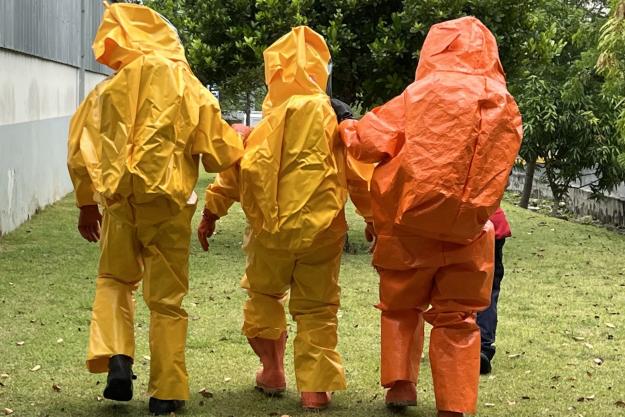
Participants wearing different levels of chemical protective equipment move through a training area during CHEMEX GRULAC in Santo Domingo, Dominican Republic. (Photo: OPCW)
Background
CHEMEX GRULAC was a program centred on regional collaboration, featuring instructors from Argentina, Barbados, Brazil, Chile, Colombia, Costa Rica, Dominican Republic, Ecuador, Grenada, Panama, Spain and Uruguay. These instructors, coordinated and technically supervised by OPCW lead experts from the Assistance and Protection Branch, conducted masterclasses, practical sessions, and field exercises for participants in their respective areas.
As the implementing body for the Chemical Weapons Convention, the OPCW, with its 193 Member States, oversees the global endeavour to permanently eliminate chemical weapons. Since the Convention's entry into force in 1997, it is the most successful disarmament treaty eliminating an entire class of weapons of mass destruction.
In 2023, the OPCW verified that all chemical weapons stockpiles declared by the 193 States Parties to the Chemical Weapons Convention since 1997 - totalling 72,304 metric tonnes of chemical agents - have been irreversibly destroyed under the OPCW's strict verification regime.
For its extensive efforts in eliminating chemical weapons, the OPCW received the 2013 Nobel Peace Prize.


