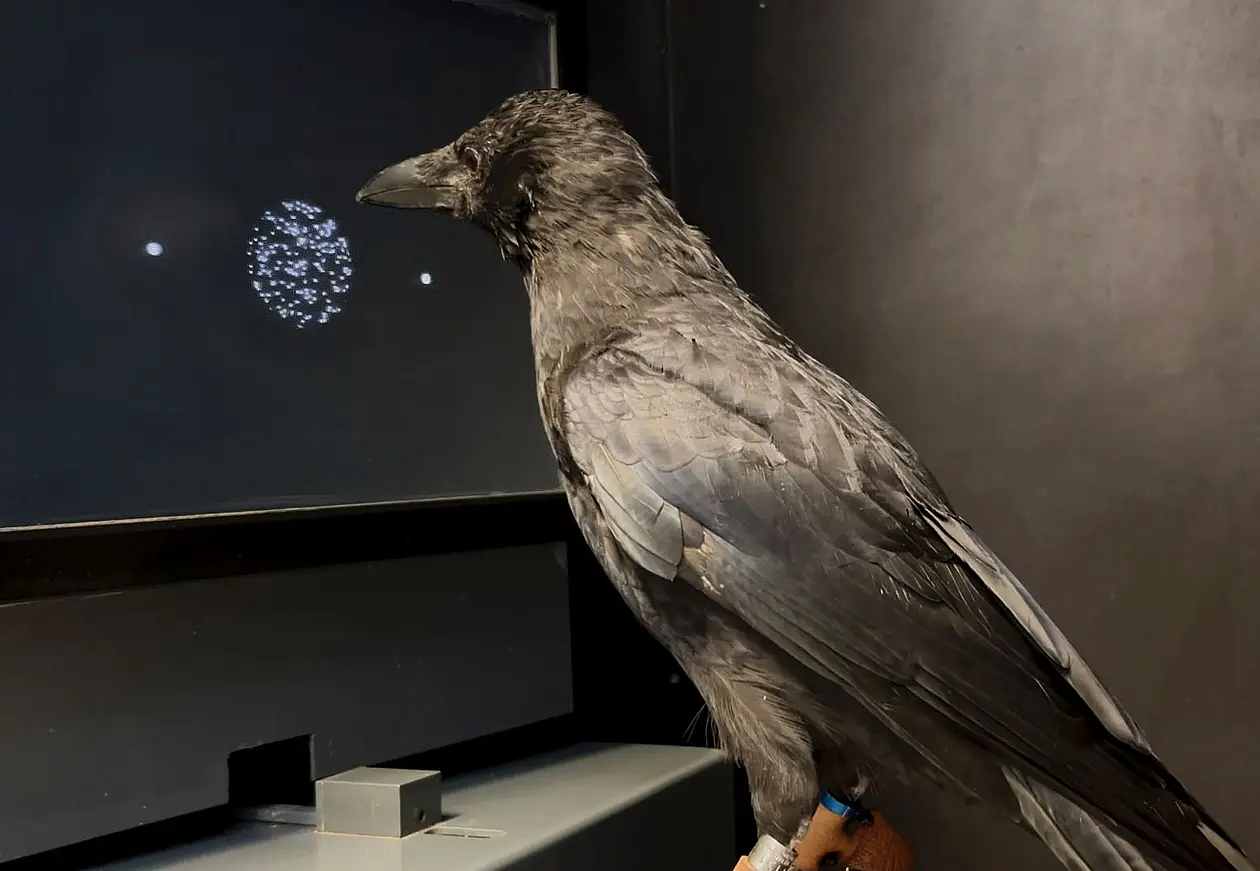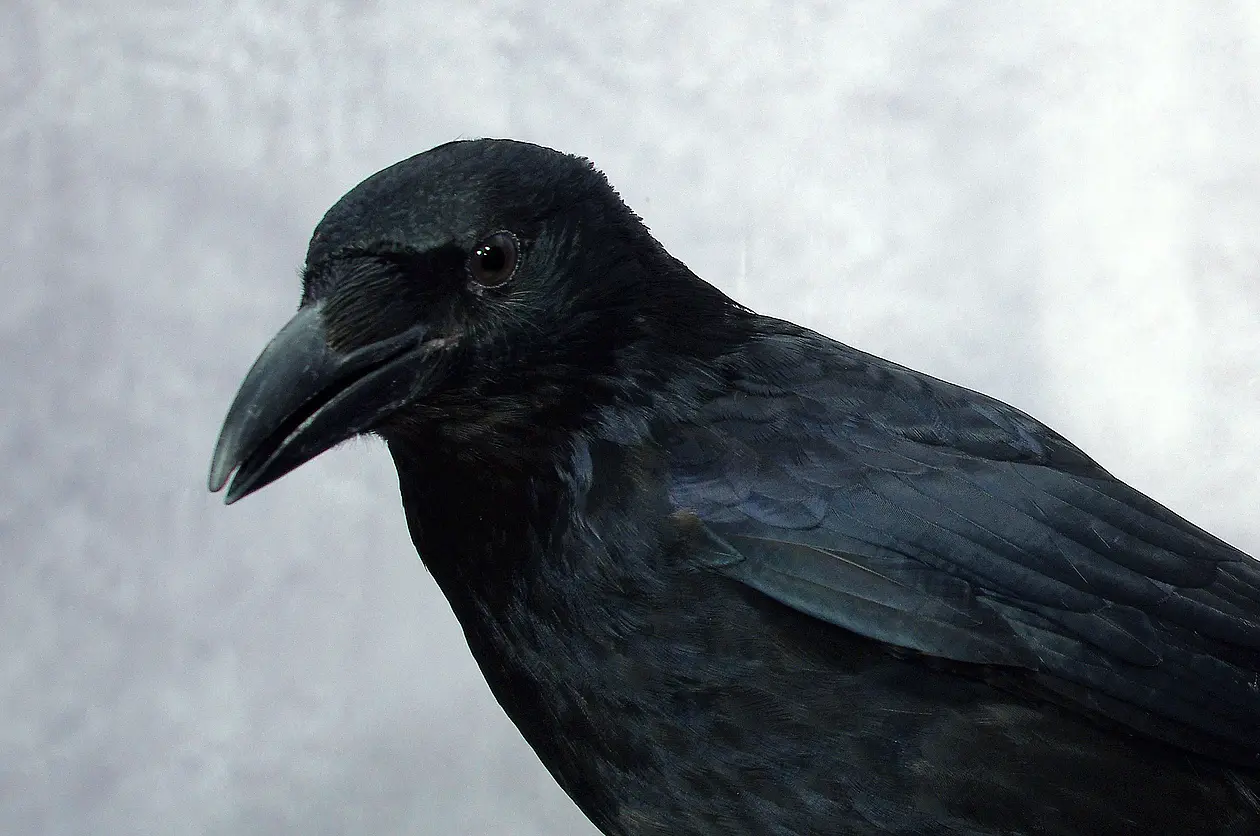
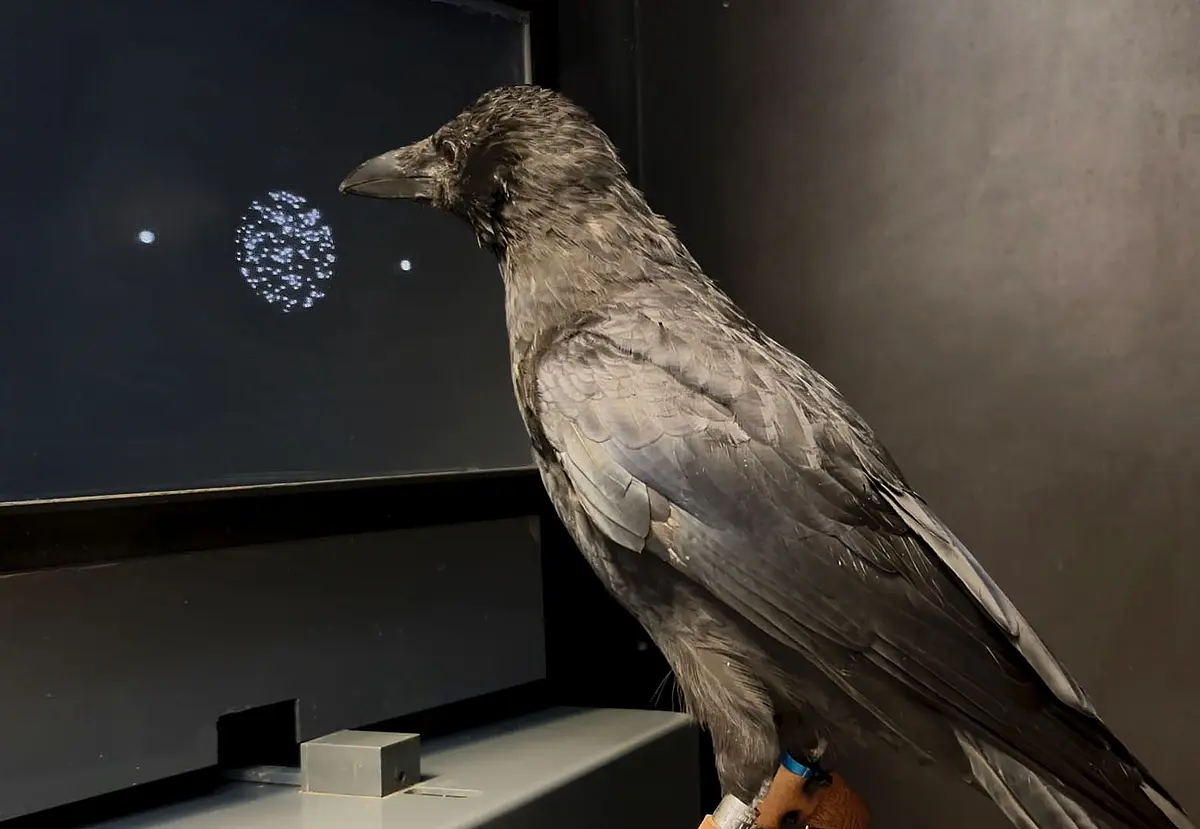
University of Tübingen researchers have shown that crows, when confronted with a visual choice, make a decision twice as fast as humans and monkeys. In the experiment, two carrion crows took just 235 milliseconds on average to identify the direction in which a dot pattern was moving and to indicate their choice - while maintaining a high degree of accuracy. Philipp Schmidbauer and Professor Andreas Nieder from the Institute of Neurobiology of the University of Tübingen demonstrated how this remarkable speed is reflected in the activity of neurons in the crow brain. Their study has been published in the journal Science.
In the task, the birds had to determine whether moving dots on a touchscreen were predominantly moving to the left or to the right. The crows indicated their decision by pecking at a target to the left or right of the dot pattern. "Even when the patterns of motion were hard to recognize, the crows' decisions were still better than random choices," Philipp Schmidbauer reports, "and with clear signals, they achieved an accuracy of nearly 100 percent."
To investigate this ability, the researchers recorded the activity of neurons in the nidopallium caudolaterale, a key associative region of the avian brain, comparable to the prefrontal cortex in humans. As early as 70 milliseconds after the onset of the visual stimulus, neuronal signals for different motion directions began to diverge in the crows' brains - long before the birds could make their responses. Neural activity gradually increased as the decision was being formed, before reaching a decision threshold and the crow indicated its choice. The neurons reflected both the strength of the available visual information and the direction selected.
Different brain structure, but comparable processes
"These findings show that neuronal dynamics in the avian brain are consistent with established models of decision-making in humans and non-human primates," says Andreas Nieder. Although birds do not possess a layered cerebral cortex, their differently organized brains appear to implement comparable basic principles of decision-making - and to do so twice as fast as primates.
This exceptional speed may be related to the evolutionary demands for rapid visual processing and motor responses in birds, Nieder explains. "Birds rely on their vision to carry out precise, rapid maneuvers during flight and to guide their beaks towards objects when foraging," he says, adding that further research will be needed to determine exactly which mechanisms enable this temporal advantage.
Publication:
Philipp Schmidbauer and Andreas Nieder: Ultrarapid decision-making in an avian brain, Science, 22. Oktober 2026, https://doi.org/10.1126/science.aed6459