
With a new focus on dynamics and a distinctive quantum vibe, the Würzburg-Dresden Cluster of Excellence ctd.qmat - Complexity, Topology and Dynamics in Quantum Matter - enters the second funding period of the Excellence Strategy.
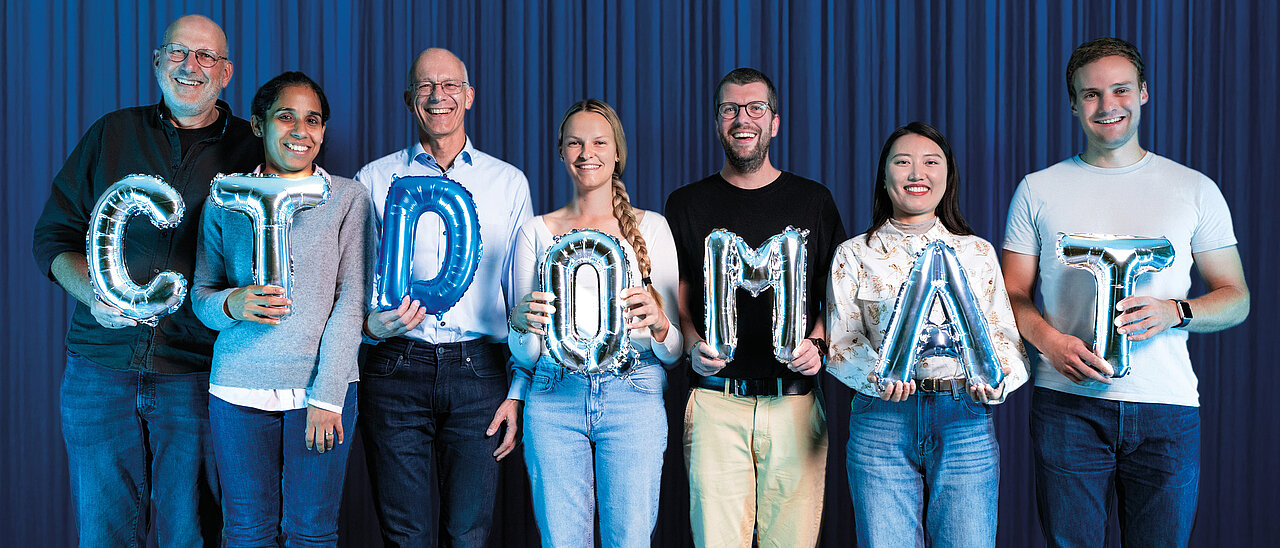
Alongside complexity and topology, the dynamics of quantum systems now form the third pillar of research at ctd.qmat and will shape all areas of its work. "Quantum dynamics is the key to understanding the phenomena discovered during the first funding period at a deeper level, controlling them, and ultimately enabling technological applications," says Matthias Vojta, Professor of Theoretical Solid-State Physics at TU Dresden and ctd.qmat's Dresden spokesperson. "In the second funding period, which runs until 2032, we look forward to pursuing even more compelling physics while placing greater emphasis on the practical concepts emerging from our fundamental research."
Controlling Quantum Processes in Real Time
How do quantum systems change over time, particularly when driven by time-dependent external impulses such as electric currents, magnetic fields, or pressure? Questions like these are moving to the forefront of ctd.qmat's research agenda. "Many applications in information processing, sensing, and energy transformation rely on extremely fast switching and control processes," explains Ralph Claessen, Professor of Experimental Physics IV at JMU Würzburg and Würzburg spokesperson for the cluster. "In the second funding period, we'll be developing theoretical frameworks for complex dynamics in topological quantum materials and exploring phenomena that only emerge under dynamic control." To enable the real-time measurement and control of ultrafast processes, ctd.qmat's experimental infrastructure will be further expanded. The overarching aim is to develop quantum materials that function at room temperature and open up new possibilities for green energy technologies, energy-efficient electronics, high-precision sensors, and robust quantum bits.
Promising Research Approaches
One particularly promising line of research is topological catalysis. In this field, ctd.qmat researchers are investigating how topological quantum materials can be used to make electrochemical processes more economical - for example in carbon dioxide conversion or the production of green hydrogen. Initial results suggest that catalytic activity can be selectively switched on and off as required by the targeted control of topological properties.
Moreover, ctd.qmat is exploring new forms of topological superconductivity that could enable long-lived quantum states and more stable qubits. Another important area is quantum sensing, where researchers are developing ultra-sensitive measurement techniques based on individual spins.
Expansion of Research and Infrastructure
By establishing its new Area C, Synthetic Quantum Matter, ctd.qmat is extending its previous research focus on photonics to include artificial platforms on which quantum phenomena can be generated, enhanced, and precisely controlled - including effects that don't occur in natural materials. In addition, six new professorships are planned (three each in Würzburg and Dresden), including several appointments in the field of quantum dynamics. In Dresden, a new quantum research center featuring state-of-the-art laboratory facilities is scheduled to open in 2029 in conjunction with the Leibniz Institute for Solid State and Materials Research (IFW Dresden).
What Does the Future Sound Like? Rebranding Video with Quantum Vibes
Dresden-based loop artist Konrad Kuechenmeister has captured the sounds of topological materials research in Würzburg and Dresden and turned them into a distinctive soundtrack - handcrafted loop music infused with quantum vibes. The result can be heard in ctd.qmat's rebranding video , released to mark the launch of the cluster's new name.
Multi-instrumentalist, producer, and performer Konrad Kuechenmeister uses a looper to create rhythmic patterns and layered soundscapes. This effects unit allows musical sequences to be recorded and replayed in continuous loops.
About ctd.qmat
The Cluster of Excellence ctd.qmat - Complexity, Topology and Dynamics in Quantum Matter - at Würzburg University and Technische Universität Dresden explores and develops novel quantum materials with tailored properties. Around 300 researchers from over 30 countries work at the interface of physics, chemistry, and materials science to lay the foundations for tomorrow's technologies. In 2026, the cluster entered the second funding period of the German Excellence Strategy of the Federal and State Governments - with an expanded focus on the dynamics of quantum processes.


