
The Danish Ministry of Taxation overestimates how much the Danish state loses in VAT and sin taxes when Danes cross the border into Germany to buy sweets, soft drinks and beer. That is one of the conclusions of a new study from the University of Copenhagen, which suggests that cross-border shopping does not significantly undermine the effectiveness of sin taxes for the vast majority of Danish consumers.
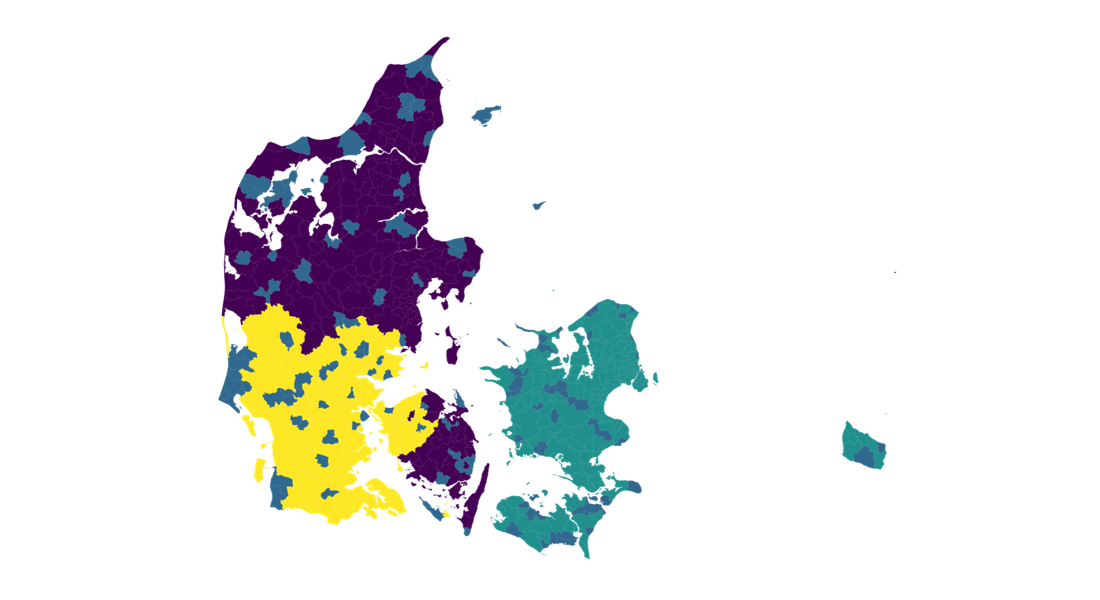
Will higher sin taxes, and therefore higher prices, on sweets, soft drinks and beer lead to more cross-border shopping? The answer is often assumed to be yes in the public debate, where one of the main arguments against sin taxes on unhealthy products has long been that higher prices will encourage more Danes to shop across the border.
However, a team of researchers from the Department of Food and Resource Economics at the University of Copenhagen challenges that argument in a new study published in The Scandinavian Journal of Economics. The researchers analysed Danish households' purchasing patterns during the COVID-19 border closures in 2020 and 2021, when cross-border shopping was effectively impossible. More specifically, they examined how much of the shopping that normally takes place at the Danish-German border returned to Danish shops when cross-border shopping was no longer an option.
Why the ministry's and researchers' estimates differ
The Danish Ministry of Taxation estimates that Denmark loses approximately DKK 1.5 billion annually due to cross-border shopping in sin goods, excluding tobacco products. This estimate is based on data on purchases made by Danes in border shops.
The researchers challenge this estimate using data from Danish households' purchases during the COVID-19 border closures in 2020 and 2021, when cross-border shopping was impossible. For comparison, they use the Ministry's estimate from 2019, when the Ministry calculated the loss from cross-border shopping at DKK 1.16 billion.
The analysis shows that Danes purchase only a fraction of the products in Denmark that they previously bought in Germany. As a result, the researchers conclude that the financial loss to the Danish state is substantially smaller.
Their estimate puts the loss at DKK 415 million, roughly a third of the estimates reported by the Ministry of Taxation.
"The amount is considerably smaller than official Danish estimates suggest. The authorities assume that all purchases made in Germany would instead have been made in Denmark if the border had been closed. Our findings show that this is not the case," says Magnus Munk Bjerg, PhD student at the Department of Food and Resource Economics and co-author of the study.
According to the Danish Ministry of Taxation, the Danish state lost DKK 1.16 billion due to cross-border shopping in 2019, excluding tobacco products. The researchers' estimate is substantially lower, at DKK 415 million.
"The Ministry of Taxation bases its calculations on what Danes buy in Germany. But if we want to understand what Denmark actually loses, we need to look at what happens to consumption in Denmark. That is precisely what we have done," says Magnus Munk Bjerg.
He also offers a possible explanation for why Danes do not simply buy the same products in Denmark that they purchase across the border:
"Once people have packed the car or trailer and driven a considerable distance, they are likely to buy a range of additional products to make the trip worthwhile," says Magnus Munk Bjerg.
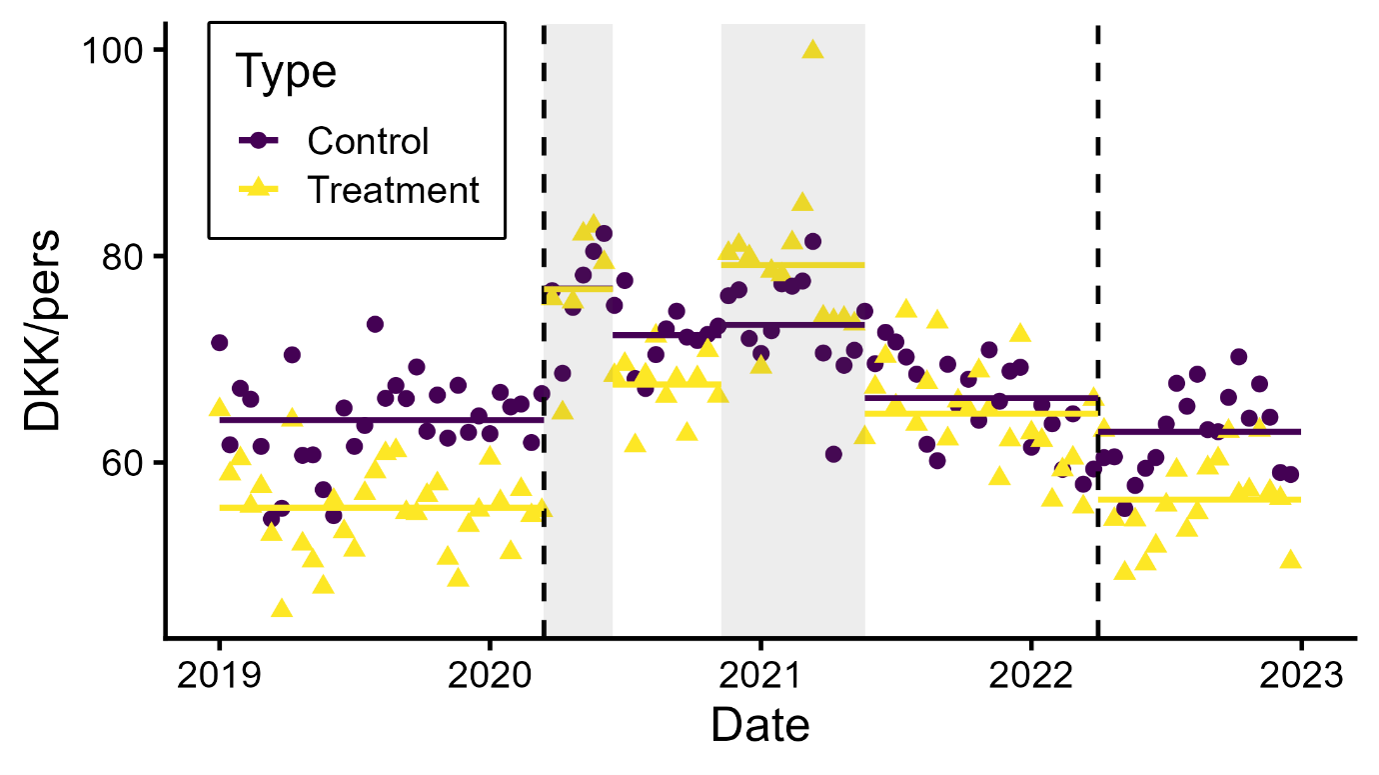
The figure shows spending on sin goods in Danish shops among households in the treatment group (yellow) and the control group (purple), excluding tobacco products. The grey shaded areas indicate the two COVID-19 lockdown periods and the associated border closures. The dashed lines mark periods of pandemic-related restrictions. Before the lockdowns, households living close to the border spent noticeably less in Danish shops because they could shop in Germany. When the border closed, the difference disappeared. It re-emerged when the border reopened.
Source: Bjerg et al. (2026), based on data from the YouGov Shopper Panel
Cross-border shopping is primarily a local phenomenon
In the study, the researchers compare purchases made by households living close to the border with those made by households living so far away that cross-border shopping has never represented a financial benefit.
They found that households living within 30 kilometres of the border increased their spending on sin goods, including sweets, chocolate, crisps, soft drinks, beer, wine and spirits, by 109 percent in Danish shops when the border closed.
The study has recently been published in The Scandinavian Journal of Economics.
The researchers used data from the YouGov Shopper Panel, a panel of Danish households that continuously records grocery purchases. The findings were validated using an independent dataset from Spenderlog.
The following researchers from the Department of Food and Resource Economics contributed to the study: Magnus Munk Bjerg, Carl-Emil Pless, Christopher Posselt and Sinne Smed.
Overall, households within 150 kilometres of the border increased their spending on sin goods by an average of 21 percent as a result of the border closure. Beyond 120 kilometres from the border, the researchers could detect no change in household consumption patterns.
The researchers stress that cross-border shopping remains highly significant for people living close to the border. Nevertheless, the study highlights an important point:
"If the policy objective of taxing these products is both to increase government revenue and improve public health, our findings suggest that those effects are likely to be fully realised for the vast majority of Danish households," says Carl-Emil Pless, postdoctoral researcher and co-author of the study.
If sin taxes on sin goods were increased tomorrow, the results suggest that it would primarily be people living close to the border who would respond by shopping across the border.
"Some residents of the border region might travel to Germany even more frequently than they already do, but this is a relatively small group overall. The effect is therefore primarily local rather than national," says Carl-Emil Pless.
According to the researchers, the findings may also have implications for how policymakers think about the optimal level of taxation on sin goods:
"We are not saying what the tax rate should be. But our results show that cross-border shopping should carry less weight when policymakers decide how taxes on unhealthy foods ought to be designed," concludes Magnus Munk Bjerg.


