
No stranger to bumps and bruises or an occasional muscle ache, 10-year-old Jordan Magaña seemed unstoppable. He would bike to school, practice martial arts and even do tricks on a pogo stick. But when his left hip started hurting before bed, his mother, Julia Magaña, feared there was a problem.
Magaña, an emergency medicine physician at UC Davis Medical Center, recalled asking him what made the pain more severe.
"It was worse walking up the stairs and he didn't have any trauma history," Magaña said. "I watched him walk and noticed he was swinging out his leg a bit. I worried there was something more going on."
Magaña suspected he had a condition called slipped capital femoral epiphysis, or SCFE, the most common hip disorder in adolescents. SCFE occurs when the ball at the top of the thighbone (femur) slips backward off the neck of the bone through the growth plate. SCFE causes hip, groin, or knee pain and a limp — exactly like Jordan's hip pain. But the disorder typically occurs in kids older than 10. Wasn't it too early?
It was very, very subtle but Dr. Obi picked up on it. I am confident that a non-pediatric radiologist would have missed it."-Julia Magaña, Jordan's mom

Pediatrics and radiology, under one roof
Jordan's dad, Orlando, took him to pediatrician Maria Martins, located in the UC Davis Health Davis Clinic near their home.
Martins also recognized the signs of SCFE and sent Jordan for X-rays, conveniently in the same building.
"Dr. Martins is a fantastic pediatrician," Magaña said. "She knew to get the frog leg X-ray."
Indeed, Jordan had SCFE, as confirmed by pediatric diagnostic and interventional radiology fellow, Chrystal Obi.
"It was very, very subtle but Dr. Obi picked up on it," Magaña said. "I am confident that a non-pediatric radiologist would have missed it."
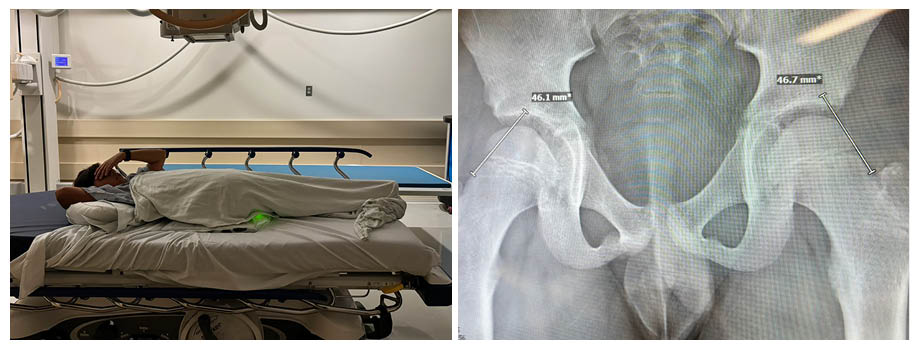
Martins called the Magañas within 20 minutes of the X-ray results with a plan. She had already spoken to the UC Davis pediatric orthopaedics team and said they were expecting Jordan at UC Davis Medical Center.
SCFE requires immediate surgery
Delayed diagnosis and treatment of SCFE increases the likelihood of more serious complications, including disabling conditions and early-onset degenerative hip arthritis that may require hip reconstruction or replacement. The Davis clinic care team directed Jordan to the pediatric emergency department (ED) at UC Davis Children's Hospital in Sacramento. He would require immediate surgery to stabilize the growth plate and prevent further slipping.
Jordan had been to the ED before but never arriving in a wheelchair.
"When we got there, I couldn't walk so they wheeled me in," Jordan recalled. "I was very scared and nervous. I was worried about what would happen next."
Jordan would get the same high-level, competent, detailed attention and care we give to absolutely every child, every shift, every day."-Emily Andrada, pediatric emergency department attending physician

Even though Magaña was not used to being on the parent side of an emergency, she was confident in her son's care plan. After all, she provided the same level of care for her pediatric emergency patients, and she knew her colleagues would as well.
"Jordan would get the same outstanding, excellent service that we give every single child that arrives to our pediatric ED," said Emily Andrada, attending physician and director of pediatric emergency medicine education. "Nothing special; no VIP service, no shortcuts, no expedited anything. Just the same high-level, competent, detailed attention and care we give to absolutely every child, every shift, every day."
Orthopaedics enters the mix
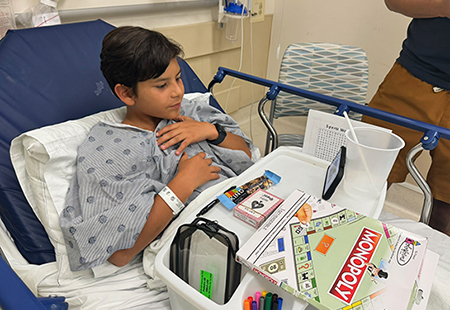
UC Davis is also home to a comprehensive hip program offering an expert, compassionate orthopaedic surgery team. Surgeons are experts in a full range of procedures for hip replacement and hip joint preservation. They use the most up-to-date techniques to make surgery safer and more effective for children and adults alike.
Jordan was in good hands.
"I'm obviously biased, but I wouldn't send my kids anywhere else other than UC Davis," Magaña said. "While it was concerning to think about my son needing urgent surgery, there wasn't a question of where to go."
Jordan was moved to Tower 6 at UC Davis Children's Hospital where he found a stuffed animal waiting for him on his bed, which the staff called Spinosaurus.
"My pillow and a blanket were all set up, too" Jordan recalled. "It was nice."
Early the next morning, pediatric orthopaedic surgeon Amanda Whitaker clearly explained to Jordan what the surgery would entail.
The risk of doing a procedure where you would shut down that growth plate is that a younger child like Jordan would potentially have a leg length discrepancy. His femoral head (hip) could also grow into an abnormal shape."-Amanda Whitaker, pediatric orthopaedic surgeon
A new device that grows with the child
Surgical treatment usually involves placing a metal screw across the growth plate to hold the bone in place. But because Jordan was so young, there were additional considerations.
"The risk of doing a procedure where you would shut down that growth plate is that a younger child like Jordan would potentially have a leg length discrepancy," Whitaker said. "His femoral head (hip) could also grow into an abnormal shape."
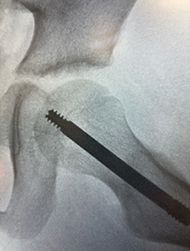
She decided to lessen that risk by using a new device that extends as the child grows. Jordan was among the first patients at UC Davis Children's Hospital treated with this implant because it's geared primarily for younger children with a small slip. Jordan's situation made him an ideal candidate.
"This device holds the slipped capital epiphysis in place and doesn't allow it to move, which is key," Whitaker said. "But then it also telescopes on itself so it still allows for growth. The goal behind it is that you don't get a leg length discrepancy and your ephemeral head stays nice and round."
Mom found the new equipment fascinating.
"This device is mind-blowingly cool because they're empty tubes and the screw is inside and attached to Jordan's hip bone. But then, as the bone grows, it can come out and expand to match his growth. Biotechnology. Wow," Magaña said.
Bouncing back
The surgery was successful and Jordan went home the next day.
"He was a great patient. One of the reasons I'm a pediatric orthopaedic surgeon is to restore function back to kids and allow them to live their life as if they never even had this condition," Whitaker said. "My hope was that Jordan could return to everything he loves doing. We really do have an amazing team and thanks to everyone's care and recognition of early SCFE, this won't stop him."
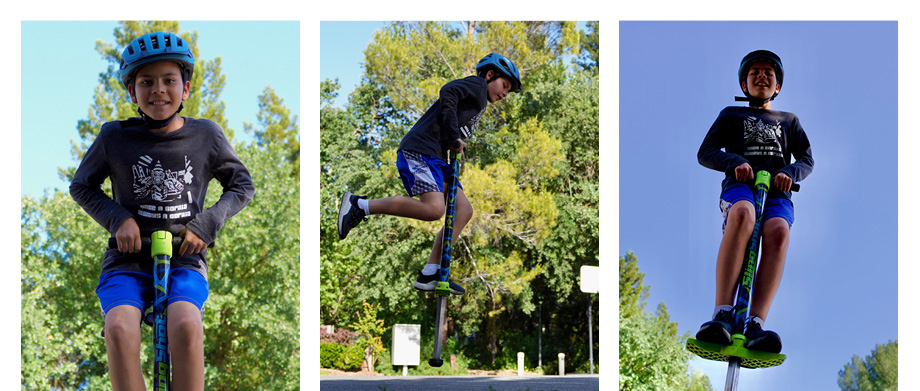
Jordan used a wheelchair and crutches for three months. Soon after, he was able to play with friends, run and do the activities he loves — including pogo sticking.
Early detection is the difference maker
Jordan's prognosis is positive, Whitaker said. He's at very low risk of future hip problems because his SCFE was caught so early.
"Ten years old is young, but any child in the 8 to 15 age range who's having hip pain and is still growing, could have SCFE. We want to try to catch it early," Whitaker said. "SCFE is probably one of the most common missed diagnoses on X-rays. The fact that we were able to see it and then fix it in this way is amazing."
Andrada, the attending ED physician, agrees.
"It is an absolute privilege and honor to be able to wield the resources of this institution in service of a child," she said. "In Jordan's case, our whole team worked together like a well-oiled machine to get him back to his life with minimal interruption. I recently saw Jordan and the mission is complete."
Food for thought
Now 12-years-old, Jordan feels good and hasn't experienced much pain. He visits the orthopaedic team for annual checkups and doesn't have asymmetry in his leg length. So far, so good.
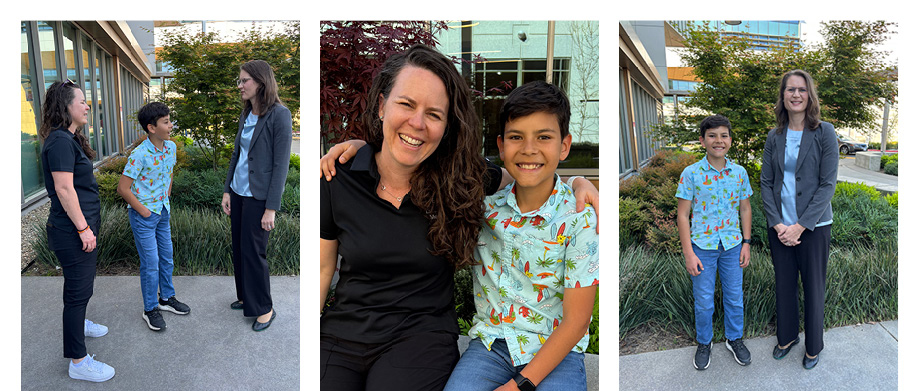
Recently promoted from sixth grade and an avid Dungeons and Dragons and Pokémon fan, Jordan is excited about the future. He wants to encourage other kids to speak up if they have hip pain and to not be afraid of SCFE surgery.
"It felt safe and they were very nice," Jordan said. And the Jell-O tasted good as well."
And as for Spinosaurus? He played an important role in Jordan's SCFE experience, but is now just a memory. A fond one, but a distant one. Just as everyone had hoped.


