
• Researchers achieved precise structural control of graphene using extremely low energy input.
• The discovery could lead to new memory technologies, sensors, and nano-scale electronic components.
• The findings may support advances in neuromorphic computing — brain-inspired electronic systems.
A team of researchers from Tel Aviv University, in collaboration with colleagues from Japan, has taken an important step toward the next generation of electronics. The scientists achieved highly precise control of the internal structure of graphene - an exceptionally thin and strong material - using a minute, nearly negligible amount of energy.
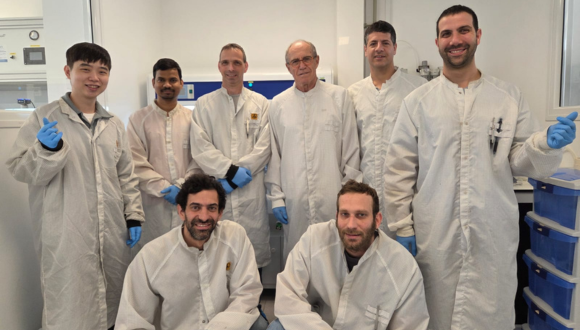
The study was conducted under the supervision of Prof. Moshe Ben-Shalom of the School of Physics and Astronomy, together with Prof. Michael Urbakh and Prof. Oded Hod of the School of Chemistry. The experiments and calculations were led by Dr. Nirmal Roy and Dr. Pengua Ying, supported by Simon Salleh Atri, Yoav Sharaby, Noam Raab, and Dr. Youngki Yao. The findings were published in the journal Nature Nanotechnology.
Why graphene stacking matters
Graphene, which consists of a thin layer of carbon atoms, has long been regarded as a "star" in the world of materials. Yet it is not only the material itself that matters, but also how the graphene layers are stacked on top of one another. Different stacking arrangements create entirely different properties: different electrical conductivity, different responses to magnetic fields, and even conditions that enable the emergence of superconductivity.
Until now, controlled switching between these stacking arrangements has been a complex process that required a great deal of energy and was unsuitable for practical applications. In the new study, the researchers succeeded in overcoming this obstacle.
The solution they developed is based on an elegant concept: creating tiny "islands" of graphene - only tens of nanometers in diameter - where the layers remain in direct contact with one another, while the surrounding areas are separated by a layer that allows nearly frictionless sliding. Within these islands, one graphene layer can be shifted relative to another, thereby changing the stacking arrangement.
A striking result: structural change with minimal force
The result is striking: the material's state can be changed using an extremely small force, with an energy input orders of magnitude lower than that required by existing memory technologies. In many cases, once the change is initiated, it continues on its own, without the need to apply additional force.
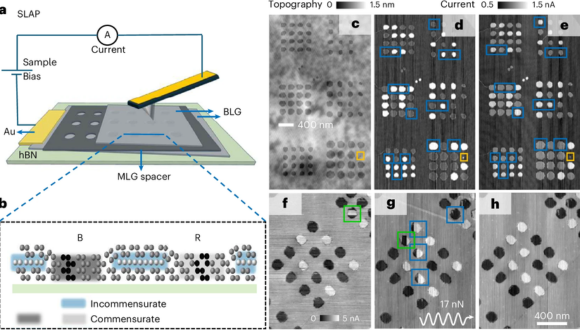
An illustration of the research: The Super-Lubric Array of Polytypes (SLAP) device in action. The bright and dark circles represent high and low electrical currents.
Toward brain-inspired computing
Beyond this, the researchers showed that neighboring islands can be connected so that a structural change in one island also affects its neighbors. This opens the door to creating systems in which different regions "communicate" with one another in a mechanical-elastic manner, similar to a neural network. Such a property may be particularly relevant to the development of neuromorphic computing - computers that mimic the way the brain operates.
According to the researchers, the new method opens promising avenues for the development of memory components, sensors, and tiny electronic devices that are both fast and exceptionally energy-efficient. In the future, it may enable the creation of smart electronic systems on the nanometer scale - systems that consume less energy, generate less heat, and can perform complex operations in ways that until now seemed purely theoretical.
Prof. Moshe Ben-Shalom concludes: "This is a breakthrough that has the potential to transform the way electronic components are designed at the nanometer scale. We show that it is possible to control the structure of graphene and other layered crystals in a precise, reversible, and extremely energy-efficient manner. Instead of breaking and rebuilding chemical bonds, we simply slide atomic layers over one another - a natural process that is much faster and more efficient. The ability to design interactions between different regions within a material opens up new possibilities, not only for advanced electronics but also for brain-inspired computing systems. This is another step toward turning physical phenomena that until now were considered purely academic into practical, working technology."


