
The European Research Council has granted €14 million to a research project aimed at investigating why Antarctica's floating glaciers are disintegrating. €5,2 million will go to the University of Gothenburg.
"This is incredibly exciting and confirms that the marine research carried out at the University of Gothenburg is central to global marine research," says Anna Wåhlin, Professor of Oceanography and corresponding PI.
It is the 400 km-long Riiser-Larsen ice shelf along the coast of East Antarctica that is the focus of this large EU research project.
An ice shelf is the outermost part of a glacier that has drifted from the mainland out into the sea and thus floats on the surface of the ocean - a 'floating glacier'. It acts as a protective barrier that prevents the glacier behind it from skidding out into the sea too quickly.
It's important that this protection works for both the climate and sea levels. However, in recent decades, the extent of the ice shelves has decreased as a result of melting, calving and, in some cases, complete collapse. Scientists do not know why some of the ice shelves collapse, whilst others remain unaffected.
"Despite their immense importance, we do not really know what affects the stability of these enormous ice shelves. Without that knowledge, we cannot make reliable predictions about future sea-level rise," says Anna Wåhlin.
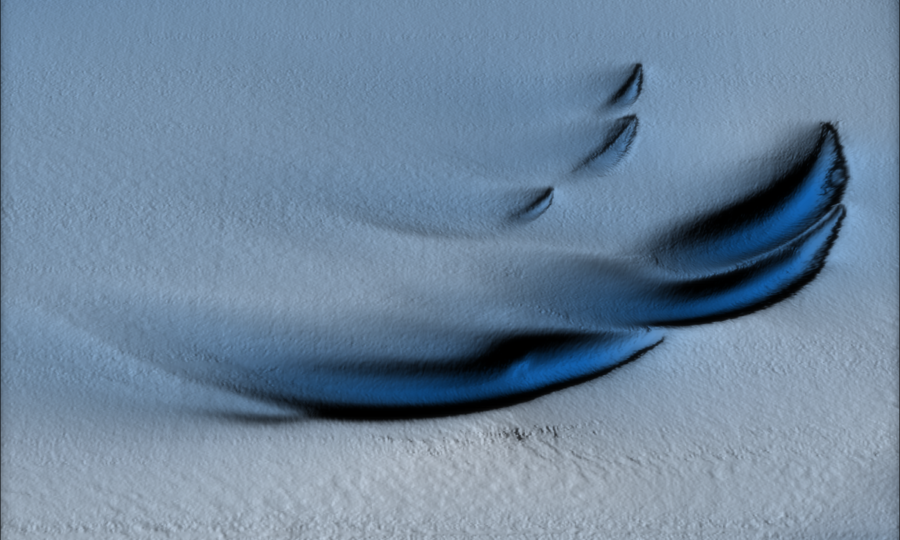
Snow, cracks, and warm ocean currents
Everything is interconnected. It's not possible to study one aspect without studying the others. The researchers will therefore investigate processes beneath the ice, on top of the ice, and within the ice - and how they interact with one another.
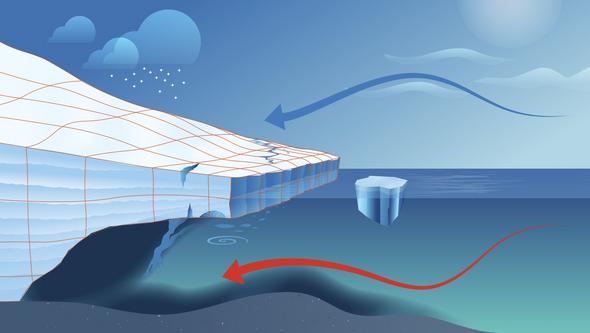
It's about how warmer seawater flows into the cavities beneath the ice, melting the ice and weakening it from below. It's about how increased snowfall leads to heavier ice, which can melt and weaken the ice from above. And it's about how cracks, channels, and shear stress weaken the ice from within.
"Our hypothesis is that the hidden structure within the ice shelves - formed by snowfall, melting, and internal fractures - determines how influences from the sea and the atmosphere lead to weathering. The data collected will hopefully provide a better understanding of the processes that weaken the ice shelves," says Anna Wåhlin.
The data collected during the project will also be important for assessing the future of other glaciers in Antarctica, such as Thwaites Glacier, also known as the Doomsday Glacier. Thwaites Glacier is enormous, and its collapse could have major consequences for sea levels.
"That is why this type of major European funding is so important. Existing observations and models are not yet able to capture these interacting processes. That is why we are putting together a completely new team with a range of expertise, which together can take a broader perspective. It encompasses oceanography, meteorology, glaciology, satellite data, and modelling," says Anna Wåhlin.
Launch of Ran II
The researchers will undertake several expeditions to Antarctica over the six years the project runs. Among other things, Anna Wåhlin will be using the underwater robot Ran II, the replacement for Ran, which disappeared beneath the Dotson Glacier in January 2024. Just as with Ran, Ran II will be sent beneath the ice shelf to map the base and investigate how ocean currents affect the melting process.
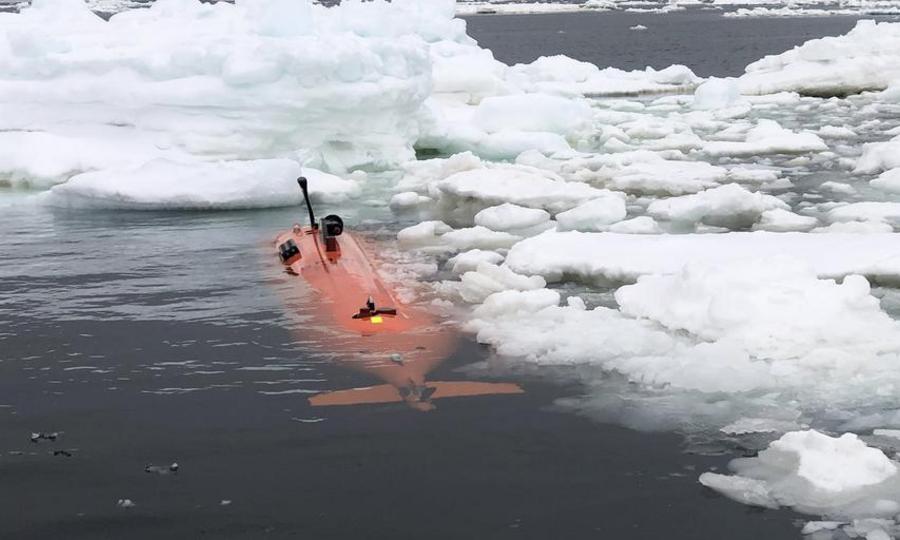
"With Ran, we obtained globally unique research findings from beneath the Thwaites and Dotson glaciers. We uncovered a complex system of channels that control the flow paths of the water and how the ice melts from below. We hope to obtain similar data this time too," says Anna Wåhlin.
"From the outside, it might seem like utter madness to once again send an enormously expensive robot beneath several hundred metres of ice. But it's the only way to collect the data needed to fill these knowledge gaps. The alternative would be to stop researching because it's too expensive and too risky. Fortunately, we have organisations that are willing to fund high-risk research," says Anna Wåhlin.
Custom-built robot to fit borehole
So far, icebreaker expeditions are planned for 2028 and 2030, as well as a land-based expedition with tracked vehicles in 2029, during which a number of holes will be drilled in the ice using hot water. Sensors, robots, and cameras will be sent through the holes to study the ice in minute detail.
One of the robots is currently being custom-built in Gothenburg by AUV technician Filip Stedt to fit into the narrow borehole.
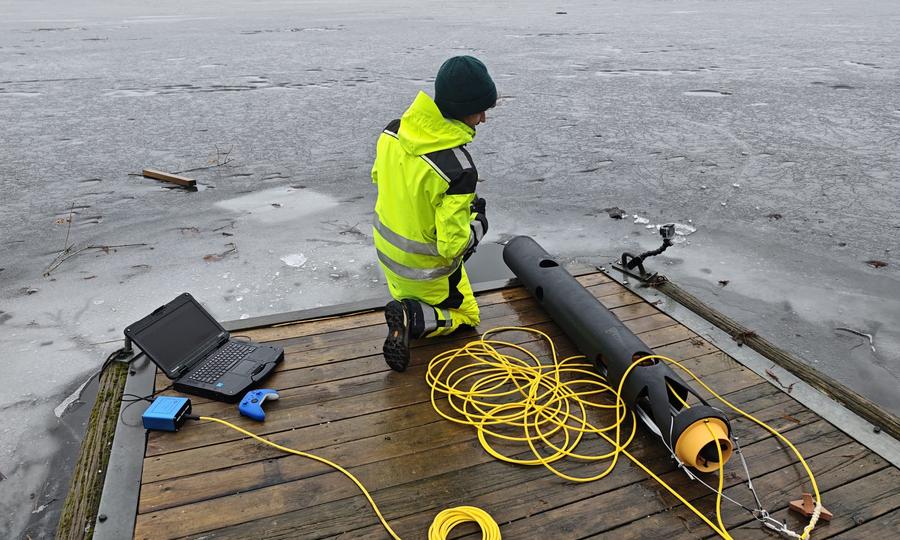
Also taking part from the University of Gothenburg is Mark Peternell, a senior lecturer in geology, who is leading the research into the microstructures that affect the load-bearing capacity of the ice, such as impurities and small cracks.
"We want to see how temperature, salt, water, and the arrangement of the ice crystals affect whether the ice deforms slowly or breaks suddenly, but also how repeated melting and refreezing can cause small cracks to grow," says Mark Peternell.
"It's a wonderful feeling to receive such a large grant that we actually can plan the expeditions for the next six years, down to the smallest detail, with all that this entails in terms of procurement, logistics, and personnel. This is all I want to do," says Anna Wåhlin.
Links to ERC
Link to the European Research Council's press release: ERC Synergy Grants 2026: Bringing 48 research teams together to tackle science's biggest challenges
Link to more information on the SKUA Project: Synergy Grants 2026: Examples of projects


