Leeds researchers have played a key role in a pioneering study in the Irish Sea. It aims to address critical evidence gaps on the impact of bottom trawling on seabed carbon storage.
Bottom trawling – the practice of dragging nets along the seabed for fishing – has long been known to disturb carbon stored in the seabed, but scientists do not fully understand how these changes affect the environment.
The SeaSTORE project provides a unique opportunity for scientists working with the fishing industry to measure carbon in the water column and sediment during active, real-world fishing activity, helping researchers understand how disturbed carbon moves through water and how much carbon may be released into the atmosphere.
While previous research has suggested that bottom trawling may have a significant impact on the release of planet-heating carbon dioxide (CO2), it is unclear how much carbon from the seabed reaches the atmosphere in practice.
"Our team is using innovative sampling and analytical approaches to identify relationships between seabed composition and bottom trawling that will fill vital gaps in our knowledge.
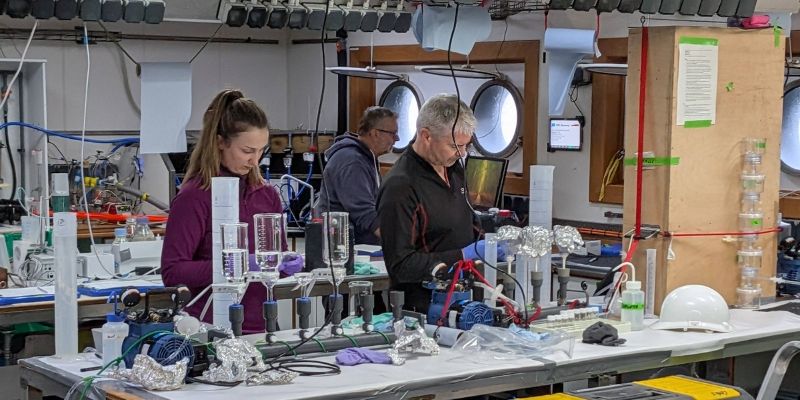
Scientists from across the UK travelled to the Irish Sea to study the impact of activity by three professional fishing trawlers, using novel techniques to track carbon. The ability to analyse the impact of real-world activity immediately after it has taken place, with the research ship following directly behind the trawlers, was made possible through a unique collaboration between SeaSTORE and the fishing industry.
The research cruise in the Irish Sea, which began on 22 July and ended on 15 August, followed an earlier cruise in the winter. Together, the two research trips will help researchers to understand the impact of bottom trawling in different weather and seasonal conditions.
SeaSTORE, which has been funded by the Natural Environment Research Council (NERC), is led by Bangor University, in collaboration with Imperial College London, the University of Leeds, Heriot-Watt University, the Plymouth Marine Laboratory and the Centre for Environment, Fisheries and Aquaculture Science (Cefas).
Knowledge gap
Professor Jan Geert Hiddink, Project Lead for SeaSTORE, from Bangor University, said: "Bottom trawling is the most extensive physical disturbance to seabed carbon stocks on the planet, yet we don't know whether it turns sediments into a net source of CO2, by how much, or where and when. This project aims to close that gap with direct measurement across contrasting environments.
"What's missing is a holistic assessment. Previous work has looked at sediment carbon, water column processes, or air-sea exchange in isolation. We're bringing all of that together for the first time, from the seabed to the atmosphere.
"Fisheries provide a quarter of the world's seafood, and food production has to stay part of the conversation. Our aim isn't to argue for or against trawling, but to make sure that trade-offs between food production and seabed carbon can be considered in policy decisions."
The project aims to answer four key questions around seabed carbon storage:
- How does the type of fishing gear, the frequency of trawling, and the type of sedimentary environment impact the potential for CO2 to be released into the atmosphere?
- When seabed carbon is disturbed by trawling, how does this change the surrounding seawater and where does the carbon go?
- How does movement in the water column and biological processes from marine life impact the potential for CO2 to reach the sea surface and the atmosphere?
- Could different approaches to trawling reduce carbon loss and CO2 emissions, and improve the recovery of carbon stores in the seabed?
Dr Will Homoky, Associate Professor of Marine Geochemistry in the School of Earth, Environment and Sustainability, who is the University's project lead – and Dr Ruth Parker, blue carbon expert from Cefas – said: "Effective governance of the ocean requires a clear understanding of the seabed. Our team is using innovative sampling and analytical approaches to identify relationships between seabed composition and bottom trawling that will fill vital gaps in our knowledge.
"This highly collaborative research programme will rapidly improve the evidence base to provide stakeholders and decision makers with a clearer picture of the risk to carbon from bottom trawling. This will allow the design of management measures which support our net zero and food security goals while safeguarding marine biodiversity.
"We must consider science-based solutions that carefully weigh the trade-offs between climate action, human uses and nature protection."
SeaSTORE team members from the University also include Dr Chiara Krewer, Research Fellow, School of Earth, Environment and Sustainability; Dr Clare Woulds, Professor of Marine Biogeochemistry, School of Geography; postgraduate researchers Lauren Geiser and Cari Littler, both School of Earth, Environment and Sustainability; Environmental Science graduate Sophia Panayiotou, and Lucia Gates, a visiting undergraduate from the University of Oxford, on a NERC-funded placement.
Cutting-edge technology
Dr Emma Cavan, from Imperial College London, and Professor Alex Poulton, from Heriot-Watt University, said: "Through these research cruises, we hope to be able to finally track carbon through the water column to see what happens to carbon once it is released from the seafloor.
"Using state-of-the-art technology such as imagery and sensors, we are measuring carbon in seawater in all different forms after bottom trawling, to determine where it has come from and where it might end up."
Recent studies have raised concerns that human activities around the seabed, which contains a vast store of carbon, could be linked to increased carbon emissions, with a 2024 study suggesting that as much as 370 million tonnes of planet-heating CO2 may be released each year due to bottom trawling. However, scientists do not have conclusive evidence to show exactly what happens to seabed carbon after it is displaced.
A recent technical briefing led by Cefas for the UK's Department for Environment, Food and Rural Affairs (Defra), which included contributions from several SeaSTORE researchers, noted that the fate of displaced carbon depends on how easily it can be broken down to release CO2. The briefing highlighted that anywhere between 10 per cent and 30 per cent of English seabed organic carbon may be reactive enough to release CO2 into the water.
Some of this CO2 may then reach the atmosphere and contribute to climate change, but the extent of this is dependent on a complex set of interactions with ocean currents, seasonal temperature changes, and biological processes that can absorb and process CO2.
These evidence gaps make it difficult to evaluate the environmental impact of bottom trawling and what steps could be taken to make the practice more sustainable, as well as the implications for management options supporting environmental, clean energy, and food security goals.
Industry collaboration
That is why SeaSTORE has been working with Fish Producer Organisations to close the gaps in understanding around the impact of trawling.
Harry Owen, Head of Fisheries and Innovation at the Western Fish Producers' Organisation, said: "We are committed to improving our understanding of the environmental impacts of fishing, so we are proud to have supported this project through the Margaret Of Ladram fishing vessel which is helping scientists study how towed fishing gears interact with blue carbon stored in seabed sediments.
"This builds on earlier research we supported off the southwestern coast of England, which found no clear evidence of a reduction in seabed carbon stores due to trawling, challenging previous assumptions around the impact of towed gears. SeaSTORE will expand this evidence across different seabed types and fishing gears, helping to close key knowledge gaps so future policy is based on robust science rather than untested assumptions."
Through Cefas, the project's findings will also be shared directly with Defra to provide policymakers with robust evidence of the real-world impact from this activity. It is hoped that the research could be used to inform policies in areas such as Net Zero, biodiversity and food security.