UConn School of Medicine is advancing the future of pancreatic care with Encapsulate, Inc., a precision medicine start-up company at the UConn Technology Incubation Program (TIP).

Image shows patient tumor cell growth in Encapsulate's Biochip System responding differently to varied treatments. The colors show how cancer cells are surviving (blue) or responding/dying (red) under different chemo regimens (Image courtesy of Encapsulate).
Imagine if prior to the start of cancer care, doctors could rapidly confirm the most effective chemotherapy or immunotherapy, or combination thereof, to personalize your loved ones difficult to treat pancreatic cancer treatment to improve their outcomes and life expectancy?
A collaborative UConn School of Medicine research study is exploring this possibility with Encapsulate, Inc., a precision medicine start-up company at the UConn Technology Incubation Program (TIP). Here inside their Farmington laboratory the researchers are testing the earthly effectiveness of the company's pioneering Biochip System. Creators of the company and technology are UConn's own Leila Daneshmandi '20 Ph.D., '21 MA and Armin Rad '19 Ph.D., '20 MA.
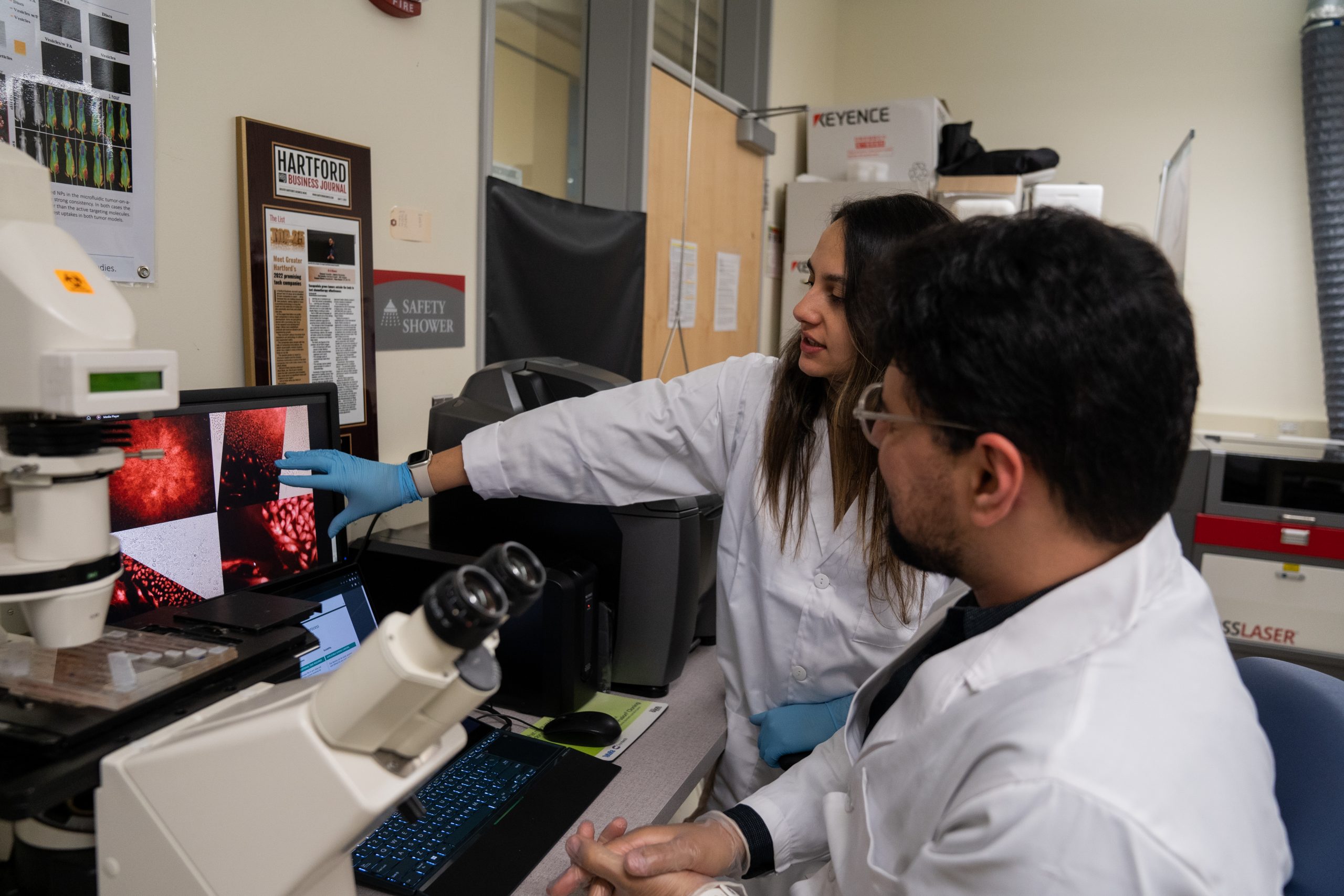
The hope is that Encapsulate's rapid, functional testing in the lab can quickly examine a pancreatic cancer patient's individual tumor's tissue sample, replicate its cellular growth in the lab, and predict which agents will be the most effective to stop its progression.
"If this technology can help us pinpoint upfront the more effective chemotherapy, it's a big deal, and will finally move the needle toward precision medicine for personalizing future pancreatic cancer care," says co-principal investigator of the trial at UConn School of Medicine Dr. John Birk, chief of gastroenterology and hepatology, who is working with co-PI Dr. Murali Dharan, director of the Advanced Endoscopy Program at UConn Health. Currently, chemotherapies only work 60 percent of the time for pancreatic cancer clinical care with often more than one drug needing to be tried at a time to see which is effective which can draw out treatment time.

Encapsulate's NASA and NSF funded testing of its Biochip device's capabilities has already shown it can successfully predict future cancer clinical insights in advance in space's microgravity environment inside the International Space Station.
Now, UConn researchers are hoping to help confirm the same predictive results on Earth by sharing with Encapsulate small amounts of de-identified biopsy tissue samples garnered from UConn Health patients undergoing pancreatic cancer care. The anonymous tissue samples of each patient enrolled in the research study are being examined using the Biochip system for research purposes only inside Encapsulate's laboratory. Researchers are then comparing the Biochip's prediction to what a patient's tumor response actually is to prescribed chemotherapy clinically 3-6 months later.
Pancreatic cancer is one of the most common GI malignancies with incidence on the rise. According to Birk, it is critical for those who are high-risk for the disease due to family history or those with pancreatic cystic lesions be followed in a preventive screening program for the disease. As early diagnosis of the disease is key.
Weight loss, abdominal pain and jaundice (yellowing of the skin and eyes) are common symptoms of pancreatic cancer, but they often only become apparent in advanced disease.

"The good news about pancreatic cancer tumors is that they don't tend to mutate much," says Birk. "If this innovative technology can help us pinpoint the right drug or drug combination to fight each pancreatic patient's cancer, that is our biggest hope for advancing the future of care."
Rad, co-founder and CEO of Encapsulate, agrees.
"This clinical study with UConn Health represents an important step toward making cancer treatment more personalized and less reliant on trial and error. Through our rapid functional testing platform, we aim to revolutionize the cancer treatment selection paradigm, improve patient outcomes, and ultimately help save thousands of lives."
Daneshmandi, co-founder and COO of Encapsulate adds, "Pancreatic cancer patients don't have time to lose. Our Biochip system recreates a patient's own tumor in the lab and shows which therapies it responds to best, giving oncologists functional evidence to build the most effective treatment plan right from the start. Advancing this work alongside the team at UConn Health is a meaningful step toward making that a reality for patients."