
Why do some people develop Alzheimer's disease while others don't? Scientists have found several definite risk factors, including family history, specific gene variants, head injury, and heart or circulatory problems.
Now a new study by researchers at Columbia University and Mount Sinai School of Medicine suggests another possible contributor: mechanical crowding in the brain.

Frank Provenzano
"Based on our findings, we propose a 'biomechanical cascade hypothesis' where chronic low-level mechanical stress acts as an initiating or accelerating factor in tau pathology."
The provocative hypothesis sprang from the observation that Alzheimer's disease pathology often begins in the entorhinal cortex (EC), a small area on the bottom edge of the brain. This region rests alongside a stiff structure called the tentorial incisura, which varies slightly in size between individuals. That means the edge of the stiff incisura is very close to the EC in some people, while in others, the two structures are further apart.
"This is something I've seen thousands of times looking at MRI scans: subtle variation in the proximity of the EC to the incisura, but we didn't really think much of it" says Frank Provenzano, assistant professor of neurological sciences at Columbia University Vagelos College of Physicians and Surgeons and senior author on the new study.
More recently, that variation led Provenzano and colleague John Crary, a neuropathologist at the Icahn School of Medicine at Mount Sinai, to wonder whether proximity between the EC and the incisura might play a role in either Alzheimer's disease progression or accumulation of neurofibrillary tangles, a toxic form of tau that is implicated in Alzheimer's and other neurodegenerative diseases.
"We know that repeated head trauma can trigger tau and leads to chronic traumatic encephalopathy (CTE)," says Provenzano. "We wondered if minor contact between the soft EC and hard incisura could, over the course of a lifetime or when tissue might be vulnerable, do something similar."
Testing a mechanical risk factor
To investigate the idea, the study's first author, Luyue Zhang, a biomedical engineering graduate student in Provenzano's lab, turned to a database of brain scans of patients with mild cognitive impairment (MCI), which is sometimes a herald of later Alzheimer's disease.
The analysis required a different approach from the team's usual methods.
"One of the first steps in almost all brain imaging is something called brain extraction, which removes the skull and dura and everything outside of the brain tissue from the image," says Provenzano. Because this information is needed to calculate the proximity of the EC and incisura, the scientists had to develop a new set of techniques to visualize and approximate how close the subjects' entorhinal cortexes were against the stiff structures.
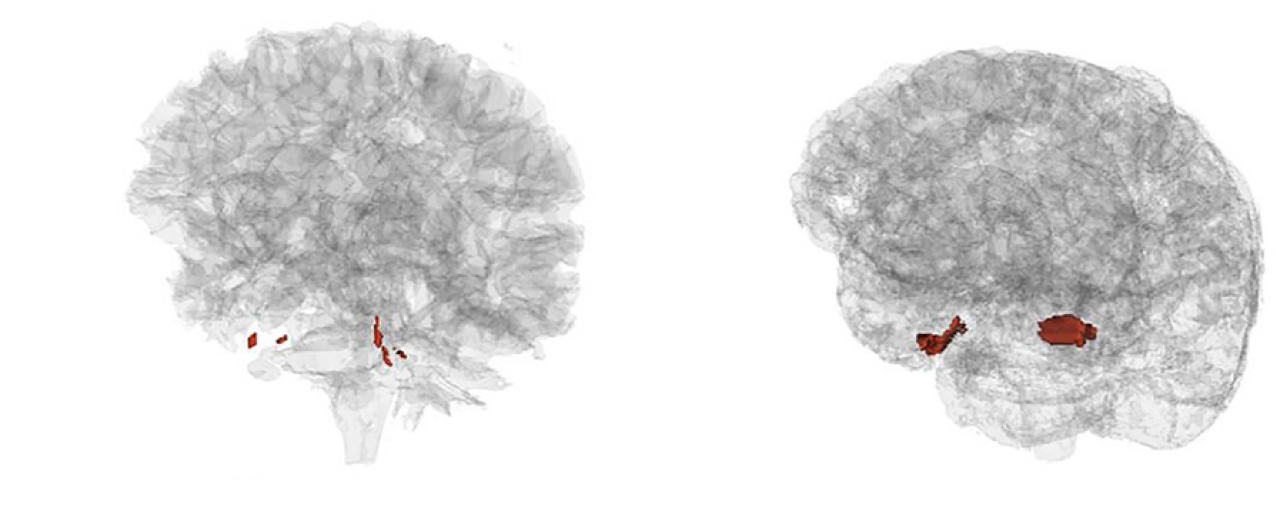
"Glass" brain images show the variation in space (red) between the entorhinal cortex and tentorial incisura in two different subjects. Image provided by Frank Provenzano.
With the methods sorted out, the researchers stratified a group of 47 MCI patients into those with close or more distant spacing. What they found supported their hypothesis: patients with a high burden of tau in the EC were more likely to progress to an Alzheimer's disease diagnosis if their EC and incisura were close together, whereas no relationship was found in the those with a wide spacing.
"This suggests there may be something about the close proximity between EC and incisura that interacts with tau to increase the risk of progression," says Provenzano. "Based on our findings, we propose a 'biomechanical cascade hypothesis' where chronic low-level mechanical stress acts as an initiating or accelerating factor in tau pathology."
Subtle strains in the brain
Provenzano is quick to add that the findings are preliminary, based on a small sample size, and don't demonstrate a mechanistic connection. "It doesn't replace any other theories," he says, "but it introduces a new potential way of thinking about why this relatively small and important area, the entorhinal cortex, accumulates tau early and profoundly in the course of the disease."
While the findings don't provide definitive answers about the beginnings of Alzheimer's disease, they raise a host of interesting questions. "As a biomedical engineer, I'm really fascinated by this, because when we think of the brain and chronic neurological diseases, few scientists think about friction or stress concentrations unless there is an obvious structural component…although that's starting to change," says Provenzano. "...when we think of the brain and chronic neurological diseases, few scientists think about friction or stress concentrations..."
Traumatic brain injury can also lead to tau deposition, but the new results suggest that more subtle strains that originate inside the brain, repeated over a lifetime, might also be worth exploring. "Perhaps what we're seeing is the consequence of natural anatomic susceptibility that impacts some people when their entorhinal cortex is particularly vulnerable, or contributes to its vulnerability," Provenzano says, "like knee or ligament strain after you run 10,000 miles."
The running analogy could even apply to another difference neuroscientists have long pondered. Tiny bumps called verrucae appear on the outer surface of the EC, and their density varies between people. The researchers hypothesize that verrucae might help protect the EC from strain, like callouses on well-worn feet. Provenzano emphasizes that "it's a very confined, exploratory finding, but one we're curious to follow up on."
Testing the team's hypotheses will require looking at larger numbers of people and from a wider pool of patients across the lifespan. One current limitation is that the team's current methods still require a lot of manual analysis of individual images; further automation will help them study larger populations. Additional measures, like advanced imaging looking at diffusion and elastic properties of living tissues are particularly exciting methods for future studies.
First published as a preprint, the work has already generated substantial interest from researchers in related fields. Provenzano says in addition to Alzheimer's disease researchers, he's heard from those working on other neurological conditions, and from paleoneurologists who study brain evolution.
"We've had a range of people reach out about other neurological diseases, and I'm happy for the dialogue it's prompted," says Provenzano. "And I'm interested to see how this may generate testable hypotheses, especially from a vascular and immunological perspective where a tissue's intrinsic mechanical properties may change over time."


