
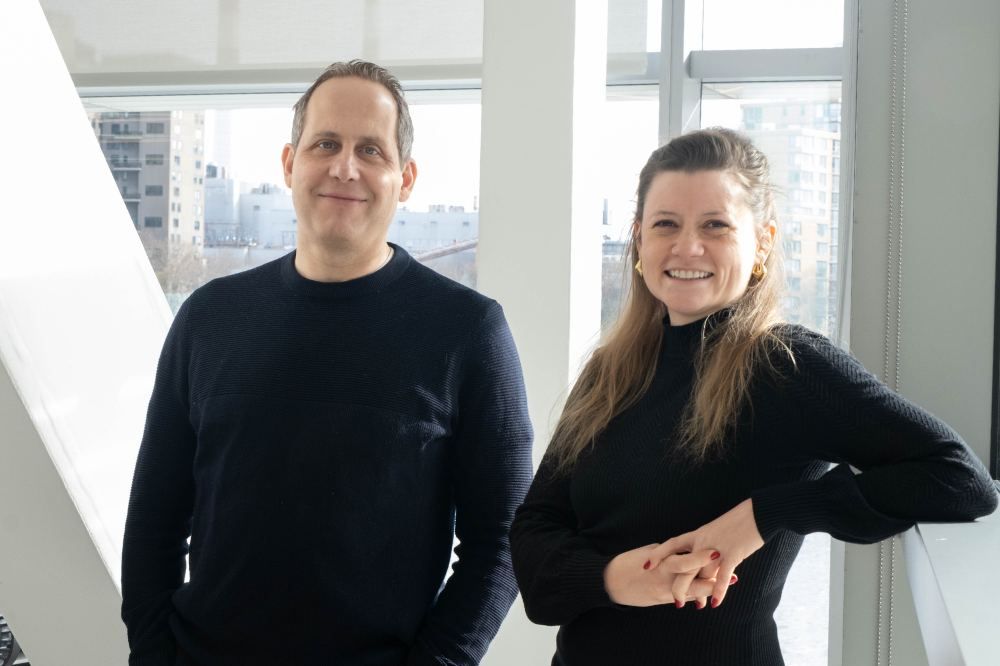
Scientists knew that obesity raises the risk of hypertension. Now Paul Cohen and Mascha Koenen have uncovered the mechanism-and the enzyme-that explains how fat can stiffen blood vessels and drive blood pressure upward. (Credit: Lori Chertoff)
In 2015, Paul Cohen established Rockefeller's Weslie R. and William H. Janeway Laboratory of Molecular Metabolism with this goal: to understand how exactly obesity causes disease. The lab has since produced numerous discoveries, shedding light on how fat communicates with other tissues, identifying health-protective roles for brown fat, and opening the door to therapies that could engineer healthier fat and break the link between obesity and disease.
Recently, Cohen and colleagues added a major breakthrough to the list-identifying a biological mechanism connecting adipose tissue to hypertension. Their findings, published in Science, demonstrate that the loss of a kind of brown fat called beige fat unleashes an enzyme that stiffens blood vessels and makes them overreact to signals that drive blood pressure upward. The results may mark a promising step toward precision therapies for some of the world's leading causes of death. We sat down with Cohen and his postdoctoral fellow, Mascha Koenen, to discuss how the study came about, what it reveals about adipose-vascular communication, and where the field goes from here.
We've known for a long time that obesity is a major risk factor for cardiovascular disease. Why did it take so long for us to figure out the mechanism behind this link?
Paul Cohen: When I came to Rockefeller as faculty, after a postdoc and a long period of clinical training in medicine and cardiology, I came with clinical and research experiences that made me center on big picture questions like this for my lab. I had seen obesity cause downstream disease, and I wanted to understand the cellular and molecular mechanisms by which it happens. This is a big question that spans many fields, and it required lots of resources, which I was fortunate to be able to access at Rockefeller.
Mascha Koenen: What's great about this focus is how it opens up many new avenues of research. These mechanisms are sometimes distinct from obesity itself-aging, for instance, is also correlated with high blood pressure. It is not always easy to tease that out, but if we can identify how changes in our fat tissue cause disease, we can not only discover novel targets for diseases like hypertension, but also targets to help treat individuals who are not obese.
PC: I would add that, in this era of personalized medicine, the more we know about the molecular basis for disease, the more we can move towards conceiving of a world in which there is not a one-size-fits-all treatment for people with hypertension, but instead treatment based on their medical and molecular characteristics. We can't design targeted therapies until we first conduct the basic science that explains the mechanisms behind clinical observations.
What did you uncover in your most recent study?
PC: We discovered one way adipose tissue can regulate blood pressure and vascular function. We've now confirmed that it's not just fat, per se, that contributes to hypertension, but the type of fat. In this paper we showed that depleting beige fat, the mouse equivalent of adult human brown fat, from otherwise healthy mice led to hypertension and related symptoms-a drastic remodeling of the fat lining the vasculature, stiffness and fibrosis in the vasculature, and hypersensitivity to hormones that constrict blood vessels. We also found that, if we deleted the enzyme QSOX1, we could actually prevent these problems from arising.
What kinds of new therapies could you envision following on these findings?
PC: We are now looking for associations between already-approved medications and brown fat activity, which raises the possibility that some of those medications might themselves be influencing brown fat activity. Depending on what we find, there may be room for repurposing those drugs to activate brown fat. Meanwhile, my lab has data on a subset of the patients in our cohort that should allow us, for the first time, to move beyond mice and look for genetic determinants of brown fat function in humans.
What made you suspect that brown fat would be linked to blood pressure in the first place?
MK: A couple of years ago, we conducted a large clinical study where we found that individuals that have brown fat had lower odds of having different cardiometabolic diseases, including type II diabetes and hypertension. We had no mechanistic understanding why that would be the case.
PC: This work is a really nice example of reverse translation, which is a broader approach we take in my lab. First, we make observations in large clinical cohorts that form the hypothesis and rationale for our work. Only then can we go back to reductionist models in mice and cells to work out the mechanisms at play. In this case, we started with a surprising and unexplained association and demonstrated a causal relationship and a biological mechanism.
I should also add that we're lucky in that we have much more information to work with than just what I can observe in my clinical practice. We have access to a tremendous resource through Memorial Sloan Kettering that only happened because I worked with a radiologist there in the course of my clinical work. He has since become one of our main collaborators; the data that we use comes from patients who have undergone scans, which happen to detect brown fat, as part of their cancer therapy. We now have more than 100,000 people in this cohort, and we can correlate all their electronic medical records with the amount of brown fat in their bodies. This is an unprecedented trove of data we're mining for new insights.


